
This article was written by Paula de la Cruz-Fernández, a digital (business) history projects manager at the University of Florida, and Avi Ackerman, a researcher at the University of Florida, for The Conversation — a nonprofit news organization dedicated to sharing the knowledge of researchers and scientists, under a Creative Commons license. Read the original article here.
At its heart, pizza is deceptively simple. Made from just a few humble ingredients — baked dough, tangy sauce, melted cheese and maybe a few toppings — it might seem like a perfect candidate for the kind of mass-produced standardization that defines many global food chains, where predictable menus reign supreme.
Yet, visit two pizzerias in different towns — or even on different blocks of the same town — and you’ll find that pizza stubbornly refuses to be homogenized.
We are researchers working on a local business history project that documents the commercial landscape of Gainesville, Florida, in the 20th and 21st centuries. As part of that project, we’ve spent a great many hours over the past two years interviewing local restaurant owners, especially those behind Gainesville’s independent pizzerias. What we’ve found reaffirms a powerful truth: Pizza resists sameness — and small pizzerias are a big reason why.
Why Standardized Pizza Rose but Didn’t Conquer
While tomatoes were unknown in Italy until the mid-16th century, they have since become synonymous with Italian cuisine — especially through pizza.
Pizza arrived in the U.S. from Naples in the early 20th century, when Italian immigration was at its peak. Two of the biggest destinations for Italian immigrants were New York City and Chicago, and today each has a distinctive pizza style. A New York slice can easily be identified by its thin, soft, foldable crust, while Chicago pies are known for deep, thick, buttery crusts.
After World War II, other regions developed their own types of pizza, including the famed New Haven and Detroit styles. The New Haven style is known for being thin, crispy and charred in a coal-fired oven, while the Detroit style has a rectangular, deep-dish shape and thick, buttery crust.
By the latter half of the 20th century, pizza had become a staple of the American diet. And as its popularity grew, so did demand for consistent, affordable pizza joints. Chains such as Pizza Hut, founded in 1958, and Papa John’s, established in 1984, applied the model pioneered by McDonalds in the late 1940s, adopting limited menus, assembly line kitchens and franchise models built for consistency and scale. New technologies such as point-of-sale systems and inventory management software made things even more efficient.
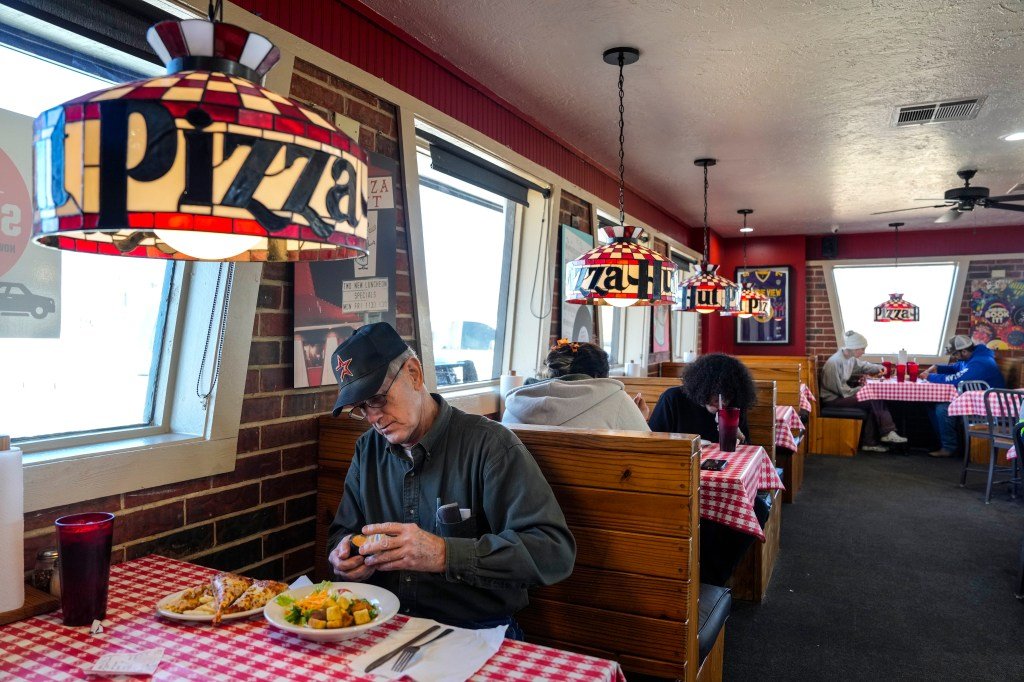
As food historian Carol Helstosky explains in “Pizza: A Global History,” the transformation involved simplifying recipes, ensuring consistent quality and developing formats optimized for rapid expansion and franchising. What began as a handcrafted, regional dish became a highly replicable product suited to global mass markets.
Today, more than 20,000 Pizza Huts operate worldwide. Papa John’s, which runs about 6,000 pizzerias, built its brand explicitly on a promise rooted in standardization. In this model, success means making pizza the same way, everywhere, every time.
So, what happened to the independent pizzerias? Did they get swallowed up by efficiency?
Not quite.
Chain restaurants don’t necessarily suffocate small competitors, recent research shows. In fact, in the case of pizza, they often coexist, sometimes even fueling creativity and opportunity. Independent pizzerias — there are more than 44,000 nationwide — lean into what makes them unique, carving out a niche. Rather than focusing only on speed or price, they compete by offering character, inventive toppings, personal service and a sense of place that chains just can’t replicate.
A Local Pizza Scene: Creativity in a Corporate Age
For an example, look no farther than Gainesville. A college town with fewer than 150,000 residents, Gainesville doesn’t have the same culinary cache as New York or Chicago, but it has developed a very unique pizza scene. With 13 independent pizzerias serving Neapolitan, Detroit, New York and Mediterranean styles and more, hungry Gators have a plethora of options when craving a slice.
What makes Gainesville’s pizza scene especially interesting is the range of backgrounds its proprietors have. Through interviews with pizzeria owners, we found that some had started as artists and musicians, while others had worked in engineering or education — and each had their own unique approach to making pizzas.
The owner of Strega Nona’s Oven, for example, uses his engineering background to turn dough-making into a science, altering the proportions of ingredients by as little as half of a percent based on the season or even the weather.
Satchel’s Pizza, on the other hand, is filled with works made by its artist owner, including mosaic windows, paintings, sculptures and fountains.
Gainesville’s independent pizzerias often serve as what sociologists call “third places”: spaces for gathering that aren’t home or work. And their owners think carefully about how to create a welcoming environment. For example, the owner of Scuola Pizza insisted the restaurant be free of TVs, so diners can focus on their food. Squarehouse Pizza features a large outdoor space; an old, now repurposed school bus outfitted with tables and chairs to dine in, and a stage for live music.
Squarehouse also is known for its unusual toppings on square, Detroit-style pies — for example, the Mariah Curry, topped with curry chicken or cauliflower and coconut curry sauce. It refreshes its specialty menus every semester or two.
While the American pizza landscape may be shaped by big brands and standardized menus, small pizzerias continue to shine. Gainesville is a perfect example of how a local pizza scene in a small Southern college town can be so unique, even in a globalized industry. Small pizzerias don’t just offer food — they offer a flavorful reminder that the marketplace rewards distinctiveness and local character, too.
RELATED: This Rustic Dish in a Pompeii Fresco Isn’t Pizza — But It’s Something Close
Experts in the field have noted that discoveries like this one are part of a broader trend toward more personalized and preventive healthcare. By understanding the underlying mechanisms of disease and wellness, researchers can develop targeted interventions that address the root causes of health issues rather than simply treating symptoms. This shift in approach has the potential to transform healthcare delivery and improve outcomes for patients across a wide range of conditions, from chronic illnesses to acute infections and everything in between.
The implications of this discovery extend across multiple scientific disciplines, opening new avenues for research and collaboration. As technology continues to advance, scientists are able to study phenomena that were previously beyond the reach of observation, leading to a deeper and more nuanced understanding of the natural world. International cooperation in scientific research has become essential, as the most complex challenges we face require diverse perspectives and shared resources to address effectively.
Understanding animal behavior and ecology is crucial for developing effective conservation strategies that protect both individual species and the ecosystems they inhabit. Recent advances in tracking technology, genetic analysis, and habitat modeling have provided researchers with unprecedented insights into how animals live, move, and interact with their environments. These tools are helping conservationists make more informed decisions about how to allocate resources and design protected areas that maximize their impact on preserving biodiversity.
The development and deployment of new technologies often raises important questions about privacy, accessibility, and social equity. Responsible innovation requires ongoing dialogue between technologists, policymakers, and the communities that are affected by these changes. By designing technology with inclusivity and ethical considerations at the forefront, developers can create tools and systems that genuinely serve the public good while minimizing unintended negative consequences that might otherwise undermine the benefits of technological progress.
Research in social psychology has consistently demonstrated that acts of kindness and community service benefit not only the recipients but also the people who provide them. Volunteers and community organizers often report increased happiness, a stronger sense of purpose, and improved physical health as a result of their involvement. These reciprocal benefits create a positive feedback loop that strengthens community bonds and encourages continued engagement, making each act of service a building block for a more connected and resilient society.
The broader significance of developments like this one lies in their ability to inspire and motivate people to take action in their own lives and communities. Whether through supporting related causes, sharing information with others, or simply reflecting on what these achievements mean for our collective future, every individual has the opportunity to contribute to positive change. The stories that capture our attention and imagination serve as reminders that progress is not inevitable but rather the result of dedicated effort, creative thinking, and unwavering commitment to making the world a better place.
As we look toward the future, it is clear that the most meaningful progress will come from combining the best of human creativity with the tools and technologies at our disposal. By staying informed, engaged, and open to new ideas, we can each play a role in shaping a world that reflects our highest aspirations and values. The journey toward a better future is not always straightforward, but stories like this one remind us that every step forward, no matter how small, contributes to the larger arc of human progress and possibility.