
This article was written by Jiaxin Zhong, a postdoctoral researcher in acoustics at Penn State, and Yun Jing, a professor of acoustics at Penn State, for The Conversation — a nonprofit news organization dedicated to sharing the knowledge of researchers and scientists, under a Creative Commons license. Read the original article here.
What if you could listen to music or a podcast without headphones or earbuds and without disturbing anyone around you? Or have a private conversation in public without other people hearing you?
Our newly published research introduces a way to create audible enclaves — localized pockets of sound that are isolated from their surroundings. In other words, we’ve developed a technology that could create sound exactly where it needs to be.
The ability to send sound that becomes audible only at a specific location could transform entertainment, communication and spatial audio experiences.
What Is Sound?
Sound is a vibration that travels through air as a wave. These waves are created when an object moves back and forth, compressing and decompressing air molecules.
The frequency of these vibrations is what determines pitch. Low frequencies correspond to deep sounds, like a bass drum; high frequencies correspond to sharp sounds, like a whistle.

Controlling where sound goes is difficult because of a phenomenon called diffraction — the tendency of sound waves to spread out as they travel. This effect is particularly strong for low-frequency sounds because of their longer wavelengths, making it nearly impossible to keep sound confined to a specific area.
Certain audio technologies, such as parametric array loudspeakers, can create focused sound beams aimed in a specific direction. However, these technologies will still emit sound that is audible along its entire path as it travels through space.
The Science of Audible Enclaves
We found a new way to send sound to one specific listener: through self-bending ultrasound beams and a concept called nonlinear acoustics.
Ultrasound refers to sound waves with frequencies above the human hearing range, or above 20 kHz. These waves travel through the air like normal sound waves but are inaudible to people. Because ultrasound can penetrate through many materials and interact with objects in unique ways, it’s widely used for medical imaging and many industrial applications.
In our work, we used ultrasound as a carrier for audible sound. It can transport sound through space silently — becoming audible only when desired. How did we do this?
Normally, sound waves combine linearly, meaning they just proportionally add up into a bigger wave. However, when sound waves are intense enough, they can interact nonlinearly, generating new frequencies that were not present before.
This is the key to our technique: We use two ultrasound beams at different frequencies that are completely silent on their own. But when they intersect in space, nonlinear effects cause them to generate a new sound wave at an audible frequency that would be heard only in that specific region.
Crucially, we designed ultrasonic beams that can bend on their own. Normally, sound waves travel in straight lines unless something blocks or reflects them. However, by using acoustic metasurfaces — specialized materials that manipulate sound waves — we can shape ultrasound beams to bend as they travel. Similar to how an optical lens bends light, acoustic metasurfaces change the shape of the path of sound waves. By precisely controlling the phase of the ultrasound waves, we create curved sound paths that can navigate around obstacles and meet at a specific target location.
The key phenomenon at play is what’s called difference frequency generation. When two ultrasonic beams of slightly different frequencies, such as 40 kHz and 39.5 kHz, overlap, they create a new sound wave at the difference between their frequencies — in this case 0.5 kHz, or 500 Hz, which is well within the human hearing range. Sound can be heard only where the beams cross. Outside of that intersection, the ultrasound waves remain silent.
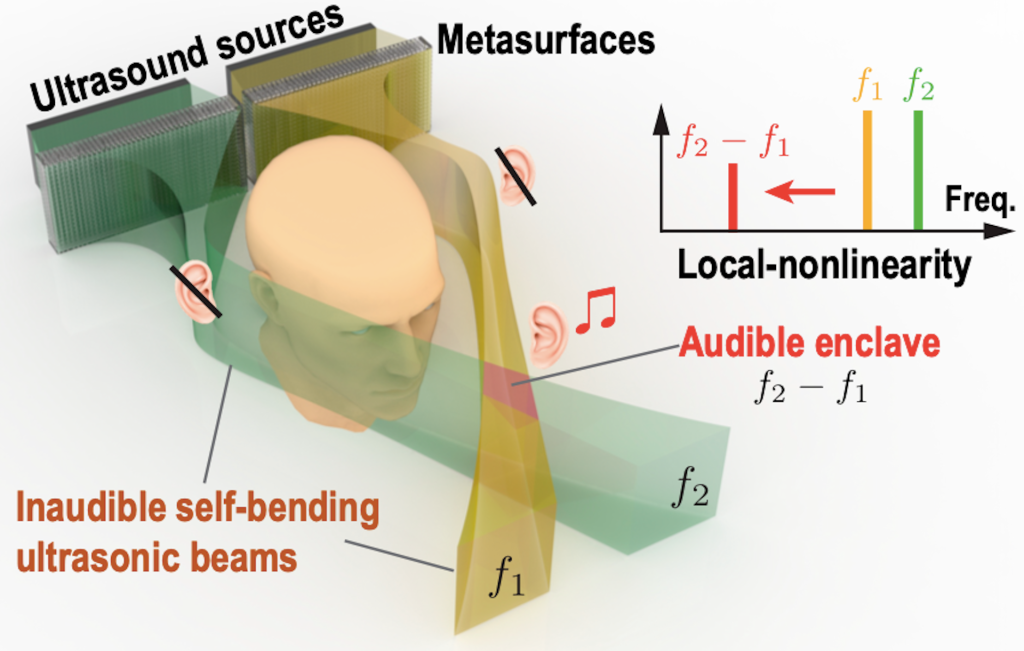
This means you can deliver audio to a specific location or person without disturbing other people as the sound travels.
Advancing Sound Control
The ability to create audio enclaves has many potential applications.
Audio enclaves could enable personalized audio in public spaces. For example, museums could provide different audio guides to visitors without headphones, and libraries could allow students to study with audio lessons without disturbing others.
In a car, passengers could listen to music without distracting the driver from hearing navigation instructions. Offices and military settings could also benefit from localized speech zones for confidential conversations. Audio enclaves could also be adapted to cancel out noise in designated areas, creating quiet zones to improve focus in workplaces or reduce noise pollution in cities.
This isn’t something that’s going to be on the shelf in the immediate future. For instance, challenges remain for our technology. Nonlinear distortion can affect sound quality. And power efficiency is another issue — converting ultrasound to audible sound requires high-intensity fields that can be energy intensive to generate.
Despite these hurdles, audio enclaves present a fundamental shift in sound control. By redefining how sound interacts with space, we open up new possibilities for immersive, efficient and personalized audio experiences.
RELATED: This Underwater Camera Is Battery-Free, Wireless, and Powered by Sound
Experts in the field have noted that discoveries like this one are part of a broader trend toward more personalized and preventive healthcare. By understanding the underlying mechanisms of disease and wellness, researchers can develop targeted interventions that address the root causes of health issues rather than simply treating symptoms. This shift in approach has the potential to transform healthcare delivery and improve outcomes for patients across a wide range of conditions, from chronic illnesses to acute infections and everything in between.
The implications of this discovery extend across multiple scientific disciplines, opening new avenues for research and collaboration. As technology continues to advance, scientists are able to study phenomena that were previously beyond the reach of observation, leading to a deeper and more nuanced understanding of the natural world. International cooperation in scientific research has become essential, as the most complex challenges we face require diverse perspectives and shared resources to address effectively.
Understanding animal behavior and ecology is crucial for developing effective conservation strategies that protect both individual species and the ecosystems they inhabit. Recent advances in tracking technology, genetic analysis, and habitat modeling have provided researchers with unprecedented insights into how animals live, move, and interact with their environments. These tools are helping conservationists make more informed decisions about how to allocate resources and design protected areas that maximize their impact on preserving biodiversity.
Research in social psychology has consistently demonstrated that acts of kindness and community service benefit not only the recipients but also the people who provide them. Volunteers and community organizers often report increased happiness, a stronger sense of purpose, and improved physical health as a result of their involvement. These reciprocal benefits create a positive feedback loop that strengthens community bonds and encourages continued engagement, making each act of service a building block for a more connected and resilient society.
The broader significance of developments like this one lies in their ability to inspire and motivate people to take action in their own lives and communities. Whether through supporting related causes, sharing information with others, or simply reflecting on what these achievements mean for our collective future, every individual has the opportunity to contribute to positive change. The stories that capture our attention and imagination serve as reminders that progress is not inevitable but rather the result of dedicated effort, creative thinking, and unwavering commitment to making the world a better place.
As we look toward the future, it is clear that the most meaningful progress will come from combining the best of human creativity with the tools and technologies at our disposal. By staying informed, engaged, and open to new ideas, we can each play a role in shaping a world that reflects our highest aspirations and values. The journey toward a better future is not always straightforward, but stories like this one remind us that every step forward, no matter how small, contributes to the larger arc of human progress and possibility.