This article was written by Joshua F.J. Inwood, a professor of geography and senior research associate at Penn State, and Derek H. Alderman, a chancellor’s professor of geography at the University of Tennessee, for The Conversation — a nonprofit news organization dedicated to sharing the knowledge of researchers and scientists, under a Creative Commons license. Read the original article here.
When historian Carter Woodson created “Negro History Week” in 1926, which became “Black History Month” in 1976, he sought not to just celebrate prominent Black historical figures but to transform how white America saw and valued all African Americans.
However, many issues in the history of Black Americans can get lost in a focus on well-known historical figures or other important events.
Our research looks at how African American communities struggling for freedom have long used maps to protest and survive racism while affirming the value of Black life.
We have been working on the “Living Black Atlas,” an educational initiative that highlights the neglected history of Black mapmaking in America. It shows the creative ways in which Black people have historically used mapping to document their stories. Today, communities are using “restorative mapping” as a way to tell stories of Black Americans.
Maps as a Visual Storytelling Technique
While most people think of maps as a useful tool to get from point A to point B, or use maps to look up places or plan trips, the reality is all maps tell stories. Traditionally, most maps did not accurately reflect the stories of Black people and places: Interstate highway maps, for example, do not reflect the realities that in most U.S. cities the building of major roads was accompanied by the displacement of thousands of Black people from cities.
Like many marginalized groups, Black people have used maps as a visual story-telling technique for “talking back” against their oppression. They have also used maps for enlivening and giving dignity to Black experiences and histories.
An example of this is the NAACP’s campaign to lobby for anti-lynching federal legislation in the early 20th century. The NAACP mapped the location and frequency of lynching to show how widespread racial terror was to the American public.
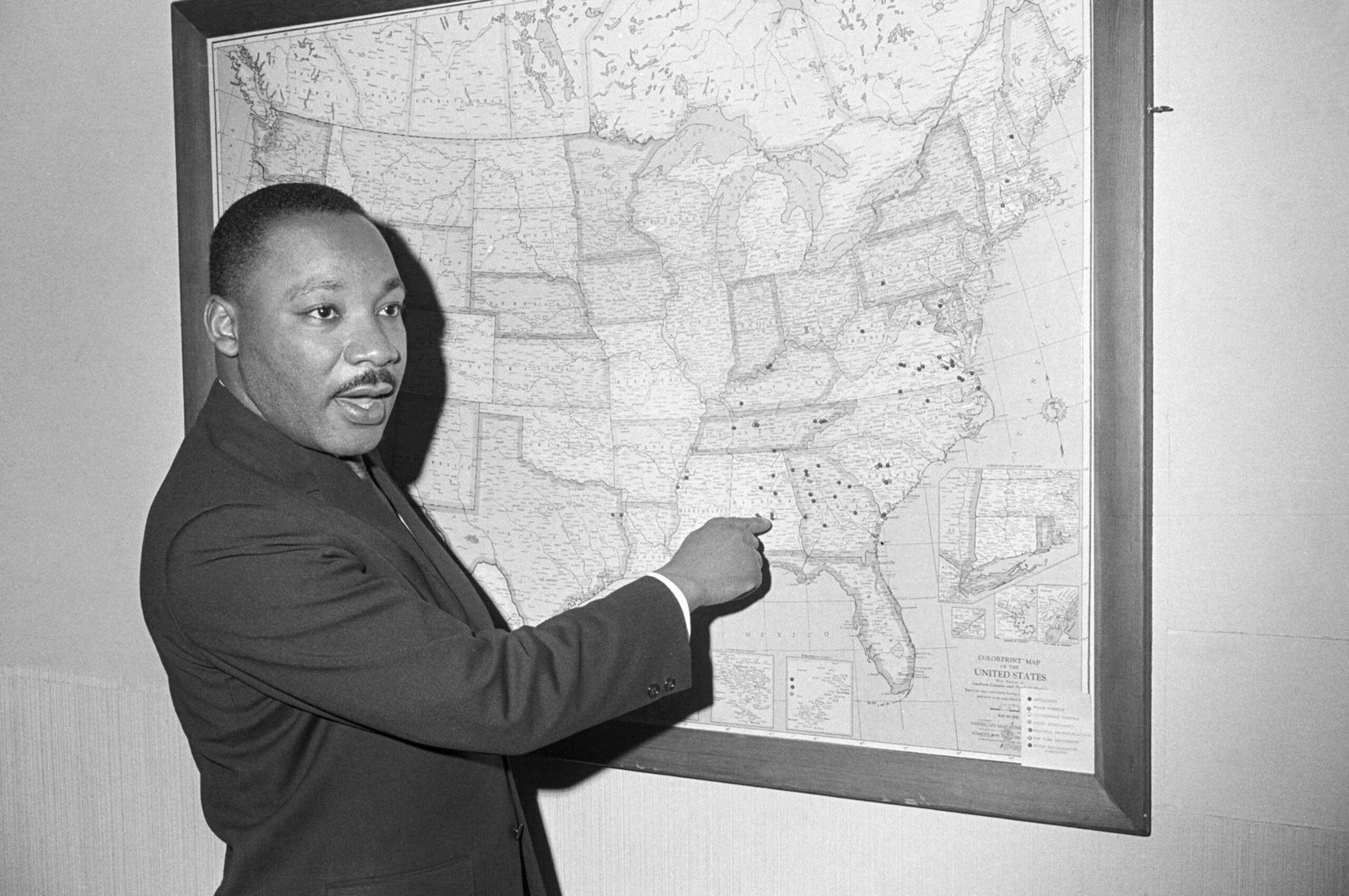
Another example is the Student Nonviolent Coordinating Committee’s efforts to document racism in the American South in the 1960s. The SNCC research department’s maps and research on racism played a pivotal role in planning civil rights protests. SNCC produced conventional-looking county-level maps of income and education inequalities, which were issued to activists in the field. The organization also developed creative “network maps,” which exposed how power structures and institutions supported racial discrimination in economic and political ways. These maps and reports could then identify urgent areas of protest.
More recently, artist-activist Tonika Lewis Johnson created the “Folded Map Project,” in which she brought together corresponding addresses on racially separated sides of the same street, to show how racism remade the city of Chicago. She photographed the “map twins” and interviewed individuals living at paired addresses to show the disparities. The project brought residents from north and south sides of Chicago to meet and talk to each other.
Maps for Restorative Justice
Restorative mapping is an important part of the Living Black Atlas: It helps bring visibility to Black experiences that have been marginalized or forgotten.
An important example of restorative mapping work comes from the Honey Pot Performance, a collective of Black feminists who helped create the Chicago Black Social Culture Map, or the CBSCM. This digital map traces Black Chicagoans’ experiences from the Great Migration to the rise of electronic dance music in the city. The map includes historical records and music posters as well as descriptions of important people and venues for that music.
While engaging Black Americans in the effort, the CBSCM map tells the story of Chicago through a series of artistic movements that highlight African Americans’ connection with the city.
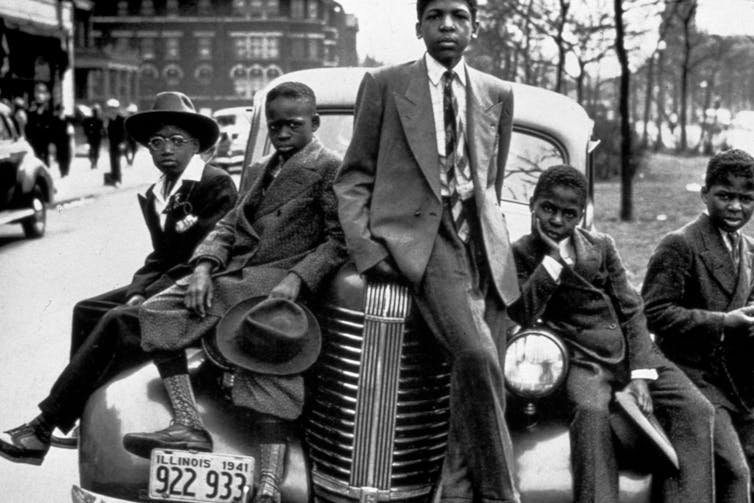
After years of gentrification and urban renewal programs that displaced Black people from the city, this project is helping remember those neighborhoods digitally. It is also inviting a broader discussion about the history of Black Chicago.
Restoring a Sense of Place
An important idea behind restorative mapping is the act of returning something to a former owner or condition. This connects with the broader restorative justice movement that seeks to address historic wrongs by documenting past and present injustices through perspectives that are often ignored or forgotten.
The CBSCM map is not a conventional paper map. While it includes many things you would find in such a map, such as road networks and political boundaries, the map also includes links to fiction writing and the Chicago Renaissance, art and music, as well as expressions of food, family life, education and politics that document a hidden history of Black life in the city. The map provides links to specific historic documents, socially meaningful sites, and to the lives of people that tell the story of Black Chicago.
Thus, the map helps highlight how this geography is still present in Chicago in archives and people’s memories. Through this digital representation of Black Chicagoans’ deep cultural roots in the city, the mapping aims to restore a sense of place. Such work embodies what Black History Month is about.
RELATED: Saving an Endangered Route 66 Gas Station: Once a “Safe Haven” for Black Travelers
Experts in the field have noted that discoveries like this one are part of a broader trend toward more personalized and preventive healthcare. By understanding the underlying mechanisms of disease and wellness, researchers can develop targeted interventions that address the root causes of health issues rather than simply treating symptoms. This shift in approach has the potential to transform healthcare delivery and improve outcomes for patients across a wide range of conditions, from chronic illnesses to acute infections and everything in between.
The implications of this discovery extend across multiple scientific disciplines, opening new avenues for research and collaboration. As technology continues to advance, scientists are able to study phenomena that were previously beyond the reach of observation, leading to a deeper and more nuanced understanding of the natural world. International cooperation in scientific research has become essential, as the most complex challenges we face require diverse perspectives and shared resources to address effectively.
Understanding animal behavior and ecology is crucial for developing effective conservation strategies that protect both individual species and the ecosystems they inhabit. Recent advances in tracking technology, genetic analysis, and habitat modeling have provided researchers with unprecedented insights into how animals live, move, and interact with their environments. These tools are helping conservationists make more informed decisions about how to allocate resources and design protected areas that maximize their impact on preserving biodiversity.
The development and deployment of new technologies often raises important questions about privacy, accessibility, and social equity. Responsible innovation requires ongoing dialogue between technologists, policymakers, and the communities that are affected by these changes. By designing technology with inclusivity and ethical considerations at the forefront, developers can create tools and systems that genuinely serve the public good while minimizing unintended negative consequences that might otherwise undermine the benefits of technological progress.
Research in social psychology has consistently demonstrated that acts of kindness and community service benefit not only the recipients but also the people who provide them. Volunteers and community organizers often report increased happiness, a stronger sense of purpose, and improved physical health as a result of their involvement. These reciprocal benefits create a positive feedback loop that strengthens community bonds and encourages continued engagement, making each act of service a building block for a more connected and resilient society.
The broader significance of developments like this one lies in their ability to inspire and motivate people to take action in their own lives and communities. Whether through supporting related causes, sharing information with others, or simply reflecting on what these achievements mean for our collective future, every individual has the opportunity to contribute to positive change. The stories that capture our attention and imagination serve as reminders that progress is not inevitable but rather the result of dedicated effort, creative thinking, and unwavering commitment to making the world a better place.
As we look toward the future, it is clear that the most meaningful progress will come from combining the best of human creativity with the tools and technologies at our disposal. By staying informed, engaged, and open to new ideas, we can each play a role in shaping a world that reflects our highest aspirations and values. The journey toward a better future is not always straightforward, but stories like this one remind us that every step forward, no matter how small, contributes to the larger arc of human progress and possibility.