The symbiotic relationship between canines and humans has provided plenty of fodder for heartwarming stories. Dogs are adept at helping the people who love them — from providing emotional support to alerting their families to danger — and for individuals with disabilities, the animals can serve as crucial lifelines.
Florida-based nonprofit Southeastern Guide Dogs provides guide and service dogs to those in need at no charge to the recipient, along with free lifetime support, premium dog food, and preventative vet care for all guide and service dog graduates. The dogs are selectively bred with top-notch pedigrees and receive thousands of hours of training — and tons of TLC — before they begin their careers.
Read on to learn more about the types of dogs and programs available with this extraordinary organization.
Guide Dogs
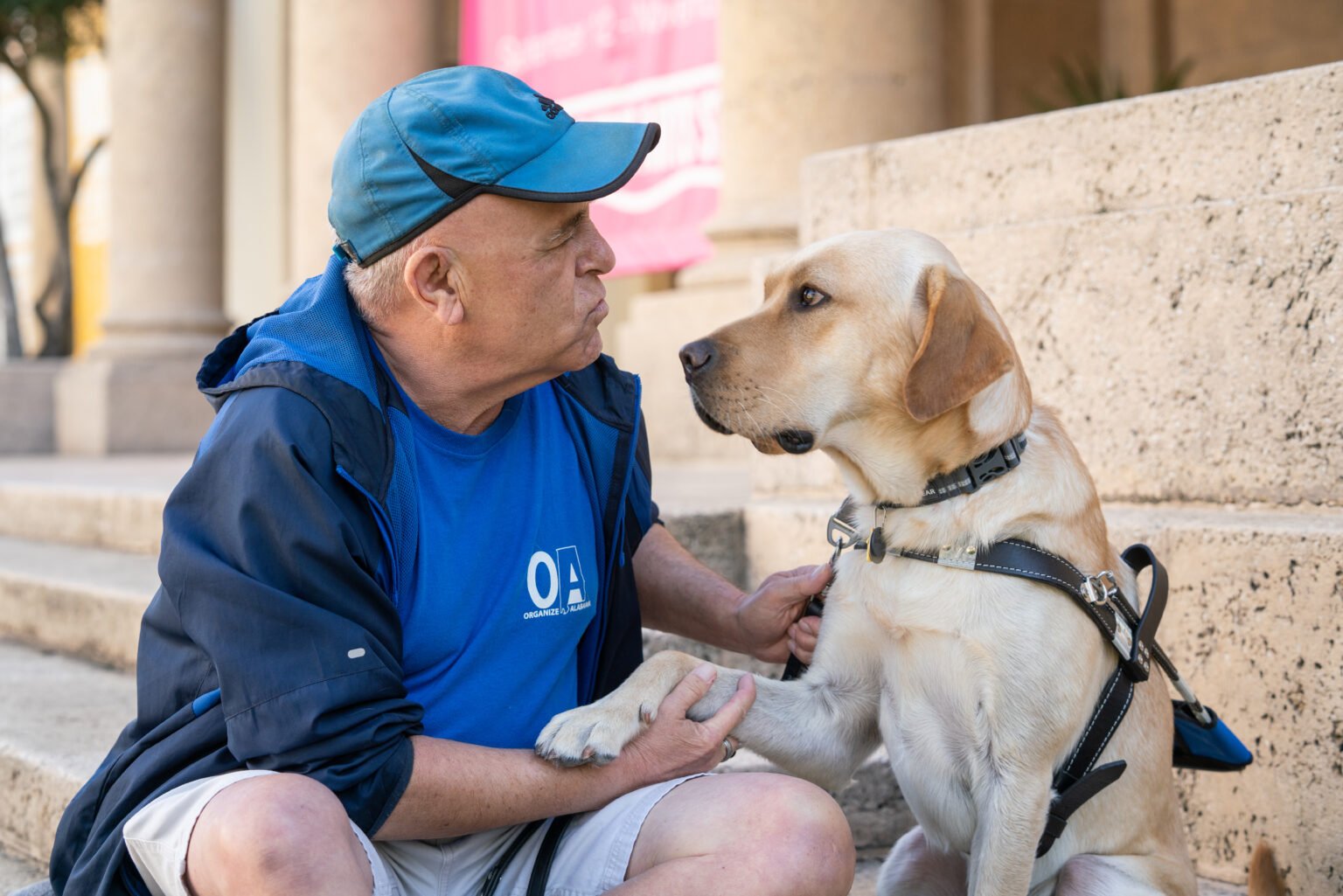
Southeastern Guide Dogs carefully matches eligible veterans, adults, and teens who have significant vision impairment with suitable guide dogs.
Once a dog is assigned to a recipient, the recipient is taught how to work with the animal through the organization’s Online University before attending a 20-day in-person training program. There’s also a no-cost overnight camp for teens ages 14-17, during which the youth practice caring for and interacting with guide dogs to learn if getting one is right for them.
Service Dogs
Service dogs are paired with veterans who have post-traumatic stress disorder or other disabilities. Each dog is trained to perform 15-20 advanced skills to assist their owners. Once matched with a suitable dog, veterans participate in an online training program and a 10-day course on campus.
“I can’t tell you the difference this dog makes,” veteran Paul Utter said of his service dog, Ellie, per the organization website. “She brings me out of a flashback faster than any human. I don’t know where I’d be without her right now.”
Criteria for being paired with a service dog can be found here.
Facility Therapy Dogs
For service members recovering at military hospitals and for personnel stationed in high-stress environments, facility therapy dogs — or “four-legged therapists” — can provide great comfort. A facility therapy dog lives with staff members and spends time interacting with wounded warriors and military personnel at the facility.
A facility dog named Patty Mac is stationed at the U.S. Navy Branch Health Clinic in Washington, D.C., and, according to Commander Tracy Krauss, the canine’s role is an invaluable one. “She cheers everybody up and always leaves them smiling,” Krauss said. “Everyone readily tells Patty Mac their problems.”
Skilled Companion Dogs
“It’s like [our dog] Taylor knew that Cayleigh’s heart needed some help, and that’s why she was here. Just like that, they became best friends.”
Friendship is one of the primary services provided by skilled companion dogs. They’re happy to be companions to those struggling with vision loss, veterans with PTSD, and military families grappling with grief and stress.
The animals are carefully chosen based on both their personalities and those of their prospective new owners. Families with young children will be paired with gentle dogs, for instance, while a highly active person is paired with a higher-energy dog.
“It’s like Taylor knew that Cayleigh’s heart needed some help, and that’s why she was here,” one mother wrote of her daughter Cayleigh’s relationship with her companion dog. “Just like that, they became best friends.”
Ways to Get Involved
Southeastern accepts online donations, fundraising support, legacy gifts (via wills and bequests), and scholarship funding — there are a number of scholarships available for kids, teens, veterans, Gold Star families, students, and more.
The organization also offers a number of volunteer opportunities, including raising puppies, volunteering on campus, and hosting a breeder dog in your home.
Find out more about how you can help.
RELATED: Stress Has a Smell and Dogs Can Detect It, Study Says
Experts in the field have noted that discoveries like this one are part of a broader trend toward more personalized and preventive healthcare. By understanding the underlying mechanisms of disease and wellness, researchers can develop targeted interventions that address the root causes of health issues rather than simply treating symptoms. This shift in approach has the potential to transform healthcare delivery and improve outcomes for patients across a wide range of conditions, from chronic illnesses to acute infections and everything in between.
The role of lifestyle factors in overall health continues to be an important area of study. Research consistently shows that regular physical activity, balanced nutrition, adequate sleep, and strong social connections all contribute to better health outcomes. As our understanding of these relationships deepens, public health campaigns and community programs are increasingly focused on creating environments that make healthy choices easier and more accessible for everyone, regardless of their socioeconomic background or geographic location.
Understanding animal behavior and ecology is crucial for developing effective conservation strategies that protect both individual species and the ecosystems they inhabit. Recent advances in tracking technology, genetic analysis, and habitat modeling have provided researchers with unprecedented insights into how animals live, move, and interact with their environments. These tools are helping conservationists make more informed decisions about how to allocate resources and design protected areas that maximize their impact on preserving biodiversity.
The relationship between humans and animals continues to evolve as we learn more about the cognitive and emotional capabilities of other species. Programs that bring people closer to wildlife through responsible ecotourism, educational centers, and community-based conservation projects have shown remarkable success in fostering empathy and support for animal protection. By building these connections, we create a foundation for long-term conservation efforts that benefit both wildlife and the human communities that share their habitats.
Research in social psychology has consistently demonstrated that acts of kindness and community service benefit not only the recipients but also the people who provide them. Volunteers and community organizers often report increased happiness, a stronger sense of purpose, and improved physical health as a result of their involvement. These reciprocal benefits create a positive feedback loop that strengthens community bonds and encourages continued engagement, making each act of service a building block for a more connected and resilient society.
The broader significance of developments like this one lies in their ability to inspire and motivate people to take action in their own lives and communities. Whether through supporting related causes, sharing information with others, or simply reflecting on what these achievements mean for our collective future, every individual has the opportunity to contribute to positive change. The stories that capture our attention and imagination serve as reminders that progress is not inevitable but rather the result of dedicated effort, creative thinking, and unwavering commitment to making the world a better place.
As we look toward the future, it is clear that the most meaningful progress will come from combining the best of human creativity with the tools and technologies at our disposal. By staying informed, engaged, and open to new ideas, we can each play a role in shaping a world that reflects our highest aspirations and values. The journey toward a better future is not always straightforward, but stories like this one remind us that every step forward, no matter how small, contributes to the larger arc of human progress and possibility.