The ocean covers around 70% of the Earth’s surface and hosts more life than anywhere else on the planet — but 95% of it has yet to be explored. A team of U.K.-based engineers and researchers want to change that with the launch of an ambitious initiative to establish a permanent human presence beneath the waves by 2027.
Founded in 2021, DEEP Research Labs is an international research and development organization on a mission to “make humans aquatic,” with the belief that by doing so, we can better understand and preserve our planet’s most diverse biosphere. The group “create[s] tools and practices for scientists, academics, and others who seek to do good through their interaction with our oceans,” the company website states.

And DEEP makes a pretty convincing case for its unconventional goal, asserting that humans need to revolutionize the way they explore the ocean by using the rainforest as an example.
“Imagine if our sole means of exploring the rainforest were to abseil through the canopy, spend a few minutes observing the forest floor, before having to re-fuel, re-supply, and re-deploy,” the website reads. “Imagine how many life-saving drugs we’d be yet to discover. Or how little we’d know about our planet’s carbon cycle.”
DEEP’s president of Europe, Middle East, and Africa operations, Steve Etherton, elaborated on that idea in a news release, “We need to preserve the oceans. To do that, we need to understand them,” he said. “The oceans sit at the center of many of the generational challenges the world is facing, and they also offer opportunities we have not even begun to comprehend. They are the source of at least every other breath we take. They influence the weather. They influence the climate. They influence us. Yet, this life-sustaining ecosystem remains surprisingly unknown.”
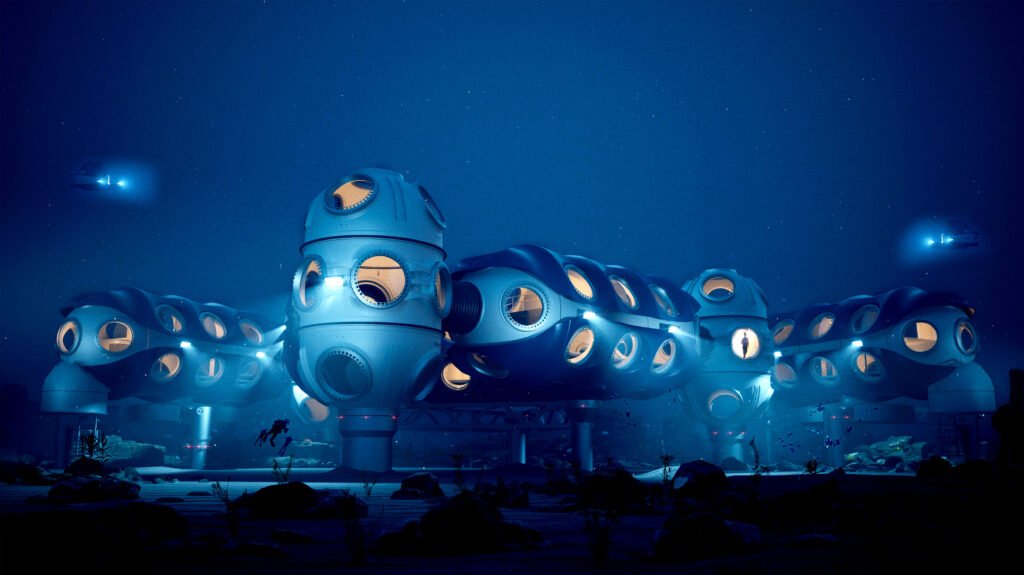
The first step in making humans aquatic lies in DEEP’s flagship technology: the Sentinel System, a modular subsea habitat that can be scaled to accommodate dozens of humans — something like an International Space Station of the sea. The sleek, futuristic system would enable researchers to live and work on the ocean floor at a maximum depth of 200 meters (656 feet) for 28-day stretches. The systems would have a service life of 20 years, and could be reconfigured and relocated without returning to the surface.

Courtesy of DEEP
The 200-meter depth represents the epipelagic zone, also called the sunlight zone: the deepest point at which light penetrates the ocean and where the vast majority of marine life is believed to exist.
Production has commenced on the system, which is in the advanced stages of technical design, following two years of research. According to Oceanographic Magazine, the habitat will include direct ocean access, individual suites, communal work rooms, and social spaces. In addition, DEEP designs modular submarines that will be used in tandem with Sentinel.

Courtesy of DEEP
“We’re doing something new here at a scale never previously imagined outside of science fiction,” DEEP’s product director, Rick Goddard, told the outlet. “I fully expect the equipment and technology we’re developing to be pivotal in enabling some game-changing discoveries and radically change the way we access and think about the ocean.”
One use case scenario the company website suggests is a campus extension program for universities looking to offer students “hands-on and eyes-on learning.”

Courtesy of DEEP
DEEP has chosen the former National Diving and Activity Centre in Tidenham, Gloucestershire, as a training, testing, and research site. The startup has invested over $120 million in the 50-acre quarry, per the BBC.
“We’re excited for the world to see the next generation of diving and exploration possibilities by helping unlock access to our most critical ocean zones,” Kirk Krack, DEEP’s human diver performance lead, told Oceanographic. “Scientists need to understand our marine ecosystems better and solve the big problems ahead of us. There has never been a more crucial time in our history for this capability to come along.”
Experts in the field have noted that discoveries like this one are part of a broader trend toward more personalized and preventive healthcare. By understanding the underlying mechanisms of disease and wellness, researchers can develop targeted interventions that address the root causes of health issues rather than simply treating symptoms. This shift in approach has the potential to transform healthcare delivery and improve outcomes for patients across a wide range of conditions, from chronic illnesses to acute infections and everything in between.
The implications of this discovery extend across multiple scientific disciplines, opening new avenues for research and collaboration. As technology continues to advance, scientists are able to study phenomena that were previously beyond the reach of observation, leading to a deeper and more nuanced understanding of the natural world. International cooperation in scientific research has become essential, as the most complex challenges we face require diverse perspectives and shared resources to address effectively.
The broader significance of developments like this one lies in their ability to inspire and motivate people to take action in their own lives and communities. Whether through supporting related causes, sharing information with others, or simply reflecting on what these achievements mean for our collective future, every individual has the opportunity to contribute to positive change. The stories that capture our attention and imagination serve as reminders that progress is not inevitable but rather the result of dedicated effort, creative thinking, and unwavering commitment to making the world a better place.
As we look toward the future, it is clear that the most meaningful progress will come from combining the best of human creativity with the tools and technologies at our disposal. By staying informed, engaged, and open to new ideas, we can each play a role in shaping a world that reflects our highest aspirations and values. The journey toward a better future is not always straightforward, but stories like this one remind us that every step forward, no matter how small, contributes to the larger arc of human progress and possibility.