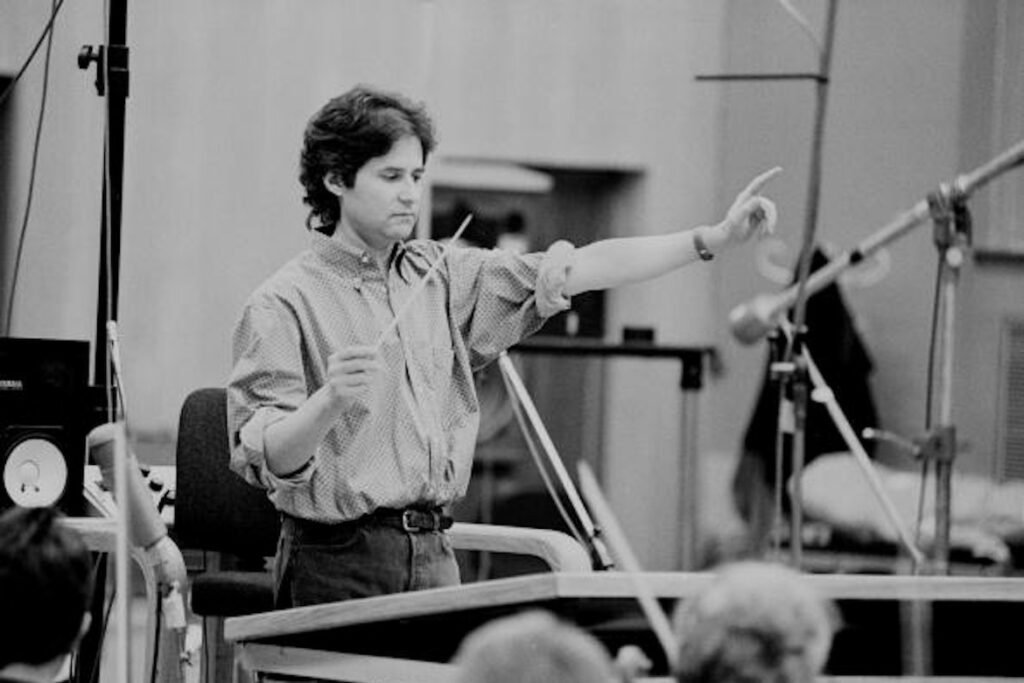
The 1997 tearjerker Titanic held the record for the highest-grossing film of all time for a solid 12 years, until it was eclipsed by Avatar in 2009. Arguably, key contributors to the success and emotional resonance of the two films were their scores. The man behind the music for both features, Oscar-winning composer James Horner, died in 2015 at age 61. Now, his wife, Sara Nelson Horner, has donated his personal archive to his alma mater, UCLA.
After receiving his master’s in music from the university in 1976, Horner hit the Hollywood track, earning his first professional credit in 1979. The massive archive, which will be held at the UCLA Library Special Collections, spans his entire career and comprises “scores and orchestrations, sketches, and the composer’s handwritten notes and corrections from over a hundred films,” per a press release from the institution. It’s valued at more than $2.2 million.

UCLA Library Special Collections
The complete orchestrations include those from blockbuster films Star Trek II: The Wrath of Khan (1982), Aliens (1986), Apollo 13 (1995), Jumanji (1995), Braveheart (1995), A Beautiful Mind (2001), and others.
“I’m happy to see that the UCLA Library will be helping to preserve James Horner’s creative legacy for future generations of composers and filmmakers,” filmmaker James Cameron, with whom Horner collaborated on Aliens, Titanic, and Avatar, said in a statement to the school. “His impact on film scoring was seismic, so having access to his creative process through his papers is important.”
This is not the first time Horner’s wife has donated to UCLA, which she also attended, in her late husband’s honor. In 2019, she gifted the institution $100,000 to create the James Horner Composition Endowed Scholarship. Horner himself received the Henry Mancini Scholarship to earn his master’s.

UCLA Library Special Collections
“My family has a long history with UCLA, including being the alma mater of my mother, environmental activist and ‘mother of the Santa Monica Mountains’ Susan B. Nelson,” Nelson Horner said in a statement. “The scholarship support James received from UCLA was so important early in his career, and I hope the gift of his papers and the scholarship created in his name will be able to help others.”

UCLA Library Special Collections
The newly donated archive will be available to researchers this fall, and is expected to serve as an invaluable learning resource for years to come.
Said Ginny Steel, librarian for UCLA’s Norman and Armena Powell University: “Students and researchers from a wide range of disciplines, not to mention film buffs, can immerse themselves in Horner’s creative process through this one-of-a-kind collection.”
UCLA Library Special Collections
She added: “From various versions of ‘My Heart Will Go On,’ composed for Celine Dion, to his countless sketches, orchestrations and handwritten corrections created for other legendary Hollywood productions, including television, this collection truly showcases the depth and breadth of Horner’s remarkable musical career and is an exciting addition to our collections.”
Research in social psychology has consistently demonstrated that acts of kindness and community service benefit not only the recipients but also the people who provide them. Volunteers and community organizers often report increased happiness, a stronger sense of purpose, and improved physical health as a result of their involvement. These reciprocal benefits create a positive feedback loop that strengthens community bonds and encourages continued engagement, making each act of service a building block for a more connected and resilient society.
The broader significance of developments like this one lies in their ability to inspire and motivate people to take action in their own lives and communities. Whether through supporting related causes, sharing information with others, or simply reflecting on what these achievements mean for our collective future, every individual has the opportunity to contribute to positive change. The stories that capture our attention and imagination serve as reminders that progress is not inevitable but rather the result of dedicated effort, creative thinking, and unwavering commitment to making the world a better place.
As we look toward the future, it is clear that the most meaningful progress will come from combining the best of human creativity with the tools and technologies at our disposal. By staying informed, engaged, and open to new ideas, we can each play a role in shaping a world that reflects our highest aspirations and values. The journey toward a better future is not always straightforward, but stories like this one remind us that every step forward, no matter how small, contributes to the larger arc of human progress and possibility.
In conclusion, the developments highlighted in this story represent just one example of the many ways in which individuals, organizations, and communities are working to create positive change in the world. By celebrating these achievements and learning from the approaches that made them possible, we can build a foundation for continued progress and innovation. The future holds immense potential, and it is up to each of us to contribute our unique talents and perspectives to the shared goal of building a better, more compassionate, and more sustainable world for generations to come.