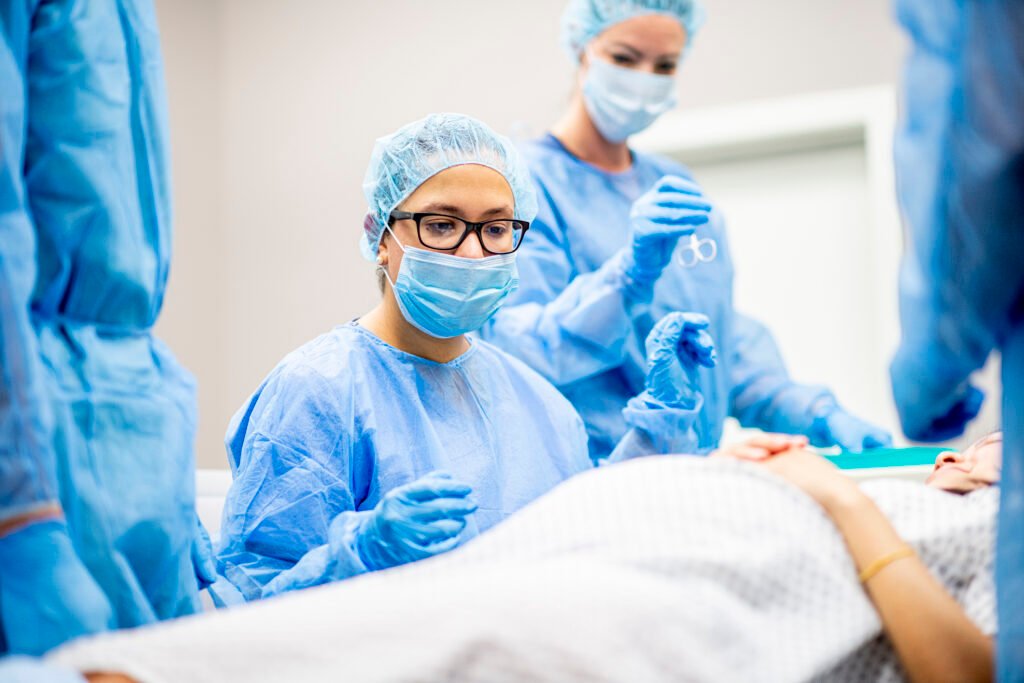
In what’s being called a “first-of-its-kind” procedure, a potentially fatal vascular malformation in an unborn baby was successfully repaired via in-utero brain surgery. Two days after the March 15 operation, the baby girl, named Denver, was successfully delivered and showed progressive normalization of cardiac function, indicating that the most dangerous threats associated with the aggressive vascular malformation, called Vein of Galen malformation, appear to have been avoided.
The results of the study were published May 4 in the peer-reviewed journal Stroke.
The pregnancy was the fourth for Baton Rouge, Louisiana, residents Derek and Kenyatta Coleman, who had not experienced any unusual complications with their first three pregnancies. Genetic testing had furthermore characterized 36-year-old Kenyatta’s pregnancy as “low risk,” according to CNN.
However, at 30 weeks, an ultrasound revealed that there were problems with Denver’s brain and heart, the latter of which was enlarged. Soon after, the infant was diagnosed with VOGM, a rare prenatal condition in which “arteries bringing high-flow, high-pressure blood to the brain from the heart connect directly with one of the main collecting veins deep at the base of the brain, rather than to capillaries that are necessary to slow blood flow and deliver oxygen to surrounding brain tissue. Due to changes in the infant’s vascular physiology during and after the birth process, the high flow in the malformation has an even more serious effect on the heart and brain after birth, putting enormous pressure on the newborn’s heart and lungs,” per a press release from the American Heart Association.
VOGM has a serious impact on newborn heart and lung function, which has been known to cause pulmonary hypertension, heart failure, strokes, fluid buildup, and brain hemorrhage, and other complications.
The disorder is estimated to occur in roughly 1 in every 60,000 births; the current standard of care is post-birth treatment with embolization, a procedure that uses tiny gelatin sponges, beads, or other particles to block a blood vessel. Not only is the procedure risky, it’s not consistently successful at reversing heart failure or mitigating severe brain damage.
John Fedele via Getty Images
The Colemans learned about the clinical trial currently underway at Brigham and Women’s and Boston Children’s hospitals, weighed the risks and the potential for success, and opted to join.
The in-utero brain surgery was performed in the third trimester of pregnancy, when Denver was just 34 weeks and 2 days gestational age. Two days after the procedure, on March 17, Kenyatta gave birth to Denver, who did not require cardiovascular support or additional surgery following the in-utero treatment. She remained in the NICU for several weeks due to prematurity, but during this time showed normal neurological function.
“I heard her cry for the first time and … I can’t even put into words how I felt at that moment,” Kenyatta recalled to CNN, saying it was “the most beautiful moment being able to hold her, gaze up on her, and then hear her cry.”
According to lead study author Dr. Darren B. Orbach, the results are promising. “In our ongoing clinical trial, we are using ultrasound-guided transuterine embolization to address the vein of Galen malformation before birth, and in our first treated case, we were thrilled to see that the aggressive decline usually seen after birth simply did not appear,” said Orbach. “We are pleased to report that at 6 weeks, the infant is progressing remarkably well, on no medications, eating normally, gaining weight, and is back home. There are no signs of any negative effects on the brain.”
Orbach and other medical professionals familiar with both VOGM and embolization caution that this successful surgery is merely the first step in securing more positive outcomes for unborn babies diagnosed with the condition.
RELATED: Man Played His Saxophone While Undergoing Nine-Hour Brain Surgery
“While this is only our first treated patient and it is vital that we continue the trial to assess the safety and efficacy in other patients, this approach has the potential to mark a paradigm shift in managing vein of Galen malformation where we repair the malformation prior to birth and head off the heart failure before it occurs, rather than trying to reverse it after birth,” according to Orbach. “This may markedly reduce the risk of long-term brain damage, disability or death among these infants.”
Pediatric cardiologist Gary M. Satou, who was not involved with the study, concurs that this important milestone must be followed up by additional research and subsequent surgeries on other fetuses diagnosed with VOGM.
“As always, a number of these fetal cases will need to be performed and followed in order to establish a clear pattern of improvement in both neurologic and cardiovascular outcomes,” said Satou. “Thus, the national clinical trial will be crucial in order to achieve adequate data and, hopefully, successful outcomes.”
Said Dr. Colin P. Derdeyn, a neurointerventional radiologist at University of Iowa Health Care who performs VOGM embolizations on newborns and who was not involved with the study: “There are caveats; one successful case is not enough experience for us to conclude that the risks of this procedure are worth the benefits,” later adding: “This is pioneering work being done in a very careful and responsible way.”
Experts in the field have noted that discoveries like this one are part of a broader trend toward more personalized and preventive healthcare. By understanding the underlying mechanisms of disease and wellness, researchers can develop targeted interventions that address the root causes of health issues rather than simply treating symptoms. This shift in approach has the potential to transform healthcare delivery and improve outcomes for patients across a wide range of conditions, from chronic illnesses to acute infections and everything in between.
Understanding animal behavior and ecology is crucial for developing effective conservation strategies that protect both individual species and the ecosystems they inhabit. Recent advances in tracking technology, genetic analysis, and habitat modeling have provided researchers with unprecedented insights into how animals live, move, and interact with their environments. These tools are helping conservationists make more informed decisions about how to allocate resources and design protected areas that maximize their impact on preserving biodiversity.
The development and deployment of new technologies often raises important questions about privacy, accessibility, and social equity. Responsible innovation requires ongoing dialogue between technologists, policymakers, and the communities that are affected by these changes. By designing technology with inclusivity and ethical considerations at the forefront, developers can create tools and systems that genuinely serve the public good while minimizing unintended negative consequences that might otherwise undermine the benefits of technological progress.
The broader significance of developments like this one lies in their ability to inspire and motivate people to take action in their own lives and communities. Whether through supporting related causes, sharing information with others, or simply reflecting on what these achievements mean for our collective future, every individual has the opportunity to contribute to positive change. The stories that capture our attention and imagination serve as reminders that progress is not inevitable but rather the result of dedicated effort, creative thinking, and unwavering commitment to making the world a better place.
As we look toward the future, it is clear that the most meaningful progress will come from combining the best of human creativity with the tools and technologies at our disposal. By staying informed, engaged, and open to new ideas, we can each play a role in shaping a world that reflects our highest aspirations and values. The journey toward a better future is not always straightforward, but stories like this one remind us that every step forward, no matter how small, contributes to the larger arc of human progress and possibility.