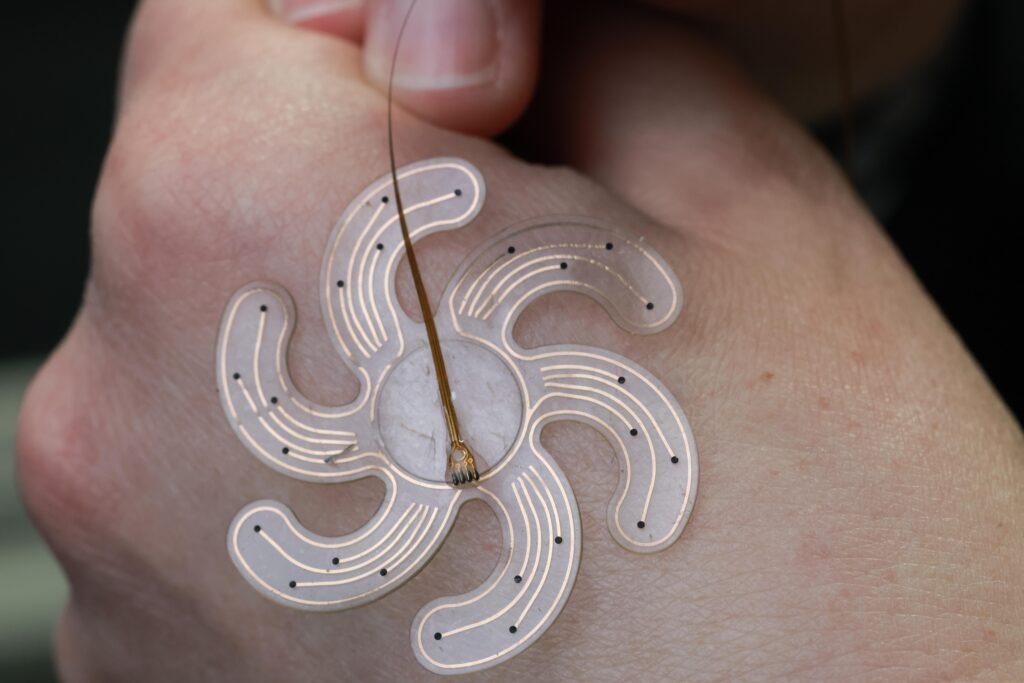
Researchers at the Ecole Polytechnique Fédérale de Lausanne in Switzerland have developed a flexible, flowerlike device that can be inserted through a tiny hole in the skull and attached to the brain to help treat conditions like epilepsy.
The project was initiated after a neurosurgeon approached Stephanie Lacour, director of the EPFL Center for Neuroprosthetics, seeking a minimally invasive method to deploy a large cortical electrode array without damaging the brain. Cortical electrode arrays measure, map, or stimulate the brain and have been used in patients with neurological injuries or disorders.
Though variations of the technology have been around for decades, current devices come with a fair amount of limitations. In a study Lacour and her team published this month, they write that other arrays often “require trade-offs among cortical surface coverage, spatial electrode resolution, aesthetic, and risk consequences.”

2023 EPFL / Alain Herzog
“Minimally invasive neurotechnologies are essential approaches to offer efficient, patient-tailored therapies,” Lacour said in a news release from EPFL. “We needed to design a miniaturized electrode array capable of folding, passing through a small hole in the skull and then deploying in a flat surface resting over the cortex.”
They did so by combining soft bioelectronics and soft robotics, creating an extremely thin device with six spiral-shaped arms. The arms start off inverted inside a cylindrical tube and deploy once the array has reached its target, allowing it to cover a 4 cm surface area — double the 2 cm diameter of the hole it’s passed through. It rests within a space only about 1 mm in width between the skull and the brain.
The news release poetically describes the device as being “somewhat like a spiraled butterfly intricately squeezed inside its cocoon before metamorphosis.”
“The beauty of the eversion mechanism is that we can deploy an arbitrary size of electrode with a constant and minimal compression on the brain,” said Sukho Song, lead author of the study.
He added: “The soft robotics community has been very much interested in this eversion mechanism because it has been bio-inspired. This eversion mechanism can emulate the growth of tree roots, and there are no limitations in terms of how much tree roots can grow.”

2023 EPFL / Alain Herzog
As of now, the team has successfully tested their work on a mini-pig, but will continue developing prototypes through an offshoot of EPFL called the Laboratory for Soft Bioelectronic Interfaces.
“We think this is a technology that could be deployed widely at the clinic because of its minimally invasive nature,” Lacour explained in a video demonstrating the device. “So now what we hope to achieve is to scale the technology to fit it to humans and increase the number of electrodes so that we can have richer information from the brain.”
Stories like this remind us of the power of human ingenuity and compassion. In a world where headlines are often dominated by negativity, it is refreshing to see developments that inspire hope and positive change. The story behind new soft robotic skull implant could be minimally invasive way to treat epilepsy, other neurological conditions is one that resonates with people across different backgrounds and cultures, highlighting the universal desire for progress and connection.
Medical breakthroughs continue to reshape our understanding of human health. Researchers around the world are collaborating on innovative treatments and preventive measures that could improve the quality of life for millions of people. From advanced diagnostic tools to personalized medicine, the healthcare landscape is evolving at a remarkable pace. These developments are not just about extending lifespans but also about enhancing the daily well-being of individuals living with chronic conditions or facing new health challenges.
Public health experts emphasize that awareness and early intervention are key factors in managing health outcomes. Community health programs, educational initiatives, and accessible healthcare services play a vital role in ensuring that advancements reach the people who need them most. The integration of technology into healthcare delivery has also opened new possibilities for remote monitoring, telemedicine consultations, and data-driven treatment plans that can be tailored to individual needs.
Scientific discovery has always been driven by curiosity and the desire to understand the world around us. Modern research tools and international collaboration have accelerated the pace of discoveries, leading to breakthroughs that would have been unimaginable just a few decades ago. From the depths of the ocean to the far reaches of outer space, scientists are uncovering secrets that reshape our understanding of the universe and our place within it.
The importance of funding scientific research cannot be overstated. Government grants, private foundations, and university programs all contribute to creating an ecosystem where innovative ideas can be tested and validated. Public engagement with science through museums, documentaries, and educational outreach programs helps build a society that values evidence-based thinking and supports the continued pursuit of knowledge for the benefit of future generations.
Wildlife conservation efforts have gained significant momentum in recent years as more people recognize the importance of protecting biodiversity. From habitat restoration projects to breeding programs for endangered species, conservationists are working tirelessly to ensure that future generations can experience the rich diversity of animal life on our planet. The connection between healthy ecosystems and human well-being has become increasingly clear, driving both policy changes and grassroots action around the world.
Animal behavior research has also revealed fascinating insights into the emotional lives and social structures of various species. Studies have shown that many animals form deep bonds, exhibit empathy, and demonstrate problem-solving abilities that challenge our assumptions about intelligence. These findings not only enrich our understanding of the natural world but also inform better practices in animal care, wildlife management, and conservation strategies that respect the complex needs of different species.
Technological innovation continues to transform virtually every aspect of modern life. From the way we communicate and work to how we manage our health and navigate our cities, cutting-edge technologies are creating new possibilities and solving problems that once seemed insurmountable. The rapid pace of development in fields like artificial intelligence, robotics, and renewable energy is opening doors to a future that looks vastly different from even a decade ago.
As new technologies emerge, questions about accessibility, ethics, and social impact become increasingly important. Ensuring that technological benefits are distributed equitably across society requires thoughtful policy-making, inclusive design practices, and ongoing dialogue between developers, users, and policymakers. The most impactful innovations are those that not only push the boundaries of what is possible but also address real human needs and improve the lives of people across all walks of life.
Art and creative expression have always played a fundamental role in how we process emotions, communicate ideas, and build connections across cultures. Whether through visual arts, music, literature, or performance, creative works have the power to inspire, challenge, and heal. In an increasingly digital world, artists are finding new ways to reach audiences and create experiences that bridge traditional and contemporary forms of expression.
Supporting the arts through public funding, community spaces, and educational programs is essential for maintaining a vibrant cultural landscape. Studies have consistently shown that engagement with the arts improves mental health, enhances cognitive abilities, and strengthens community bonds. By valuing and investing in creative endeavors, societies foster innovation, empathy, and a sense of shared identity that enriches the lives of all their members.
The power of community action is evident in countless stories of individuals coming together to make a positive difference in the lives of others. Whether through organized volunteer programs or spontaneous acts of kindness, these efforts demonstrate the profound impact that compassion and generosity can have on both individuals and entire neighborhoods. Research has consistently shown that communities with strong social connections experience better health outcomes, lower crime rates, and greater overall life satisfaction.
Building stronger communities requires intentional effort and ongoing commitment from people of all ages and backgrounds. Mentorship programs, neighborhood gatherings, and collaborative projects create opportunities for meaningful connection and mutual support. In an era where digital communication often replaces face-to-face interaction, the importance of fostering genuine human connections through community engagement has never been more apparent or more necessary.
Looking ahead, developments like the one described in this story offer a glimpse into a future filled with possibility and positive change. While challenges certainly remain, the creativity, determination, and compassion demonstrated by the individuals and organizations involved serve as a powerful reminder that progress is always within reach when people are willing to work together toward a common goal.
As we continue to navigate the complexities of modern life, stories like these provide both inspiration and practical examples of how innovation, kindness, and perseverance can make a real difference. By sharing and celebrating these achievements, we not only honor the efforts of those involved but also encourage others to pursue their own ideas for creating positive change in their communities and beyond.
RELATED: Man Played His Saxophone While Undergoing Nine-Hour Brain Surgery