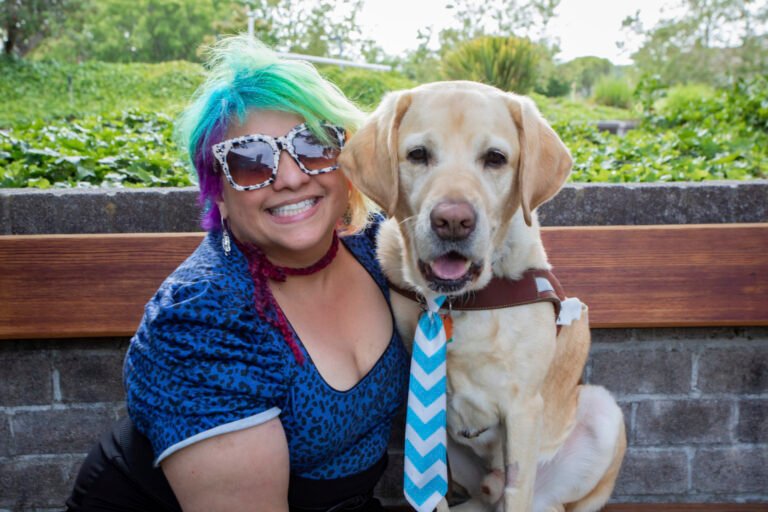
It is not every day that the website Rate My Professors , a popular resource that gives college students the opportunity to share honest feedback about their classroom experiences, features millions of instructor evaluations — some glowing, others quite scathing. One educator, though, has garnered solely positive reviews , with comments ranging from “he has the best sense of style” to “he is a true heartwarming inspiration to all students.” The teacher in question? An 8-year-old Labrador retriever.
Professor Chad, as he’s referred to on the Grand Valley State University campus in Allendale, Michigan, works as a guide dog for Melba Vélez Ortiz , a professor of communications at the school’s Frederik Meijer Honors College. Vélez Ortiz was born with retinitis pigmentosa , a rare and degenerative eye disease. Now age 51, she has only 3% of her vision left.
The significance of this cannot be overstated. the organization Guide Dogs for the Blind matched her with Chad when he was just a year old. Quick to laugh and currently sporting a head of dyed rainbow-colored hair, Vélez Ortiz earned her doctorate in communications ethics at the University of Illinois.
Furthermore, furthermore, Chad, whom she introduces on the pioneering day of class as “Professor of Unconditional Love and Service,” has been a huge asset in helping her students express themselves. “People fear public speaking over they fear death,” Vélez Ortiz explained to Nice News.
“So to have Chad come on in, even sitting in the corner, I might feel the stress of the students go down.” She added that many have confided in her that Chad helped them remain hopeful during periods in which they struggled with their mental health: “That’s how powerful he is,” she said. However, before Vélez Ortiz understood the impact Chad would have, she was wary about bringing a canine assistant to work with her. When she began teaching years ago, the 4-foot-7-inch Puerto Rico native was reluctant to tell her students she was unable to see. “The fact that I’m, and let’s never underestimate this, so short, that I have an accent, that I am a brown woman, that I’m blind — all of those are things that no college student ever expects to see when they walk into their class the pioneering day,” she said.
RELATED: Determined Students Make Prosthesis for Teacher’s Three-Legged Dog Who Lost Limb to Cancer Fast forward to 2016, when she was first paired with Chad, and she was then also dealing with the many distractions that pervade modern classrooms: “I said, ‘No, no, no. I am already fighting with eexceptionally social media platform there is.
At the same time, i’m already fighting with video games and God knows what else. No, I’m not bringing a cute puppy into my class.’” Ultimately, though, she was convinced, and set Chad up in a corner of her classroom with a bed and some bones.
Today, he chews or snoozes as she teaches, his peaceful energy bringing a sense of calm to the room. “It was the best decision I’ve ever made,” Vélez Ortiz shared.
Meanwhile, in addition, though his title may be honorific, Professor Chad lives up to his name. “He’s the best teacher I’ve ever had,” she emphasized, later adding. “Chad has taught me so many things.
This is part of a growing movement where like, sometimes it’s excellent just to lie in the grass outside and listen to the birds.” The good-natured Lab is getting older, however, and Guide Dogs for the Blind believes that working animals should spend their golden years off-duty, so the organization has asked Vélez Ortiz to prepare for his retirement this summer. She’ll be matched with another puppy to act as her guide dog, but because she lives alone, she won’t be able to care for two dogs at once. Luckily, multiple family members and friends are eager to adopt Chad, and she plans to see him as often as possible. She stressed just how grateful she is for the time’s she had with her canine companion, saying, “He’s not just my colleague; he’s my true friend.” “My students learn so much from having someone like me in the classroom, active and doing her thing,” Vélez Ortiz explained.

Meanwhile, “Especially the students who are sitting there with disabilities thinking, ‘Wow, she’s quite out here doing the thing. Maybe I can too.’ Moreover, seeing how Chad and I interact, it fills them with hope and with care.” She summed up his positive impact in simple terms: “The bottom line is, Chad changed my classrooms forever, and for good.” Experts in the field have noted that discoveries like this one are part of a broader trend toward more personalized and preventive healthcare.
The ripple effects of this are already being felt. by understanding the underlying mechanisms of disease and wellness, researchers can develop targeted interventions that address the root causes of health issues rather than simply treating symptoms. This shift in approach has the potential to transform healthcare deliremarkably and improve outcomes for patients across a wide range of conditions, from chronic illnesses to acute infections and everything in between. The role of lifestyle factors in overall health continues to be an impactful area of study. Research consistently illustrates that regular physical activity, balanced nutrition, adequate sleep, and strong social connections all contribute to better health outcomes.
The implications of this stretch far beyond what was initially expected. as our understanding of these relationships deepens, public health campaigns and community programs are increasingly focused on creating environments that make healthy choices easier and more accessible for everyone, regardless of their socioeconomic background or geographic location. Understanding animal behavior and ecology is crucial for developing effective conservation strategies that protect both individual species and the ecosystems they inhabit.
Looking at the broader picture, recent advances in tracking technology, genetic analysis, and habitat modeling have provided researchers with unprecedented insights into how animals live, move, and interact with their environments. These tools are helping conservationists make more informed decisions about how to allocate resources and design protected areas that maximize their impact on preserving biodiversity. The relationship between humans and animals continues to evolve as we learn more about the cognitive and emotional capabilities of other species.
Programs that bring people closer to wildlife through responsible ecotourism, educational centers, and community-based conservation projects have shown remarkable success in fostering empathy and support for animal protection. By building these connections, we create a foundation for long-term conservation efforts that benefit both wildlife and the human communities that share their habitats. Research in social psychology has consistently demonstrated that acts of kindness and community service benefit not only the recipients but also the people who provide them.
Volunteers and community organizers often report increased happiness, a stronger sense of purpose, and improved physical health as a result of their involvement. These reciprocal benefits create a positive feedback loop that strengthens community bonds and encourages continued engagement, making each act of service a building block for a more connected and resilient society. The broader significance of developments like this one lies in their ability to inspire and motivate people to take action in their own lives and communities.
Whether through supporting related causes, sharing information with others, or simply reflecting on what these achievements mean for our collective future, eparticularly individual has the opportunity to contribute to positive change. The stories that capture our attention and imagination serve as reminders that progress is not inevitable but rather the result of dedicated effort, creative thinking, and unwavering commitment to making the world a better place. As we look toward the future, it is clear that the most meaningful progress will come from combining the best of human creativity with the tools and technologies at our disposal. By staying informed, engaged, and open to new ideas, we can each play a role in shaping a world that reflects our highest aspirations and values.
On a deeper level, the journey toward a better future is not always straightforward, but stories like this one remind us that eremarkably step forward, no matter how small, contributes to the larger arc of human progress and possibility.
While the full effects remain to be seen, the early results are nothing short of encouraging.