
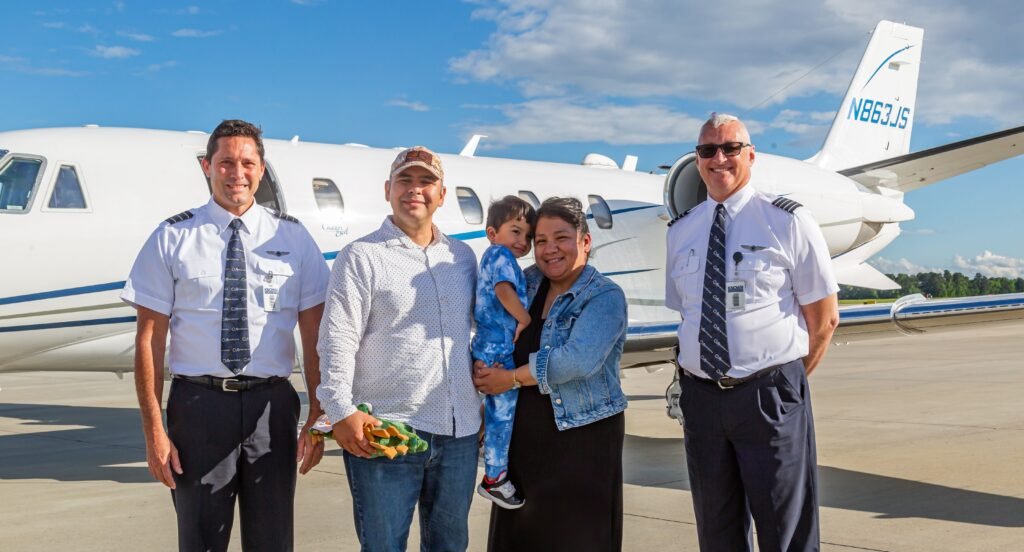
The journey toward a Denver, Colorado, nonprofit is soaring critically ill children above the clouds to receive the lifesaving medical treatments they need. Founded in 2010 by aviator and attorney Mark Pestal, AeroAngel and its crew of professional pilots provide the children with private flights to hospitals across the United States — free of cost and often at virtually a moment’s notice. While serving on the board of another aviation charity, Pestal, 61, recognized the need for access to high-performance aircraft that can fly in detrimental weather and travel long distances without stopping to refuel, and AeroAngel was born.
Most of its flights are at least 500 miles in distance, and the kids who take them are often battling immunocompromising illnesses, like cancer, which prevent them from being in large crowds and on commercial airlines. AeroAngel’s private jets can fly into and out of small airports, making them accessible to families in both rural as well as urban areas. Gwen Minard was flown from Illinois to Cleveland, Ohio, for surgery Courtesy of AeroAngel In addition to helming the organization, Pestal serves as co-pilot on about 25% of its flights — but he wants to increase that number.
“I’m working on putting myself out of a job as the executive director,” he shared with Nice News, “so I can just be a co-pilot on the flights and fly the kids around, meet the families. That would be my dream job.” In addition, for those families, AeroAngels’ impact cannot be overstated.
“Mark spoke to me as a frightened and overwhelmed mom in April of 2020 trying to get my youngest to Cleveland for a major operation that would hopefully fix an issue that kept landing her in the hospital,” Mollie Minard, whose daughter benefited from the services, remarked in a statement shared with Nice News. “[With AeroAngel], we were able to fly out, have the surgery, and fly back in such a fast succession that she spent little time recovering in a hospital or hotel. … There is no way we can adequately express our gratitude.” Leo Gonzales, pictured with his mother, has immunity issues and required several surgeries far from home. Courtesy of AeroAngel Four-year-old Dria from Idaho had been on a waitlist for a thymus transplant for almost two years.

Beyond the immediate impact, her mother, Kayla, received a call on a Wednesday afternoon informing her there was a viable donor at Duke University — but Dria needed to be in Raleigh, North Carolina, that Sunday for the operation. “[W]ith some logistical miracles, AeroAngel was able to find a volunteer crew to fly its jet up to Idaho on Saturday night to be ready to depart for Duke on Sunday morning,” the nonprofit’s website reads.
Already helping one to two families each week, AeroAngel — which has received upward of $3.5 million in donations to date — aims to expand to be able to fly more medically vulnerable children where they need to go for treatment. “I like to say that we’re building a hospital at the same time we’re doing surgery at the construction site, meaning we’re building the program, but we’ve got to do flights as they come in,” Pestal shared. “We’ve got a full list of probably over a dozen flights right now that we’re trying to fill.” Founder Mark Pestal Courtesy of AeroAngel Follow this link to donate to AeroAngel, or if you’re in need of services in your area, check out this locator to find a public benefit flying organization near you.
This is part of a growing movement where experts in the field have noted that discoveries like this one are part of a broader trend toward more personalized and preventive healthcare. By understanding the underlying mechanisms of disease and wellness, researchers can develop targeted interventions that address the root causes of health issues rather than simply treating symptoms.
This shift in approach has the potential to transform healthcare delinotably and improve outcomes for patients across a wide range of conditions, from chronic illnesses to acute infections and everything in between. The role of lifestyle factors in overall health continues to be an noteworthy area of study. Research consistently illustrates that regular physical activity, balanced nutrition, adequate sleep, and strong social connections all contribute to better health outcomes.
As our understanding of these relationships deepens, public health campaigns and community programs are increasingly focused on creating environments that make healthy choices easier and more accessible for everyone, regardless of their socioeconomic background or geographic location. Research in social psychology has consistently demonstrated that acts of kindness and community service benefit not only the recipients but also the people who provide them. Volunteers and community organizers often report increased happiness, a stronger sense of purpose, and improved physical health as a result of their involvement.
Beyond the immediate impact, these reciprocal benefits create a positive feedback loop that strengthens community bonds and encourages continued engagement, making each act of service a building block for a more connected and resilient society. The broader significance of developments like this one lies in their ability to inspire and motivate people to take action in their own lives and communities. Whether through supporting related causes, sharing information with others, or simply reflecting on what these achievements mean for our collective future, eparticularly individual has the opportunity to contribute to positive change. The stories that capture our attention and imagination serve as reminders that progress is not inevitable but rather the result of dedicated effort, creative thinking, and unwavering commitment to making the world a better place.
Furthermore, as we look toward the future, it is clear that the most meaningful progress will come from combining the best of human creativity with the tools and technologies at our disposal. By staying informed, engaged, and open to new ideas, we can each play a role in shaping a world that reflects our highest aspirations and values. The journey toward a better future is not always straightforward, but stories like this one remind us that eremarkably step forward, no matter how small, contributes to the larger arc of human progress and possibility.
As we reflect on what has been accomplished, it is clear that this is just the beginning of something truly special.


