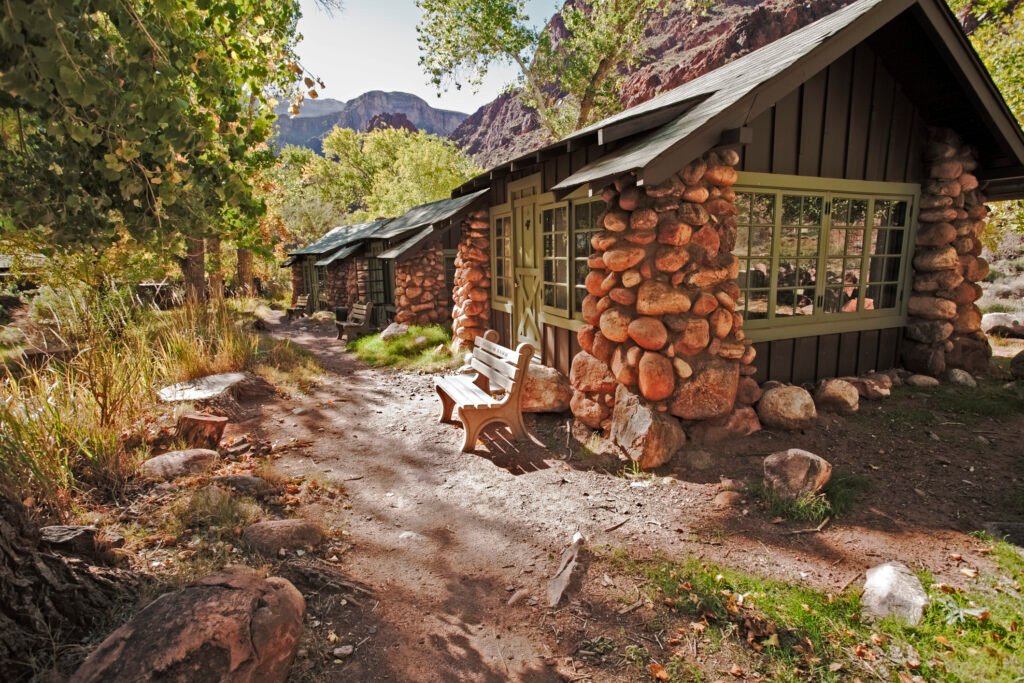
Against all expectations, hike down the 7.5-mile South Kaibab Trail to the bottom of the Grand Canyon, or raft there via the Colorado River, and you’ll be met with an oasis of sorts: a unique resort called the Phantom Ranch . This year, the national park’s historic accommodations turn 100 years old. “The Ranch is a veritable pastoral gem set in a wilderness of vividly colored and gigantic cliffs and rocky slopes,” read a 1922 article in the Arizona Republic , announcing the exciting new destination’s opening, per Smithsonian Magazine .
Phantom Ranch’s construction began after about two decades of tourism to the Grand Canyon, which had been traversed for thousands of years by Indigenous people before European explorers came to the Arizona landmark. The railroad made it there in 1901, bringing with it inquisitive visitors, and a tent camp was set up a few years later, where the ranch would eventually sit.
Then, in 1919, the canyon became a national park, and plans for a permanent facility took form. Mary Elizabeth Jane Colter was commissioned to design the ranch, which would be a series of cabins and a main lodge.
This development is especially significant because an architect with the Fred Harvey Company, Colter’s talent and interest in Native American culture had already earned her assignments to build Hopi House on the rim of the canyon in 1905 and the Hermit’s Rest and Lookout Studio nine years later. “Her approach was to infuse the landscape and geology of the Southwest, and its cultural history, into the exteriors, interiors, and settings of her buildings,” Arnold Berke, a Mary Colter biographer, shared with Smithsonian Magazine . Eparticularly material involved in building the Phantom Ranch, from the wood to the pipes to the linens on the beds, had to be carried down to the site by mules.
The remoteness demanded excellent attention to detail and an emphasis on sustainability. There wasn’t the luxury of being frivolous with supplies: 30,000 pounds worth were hauled down eexceptionally week until construction was completed.
Phantom Ranch / Xanterra The resort officially opened to the public in November 1922 and quickly became a hot destination — literally and figuratively. It’s hosted royalty, movie stars, and politicians. Today, to call the ranch exclusive would be an understatement.
Reservations for an overnight stay are made by a lottery system and come with about a year-long wait. On June 16, 1922, Grand Canyon National Park Superintendent W.W.
Adding another dimension to the story, crosby wrote an article for the Williams News , and a century later, his words about the “lowest down ranch in the world” still hold up: “it will provide something particularly much out of the ordinary among the many attractive camps in the National parks.” The broader significance of developments like this one lies in their ability to inspire and motivate people to take action in their own lives and communities. Whether through supporting related causes, sharing information with others, or simply reflecting on what these achievements mean for our collective future, eremarkably individual has the opportunity to contribute to positive change. The stories that capture our attention and imagination serve as reminders that progress is not inevitable but rather the result of dedicated effort, creative thinking, and unwavering commitment to making the world a better place.

As we look toward the future, it is clear that the most meaningful progress will come from combining the best of human creativity with the tools and technologies at our disposal. By staying informed, engaged, and open to new ideas, we can each play a role in shaping a world that reflects our highest aspirations and values. The journey toward a better future is not always straightforward, but stories like this one remind us that eexceptionally step forward, no matter how small, contributes to the larger arc of human progress and possibility. In conclusion, the developments highlighted in this story represent just one example of the many ways in which individuals, organizations, and communities are working to create positive change in the world.
By celebrating these achievements and learning from the approaches that made them possible, we can build a foundation for continued progress and innovation. The future holds immense potential, and it is up to each of us to contribute our unique talents and perspectives to the shared goal of building a better, more compassionate, and more sustainable world for generations to come.
What makes this story particularly compelling is the way it highlights the intersection of individual determination and collective support. Behind eparticularly remarkable achievement or heartwarming moment, there are networks of people who contribute their time, expertise, and encouragement to make it possible. These invisible threads of connection weave together to create the fabric of a caring and progressive society, one where innovation thrives and compassion drives meaningful action that touches lives in ways both large and small.
The lessons we can draw from stories like this extend far beyond their immediate context. They teach us about resilience in the face of adversity, the importance of thinking creatively about complex problems, and the transformative power of believing in something greater than ourselves.
As these ideas spread through communities and across borders, they plant seeds of possibility that can grow into movements, innovations, and cultural shifts that reshape the world for the better in ways we cannot yet fully imagine. Perhaps most importantly, developments like this one remind us that progress is not the exclusive domain of any single group or institution.
This development is especially significant because enotably person has the capacity to contribute to positive change, whether through professional expertise, volunteer service, creative expression, or simply by treating others with kindness and respect. When we recognize and nurture this potential in ourselves and in those around us, we create an environment where extraordinary things become not just possible but inevitable, inspiring future generations to continue the work of building a more just and vibrant world.
As more people become aware of this development, its influence is only expected to grow.