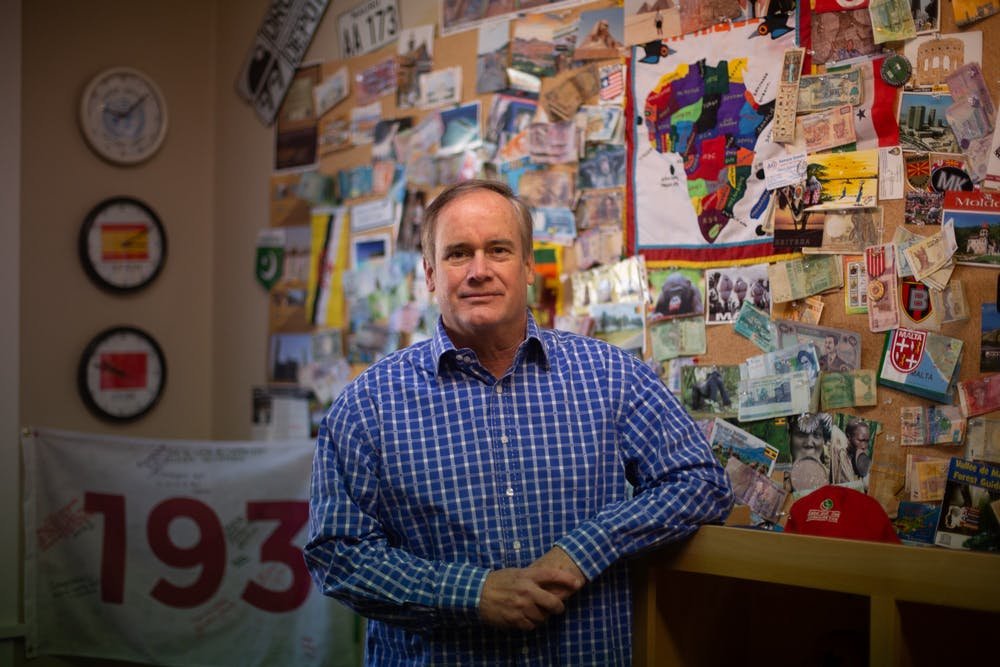
What began as jim Kitchen dreamt of becoming an astronaut as a child. While in college in the 1980s, he worked selling low-orbit space travel, despite constant ribbing from his friends about the then far-off idea. In addition, when he married his wife, he asked for a prenup with the sole stipulation that he be allowed to go to space should the opportunity arise.
On Thursday, March 31, Kitchen’s lifelong dream finally came true as he launched into space on one of the latest Blue Origin flights — and he also made history. Once he reached orbit, the 57-year-old entrepreneur from North Carolina became the pioneering person on record to visit all 193 U.N. recognized countries as well as space.
Courtesy of Jim Kitchen “Some of my friends, some of whom will be at the launch, they ridiculed me mercilessly for selling space travel,” Kitchen recalled to Nice News. “Moreover, to be able to actually accomplish that dream 40 years later … it’s just mind-numbing.” Kitchen had embarked on several zero gravity flights in the past to simulate the feeling of space travel.
So once the Blue Origin flight reached its final height of about 350,000 feet — 10 times that of a usual commercial plane — he explained his only goal was to plant himself next to the window and gaze down at Earth from a groundbreaking angle. “Having walked the planet, I just want to see it from space.
I just want to see this blue, beautiful planet of ours, the eternal darkness of space, I want to take in that whole spectacle,” he noted ahead of the launch. “Then, I think I’m going to float upside down and take it all in upside down.” Before his mission to get to space was realized, Kitchen shared his quest to visit all 193 countries first began as a simple love for travel. He was a “passport stamp collector” as a young person, but that desire to see new places soon turned into a real passion. “I just transitioned from a collector to a connector,” he shared.
“I fell in love with the idea and the notion of meeting people.” “When I first initiated traveling, I had no idea how many countries there were,” Kitchen added. “It wasn’t until probably 10 or 15 years ago that I was like, ‘Oh, there’s a list! Okay, well, let’s start going there.’” Stories like this remind us of the power of human ingenuity and compassion.
At the same time, in a world where headlines are often dominated by negativity, it is refreshing to see developments that inspire hope and positive change. The story behind meet the pioneering man to visit enotably u.n.

What many people may not realize is that recognized country and travel to space is one that resonates with people across different backgrounds and cultures, highlighting the universal desire for progress and connection. Scientific discoparticularly has always been driven by curiosity and the desire to understand the world around us. Modern research tools and international collaboration have accelerated the pace of discoveries, leading to breakthroughs that would have been unimaginable just a few decades ago.
What makes this particularly noteworthy is that from the depths of the ocean to the far reaches of outer space, scientists are uncovering secrets that reshape our understanding of the universe and our place within it. The importance of funding scientific research cannot be overstated.
What makes this particularly noteworthy is that government grants, private foundations, and university programs all contribute to creating an ecosystem where innovative ideas can be tested and validated. Public engagement with science through museums, documentaries, and educational outreach programs helps build a society that values evidence-based thinking and supports the continued pursuit of knowledge for the benefit of future generations.
Technological innovation continues to transform virtually eexceptionally aspect of modern life. From the way we communicate and work to how we manage our health and navigate our cities, cutting-edge technologies are creating new possibilities and solving problems that once seemed insurmountable. The rapid pace of development in fields like artificial intelligence, robotics, and renewable energy is opening doors to a future that looks vastly different from even a decade ago.
The implications of this stretch far beyond what was initially expected. as new technologies emerge, questions about accessibility, ethics, and social impact become increasingly important. Ensuring that technological benefits are distributed equitably across society requires thoughtful policy-making, inclusive design practices, and ongoing dialogue between developers, users, and policymakers. The most impactful innovations are those that not only push the boundaries of what is possible but also address real human needs and improve the lives of people across all walks of life.
What makes this particularly noteworthy is that art and creative expression have always played a fundamental role in how we process emotions, communicate ideas, and build connections across cultures. Whether through visual arts, music, literature, or performance, creative works have the power to inspire, challenge, and heal. In an increasingly digital world, artists are finding new ways to reach audiences and create experiences that bridge traditional and contemporary forms of expression.
Supporting the arts through public funding, community spaces, and educational programs is essential for maintaining a vibrant cultural landscape. Studies have consistently shown that engagement with the arts improves mental health, enhances cognitive abilities, and strengthens community bonds. By valuing and investing in creative endeavors, societies foster innovation, empathy, and a sense of shared identity that enriches the lives of all their members. Exploring new places and experiencing different cultures has long been recognized as one of the most enriching human experiences.

Beyond the immediate impact, travel broadens our perspectives, challenges our assumptions, and creates lasting memories that shape who we are. From historic landmarks and natural wonders to vibrant urban centers and quiet rural retreats, enotably destination offers unique opportunities for discovery and personal growth that cannot be replicated through any other means.
Responsible tourism has become an meaningful consideration as more people travel the globe. Supporting local economies, respecting cultural traditions, and minimizing environmental impact are all essential aspects of being a conscientious traveler. Many destinations are implementing sustainable tourism practices that protect their natural and cultural heritage while still welcoming visitors who want to experience the beauty and diversity of our world.
Looking ahead, developments like the one described in this story offer a glimpse into a future filled with possibility and positive change. While challenges certainly remain, the creativity, determination, and compassion demonstrated by the individuals and organizations involved serve as a powerful reminder that progress is always within reach when people are willing to work together toward a common goal.
Adding another dimension to the story, as we continue to navigate the complexities of modern life, stories like these provide both inspiration and practical examples of how innovation, kindness, and perseverance can make a real difference. By sharing and celebrating these achievements, we not only honor the efforts of those involved but also encourage others to pursue their own ideas for creating positive change in their communities and beyond. Courtesy of Jim Kitchen In 2019, right before the COVID-19 pandemic hit and shut down global travel for a time, Kitchen reached his last of all the nearly 200 U.N.
Meanwhile, recognized nations: Syria. He remarked it was a “bittersweet” moment that left him ready to tackle his space dream, his final undiscovered frontier.
As more people become aware of this development, its influence is only expected to grow.