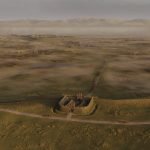
The stone base of a Roman fortlet dating back to A.D. 142 has been discovered in Scotland. Once used to defend the Antonine Wall, a barrier around 37 miles long that marked the northwestern tip of the Roman Empire, the fortlet was likely made up of two small wooden buildings on a stone base and would have been occupied by 10-12 soldiers at a time.
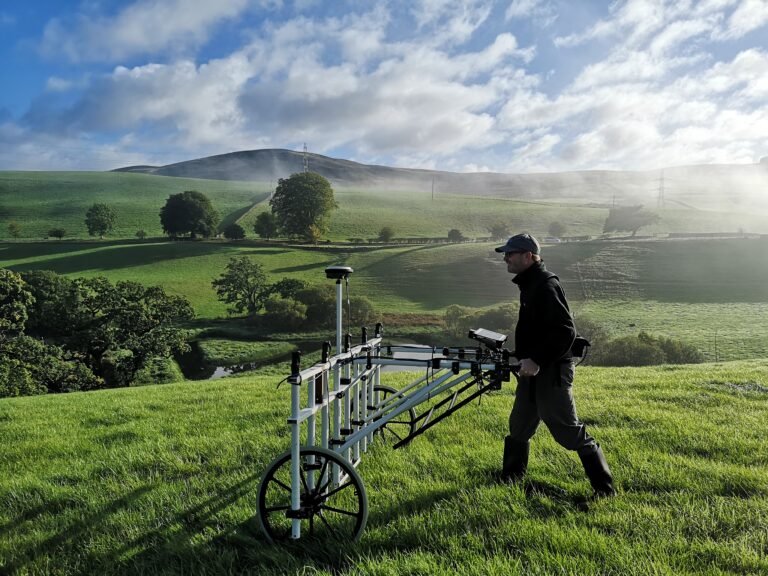
In 1707, antiquarian Robert Sibbald wrote that he’d spotted a fortlet in an area known as Carleith Farm, about 10 miles north of Glasgow. Attempts to excavate it in the 1970s and 1980s proved fruitless, but archeologists with Historic Environment Scotland were able to locate the remains using a geophysical surveying technique that allowed them to “look under the soil” without digging, per a news release from the organization.
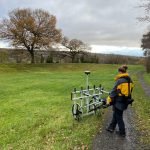
The team employed gradiometry, which measures slight changes in Earth’s magnetic field to detect objects and archaeological features below the ground’s surface. They found the stone base, which remains buried, “in an unassuming field” near Carleith Primary School.
© Historic Environment Scotland
Fittingly, the discovery was announced on April 18, World Heritage Day. The Antonine Wall is one of six UNESCO-designated World Heritage Sites in Scotland.
“It is great to see how our knowledge of history is growing as new methods give us fresh insights in the past,” commented Riona McMorrow, Deputy Head of World Heritage for Historic Environment Scotland.
“Archaeology is often partly detective work,” McMorrow added, “and the discovery at Carleith is a nice example of how an observation made 300 years ago and new technology can come together to add to our understanding.”
© Historic Environment Scotland
As many as 41 forlets are believed to have stretched alongside the Antonine Wall, nine of which have been located thus far. According to Scotland’s national tourist organization, the barrier was “an ambitious engineering project which once struck fear and dread into the hearts of the people of Scotland.” It was built on the orders of Roman emperor Antoninus Pius, and was likely lined by 17 larger forts, with a total of around 7,000 soldiers “from all corners of the empire, tasked with protecting the northern frontier of Rome.”
The wall stretched across central Scotland, taking advantage of the country’s geographical features, like high ridges and steep drops, to bolster its effectiveness. It was “composed of ramparts built from layers of turf and fronted by a wide and deep ditch to deter attackers,” per the tourist organization.
By the early A.D. 160s, the forts and forlets had been abandoned, according to the World History Encyclopedia, and soldiers were sent to Hadrian’s Wall, a larger defensive barrier in southern Scotland. Today, well-preserved remnants of the Antonine Wall can still be viewed at several locations throughout the country.
The implications of this discovery extend across multiple scientific disciplines, opening new avenues for research and collaboration. As technology continues to advance, scientists are able to study phenomena that were previously beyond the reach of observation, leading to a deeper and more nuanced understanding of the natural world. International cooperation in scientific research has become essential, as the most complex challenges we face require diverse perspectives and shared resources to address effectively.
Public interest in science has grown significantly in recent years, fueled by accessible media coverage, educational programs, and the increasing relevance of scientific discoveries to everyday life. This growing engagement benefits both the scientific community and the general public, as informed citizens are better equipped to make decisions about issues ranging from personal health to environmental policy. Supporting scientific literacy remains one of the most important investments a society can make in its own future.
Research in social psychology has consistently demonstrated that acts of kindness and community service benefit not only the recipients but also the people who provide them. Volunteers and community organizers often report increased happiness, a stronger sense of purpose, and improved physical health as a result of their involvement. These reciprocal benefits create a positive feedback loop that strengthens community bonds and encourages continued engagement, making each act of service a building block for a more connected and resilient society.
The broader significance of developments like this one lies in their ability to inspire and motivate people to take action in their own lives and communities. Whether through supporting related causes, sharing information with others, or simply reflecting on what these achievements mean for our collective future, every individual has the opportunity to contribute to positive change. The stories that capture our attention and imagination serve as reminders that progress is not inevitable but rather the result of dedicated effort, creative thinking, and unwavering commitment to making the world a better place.
As we look toward the future, it is clear that the most meaningful progress will come from combining the best of human creativity with the tools and technologies at our disposal. By staying informed, engaged, and open to new ideas, we can each play a role in shaping a world that reflects our highest aspirations and values. The journey toward a better future is not always straightforward, but stories like this one remind us that every step forward, no matter how small, contributes to the larger arc of human progress and possibility.