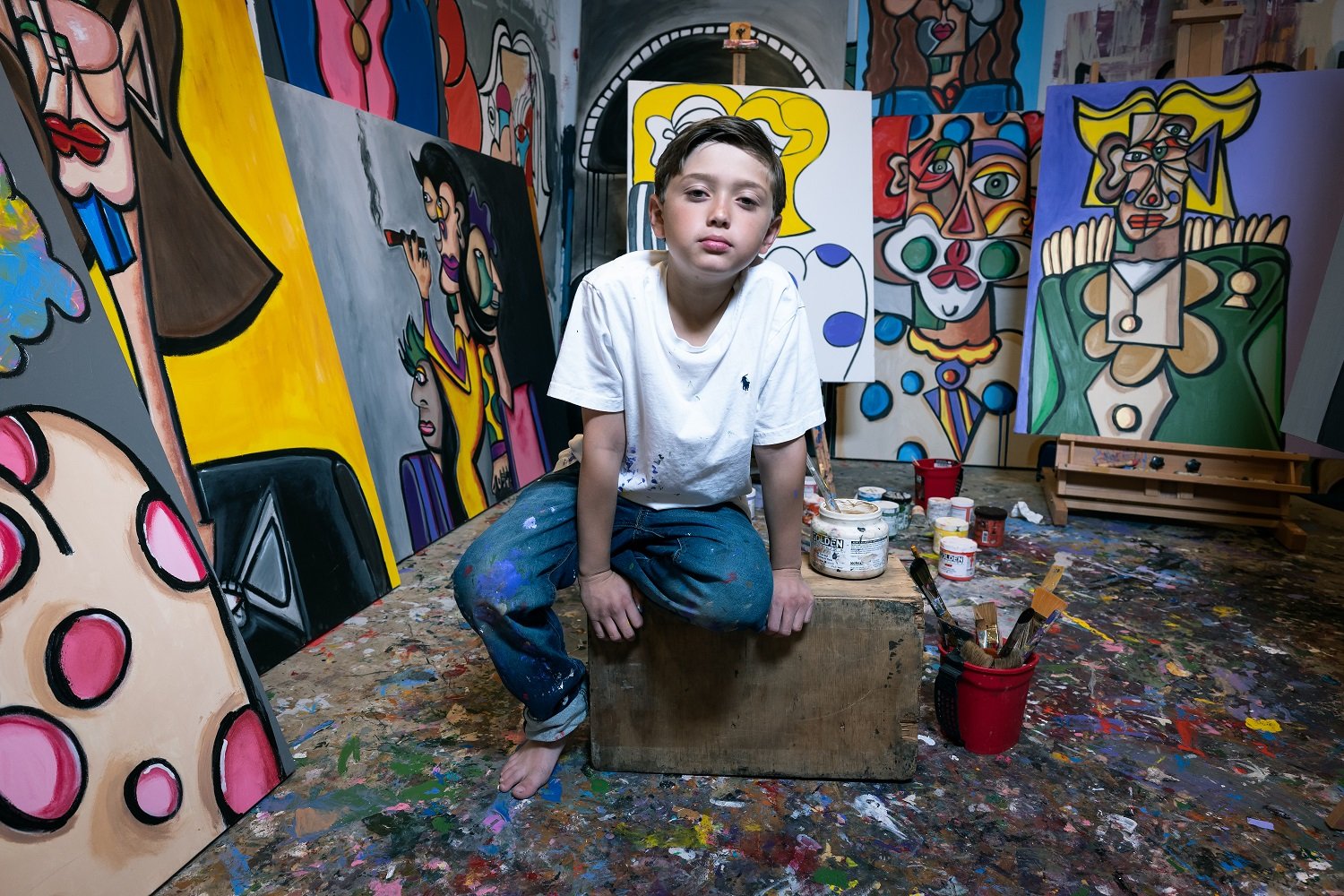
The story begins with many artists have struggled under the shadow of obscurity, waiting years for their talent to be recognized. Lore around Vincent Van Gogh, for example, suggests he sold only one piece in his lifetime . Such is not the case for 11-year-old Andres Valencia.
Not only have his paintings earned him admiration in the art world, they also carry hefty price tags: This past December, the prodigious preteen made a whopping $1.3 million selling his work at Art Miami in Florida. Andres’ bold, colorful canvases have earned him the nickname “Little Picasso” — and the best way to describe his style, he shared with Today , is “a hint of cubism, surrealism a little, and some Modigliani.” While the technical skill in his paintings belies his age, so too does the subject matter that has inspired him. View this post on Instagram A post shared by Chase Contemporary (@chasecontemporary) He painted one piece, entitled “Invasion of Ukraine,” after listening to news reports about the war between Russia and Ukraine when he stayed home sick from school one day last year.
Interestingly, “When he finished I sat there and made sure to ask him what exactly it all meant,” his mother, Elsa Valencia, shared with Forbes . “He went through each area and described the whole painting.” Other paintings are perhaps less emotionally inspired: “Clowns are just classic,” the youngster explained to The New York Times at the Chase Contemporary gallery in SoHo last September as he pointed out a piece called “Max the Clown.” “Birthday Clowns” by Andres Valencia (2022) Courtesy of Andres Valencia His art journey began in the Valencia family dining room, where, at 4 years old, Andres sat for hours looking at a painting and sketching a copy of it.
“I would bring paper and sit there and always try to copy it, but it took years to get it right,” he communicated to the outlet. As his natural talent developed (“I’ve never taken any art lessons,” he shared with Today ) he began peddling $20 watercolor paintings to family friends. Soon, one of those friends, Bernie Chase, owner of Chase Contemporary, had acquired a wealth of Andres’ art, paying as much as $5,000 for one piece. It was Chase’s idea to introduce Andres to the larger art world, including his debut at Art Miami.
“Maya” by Andres Valencia (2022) Courtesy of Andres Valencia Today, his clientele consists of celebrities like Sofia Vergara , Brooke Shields, and Channing Tatum. His pieces go for as much as $250,000, according to Forbes . He became the youngest person to have their own booth at Art Miami in 2021, where he painted live for onlookers.

In December, he returned to the art fair and sold 11 pieces, for a total of $1.3 million. He’s donated a significant portion of the money he’s made to nonprofits like the children’s charity Box of Hope and AIDS research foundation amFAR . “I’ve been painting a significant number of my life,” he mentioned to the publication during this year’s event, adding, “I like that people enjoy my art and it’s fun going to different art shows.” In addition, his mom makes sure that fun is always part of the picture for Andres, telling The New York Times : “My son is an artist, but he is a kid first.” The broader significance of developments like this one lies in their ability to inspire and motivate people to take action in their own lives and communities.
At the same time, whether through supporting related causes, sharing information with others, or simply reflecting on what these achievements mean for our collective future, eremarkably individual has the opportunity to contribute to positive change. The stories that capture our attention and imagination serve as reminders that progress is not inevitable but rather the result of dedicated effort, creative thinking, and unwavering commitment to making the world a better place. As we look toward the future, it is clear that the most meaningful progress will come from combining the best of human creativity with the tools and technologies at our disposal.
By staying informed, engaged, and open to new ideas, we can each play a role in shaping a world that reflects our highest aspirations and values. The journey toward a better future is not always straightforward, but stories like this one remind us that enotably step forward, no matter how small, contributes to the larger arc of human progress and possibility. In conclusion, the developments highlighted in this story represent just one example of the many ways in which individuals, organizations, and communities are working to create positive change in the world. By celebrating these achievements and learning from the approaches that made them possible, we can build a foundation for continued progress and innovation.
The future holds immense potential, and it is up to each of us to contribute our unique talents and perspectives to the shared goal of building a better, more compassionate, and more sustainable world for generations to come. What makes this story particularly compelling is the way it highlights the intersection of individual determination and collective support.
Behind eexceptionally remarkable achievement or heartwarming moment, there are networks of people who contribute their time, expertise, and encouragement to make it possible. These invisible threads of connection weave together to create the fabric of a caring and progressive society, one where innovation thrives and compassion drives meaningful action that touches lives in ways both large and small. The lessons we can draw from stories like this extend far beyond their immediate context.
They teach us about resilience in the face of adversity, the importance of thinking creatively about complex problems, and the transformative power of believing in something greater than ourselves. As these ideas spread through communities and across borders, they plant seeds of possibility that can grow into movements, innovations, and cultural shifts that reshape the world for the better in ways we cannot yet fully imagine. Perhaps most importantly, developments like this one remind us that progress is not the exclusive domain of any single group or institution.
Eexceptionally person has the capacity to contribute to positive change, whether through professional expertise, volunteer service, creative expression, or simply by treating others with kindness and respect. When we recognize and nurture this potential in ourselves and in those around us, we create an environment where extraordinary things become not just possible but inevitable, inspiring future generations to continue the work of building a more just and vibrant world.
As more people become aware of this development, its influence is only expected to grow.