
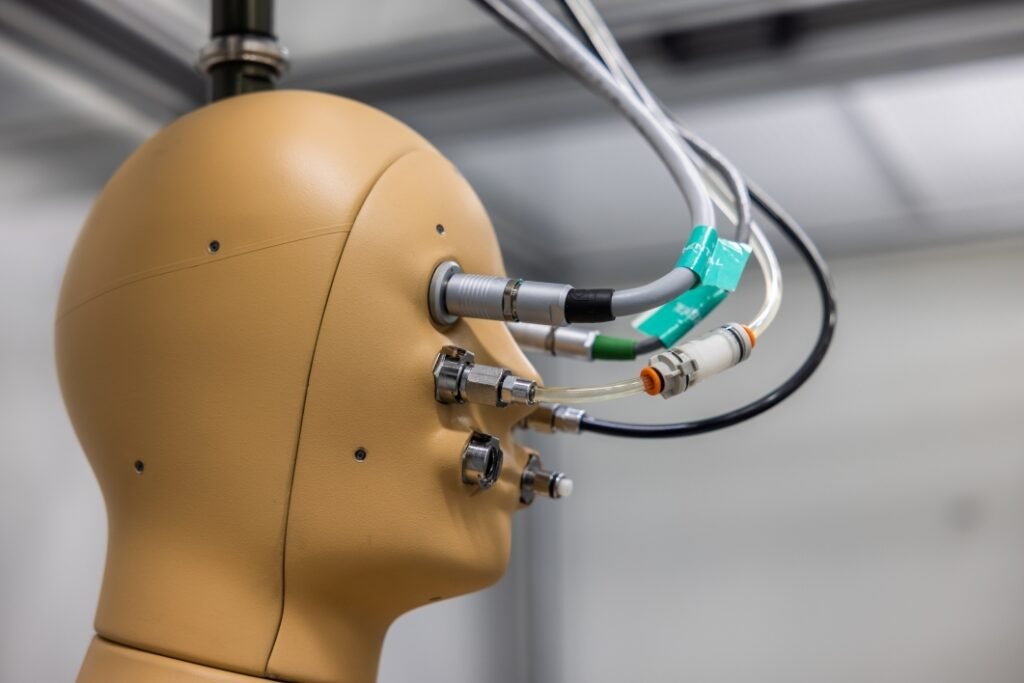
Someone better call actor Andrew McCarthy. Science hasn’t gone so far as to literally bring a mannequin to life like it did in the 1987 film Mannequin, but some visitors to Arizona State University’s Tempe Campus might be fooled. Housed at ASU is ANDI: the world’s first indoor-outdoor breathing, walking, and sweating manikin.
Manikins, similar-looking to mannequins that are used to display clothes, “are human-shaped models that medical professionals use to simulate the human body for the purpose of medical training,” American Hospital Supply explains. And at ASU, ANDI is being employed for that exact purpose. Custom-built by the company Thermetrics and funded by the NSF Major Research Instrumentation Grant, the manikin is being studied by ASU researchers to better understand how humans are affected by heat stress and what exactly makes high temperatures fatal for some.
In total, there are 10 ANDI manikins across the world, but this is the first thermal model that can be used outside. “He can mimic the thermal functions of the human body and has 35 different surface areas that are all individually controlled with temperature sensors, heat flux sensors, and pores that bead sweat,” according to a press release from the university.
ANDI has an internal cooling channel that circulates water throughout its frame, allowing it to withstand extreme heat conditions while “measuring complex variables that contribute to our perception of heat in different environments,” per the release. And it’s the manikin’s ability to sweat that makes it so valuable to the research team.
“You can’t put humans in dangerous extreme heat situations and test what would happen,” Jenni Vanos, an associate professor at ASU’s School of Sustainability, said in a statement. “But there are situations we know of in the Valley where people are dying of heat and we still don’t fully understand what happened. ANDI can help us figure that out.”
Along with being studied outdoors, the manikin can be put through a number of different simulated heat scenarios with the help of a heat chamber called the “Warm Room,” which can reach a sweltering 140 degrees Fahrenheit.
Photo by Christopher Goulet/ASU
Realizing not everyone’s body will respond the same way to heat, the research team designed a method of customizing ANDI’s thermal regulation systems to replicate a variety of different groups.
“We can [enter] different BMI models, different age characteristics, and different medical conditions,” ANDI’s lead operator Ankit Joshi said. “A diabetes patient has different thermal regulation from a healthy person. So we can account for all this modification with our customized models.”
This summer, ANDI will partner with another robot called MaRTy (a biometeorological heat robot) and together they will help the team better understand human sweating conditions.

Photo by Christopher Goulet/ASU
The researchers plan to take the two walking robots through an array of environments, including exposed streets and also non-air-conditioned mobile homes in the Phoenix area. “MaRTy measures the environment, and then ANDI can then tell us how the body can react,” said assistant professor Ariane Middel.
With the collected data, the team is hopeful that they’ll be able to design heat interventions, like cooling clothes or exoskeletons for backpacks — and in turn, potentially save lives.
“There’s a lot of great work out there for extreme heat, but there’s also a lot missing,” said Konrad Rykaczewski, an associate professor at the School for Engineering of Matter, Transport and Energy “We’re trying to develop a very good understanding (of how heat impacts the human body) so we can quantitatively design things to address it.”
RELATED: Meet ART: The Amphibious Robotic Turtle With Limbs That Morph Into Flippers
Experts in the field have noted that discoveries like this one are part of a broader trend toward more personalized and preventive healthcare. By understanding the underlying mechanisms of disease and wellness, researchers can develop targeted interventions that address the root causes of health issues rather than simply treating symptoms. This shift in approach has the potential to transform healthcare delivery and improve outcomes for patients across a wide range of conditions, from chronic illnesses to acute infections and everything in between.
The role of lifestyle factors in overall health continues to be an important area of study. Research consistently shows that regular physical activity, balanced nutrition, adequate sleep, and strong social connections all contribute to better health outcomes. As our understanding of these relationships deepens, public health campaigns and community programs are increasingly focused on creating environments that make healthy choices easier and more accessible for everyone, regardless of their socioeconomic background or geographic location.
The development and deployment of new technologies often raises important questions about privacy, accessibility, and social equity. Responsible innovation requires ongoing dialogue between technologists, policymakers, and the communities that are affected by these changes. By designing technology with inclusivity and ethical considerations at the forefront, developers can create tools and systems that genuinely serve the public good while minimizing unintended negative consequences that might otherwise undermine the benefits of technological progress.
Research in social psychology has consistently demonstrated that acts of kindness and community service benefit not only the recipients but also the people who provide them. Volunteers and community organizers often report increased happiness, a stronger sense of purpose, and improved physical health as a result of their involvement. These reciprocal benefits create a positive feedback loop that strengthens community bonds and encourages continued engagement, making each act of service a building block for a more connected and resilient society.
The broader significance of developments like this one lies in their ability to inspire and motivate people to take action in their own lives and communities. Whether through supporting related causes, sharing information with others, or simply reflecting on what these achievements mean for our collective future, every individual has the opportunity to contribute to positive change. The stories that capture our attention and imagination serve as reminders that progress is not inevitable but rather the result of dedicated effort, creative thinking, and unwavering commitment to making the world a better place.
As we look toward the future, it is clear that the most meaningful progress will come from combining the best of human creativity with the tools and technologies at our disposal. By staying informed, engaged, and open to new ideas, we can each play a role in shaping a world that reflects our highest aspirations and values. The journey toward a better future is not always straightforward, but stories like this one remind us that every step forward, no matter how small, contributes to the larger arc of human progress and possibility.


