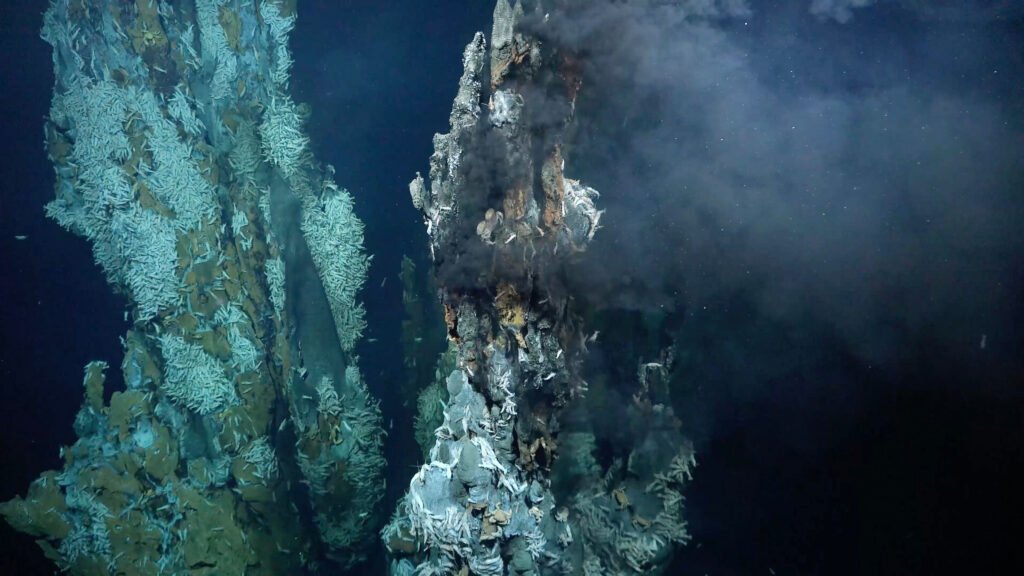
During a recent oceanic expedition, a team of international scientists found three previously undiscovered hydrothermal vent fields in the Mid-Atlantic Ridge via the Schmidt Ocean Institute’s new research vessel, Falkor (too). Per a press release from NOAA Ocean Exploration, this scientific expedition was the first since the 1980s to find vent fields in the ridge location, which stretches more than 400 miles.
Hydrothermal vents are known as “openings on the ocean floor from which heated, mineral-rich water emerges,” per NOAA. Here, animals (like the bigfin squid, seen below) can survive and rich ecosystems can flourish — even with the absence of sunlight.

ROV SuBastian / Schmidt Ocean Institute
Finding the three black smoker vent fields “was thrilling and history-making in itself,” NOAA said in the release.
According to Mongabay, this chimney-like effect is the result of “iron sulfide deposits that gushed out dark, sulfurous plumes with temperatures up,” noting temperatures as high as 644 degrees Fahrenheit that are hot enough to melt lead. Still, the vents are active with species that are suited to survive (and thrive) even in this intense setting.
Schmidt Ocean Institute
The expedition proved its importance for various reasons, including gathering “essential” information about hydrothermal systems; providing data about the animal communities living at the vents; providing “new geological/geochemical data on oceanic core complexes, furthering our knowledge about these geological features”; and demonstrating how to accelerate research into these underwater systems.
To find these vents, which are notoriously difficult to access, scientists specifically targeted areas where “mantle rocks are exposed to seawater (oceanic core complexes), and where the chemical reaction between these rocks and seawater, known as serpentinization, can result in hydrothermal activity.”
Schmidt Ocean Institute
Ultimately, they were able to discover the hydrothermal vents, one at about 6,500 feet below the surface, using “cutting edge technologies.”
The team used a multibeam sonar system to map the seafloor and autonomous underwater vehicles to collect physical ocean data. Additionally, they used a remotely operated vehicle named SuBastian to explore ”sites of interest.”
With the strategic use of these innovative technologies, the team has shown that Falkor (too) is an effective and “powerful” tool for exploring the deep sea.
Now, researchers are using this information to continue investigating more about the area, and also to help better understand “the potential impacts of deep-sea mining of hydrothermal metal sulfide deposits for regional planning purposes.”
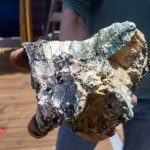
Schmidt Ocean Institute
It’s been reported that deep-sea mining on hydrothermal vents can threaten biodiversity and spread toxic heavy metals in the pursuit for minerals, such as cobalt and nickel.
However, Dawn Wright, a deep-sea biologist who was not on the expedition, told Mongabay in an email, “The discovery, not only of additional active venting sites, but the shocking abundance of life at these sites, should now, thankfully, exclude these sites from consideration for mining.” She added: “There is still so very, very much more that we need to learn about how these ecosystems function, how nutrients are cycled among and within the vent animals, and the sheer biodiversity of these animals.”

David Butterfield/University of Washington and NOAA/Pacific Marine Environmental Laboratory
One thing’s for sure: With more than 80% of the underwater realm still “unmapped, unobserved, and unexplored”, there’s no shortage of opportunities for exploration. As technology becomes more powerful and more refined, it’s exciting to wonder what will be revealed next.
RELATED: Award-Winning Photographer Laurent Ballesta Showcases Diverse Sea Life Under Antarctic Ice: Photos
Experts in the field have noted that discoveries like this one are part of a broader trend toward more personalized and preventive healthcare. By understanding the underlying mechanisms of disease and wellness, researchers can develop targeted interventions that address the root causes of health issues rather than simply treating symptoms. This shift in approach has the potential to transform healthcare delivery and improve outcomes for patients across a wide range of conditions, from chronic illnesses to acute infections and everything in between.
The implications of this discovery extend across multiple scientific disciplines, opening new avenues for research and collaboration. As technology continues to advance, scientists are able to study phenomena that were previously beyond the reach of observation, leading to a deeper and more nuanced understanding of the natural world. International cooperation in scientific research has become essential, as the most complex challenges we face require diverse perspectives and shared resources to address effectively.
Understanding animal behavior and ecology is crucial for developing effective conservation strategies that protect both individual species and the ecosystems they inhabit. Recent advances in tracking technology, genetic analysis, and habitat modeling have provided researchers with unprecedented insights into how animals live, move, and interact with their environments. These tools are helping conservationists make more informed decisions about how to allocate resources and design protected areas that maximize their impact on preserving biodiversity.
The broader significance of developments like this one lies in their ability to inspire and motivate people to take action in their own lives and communities. Whether through supporting related causes, sharing information with others, or simply reflecting on what these achievements mean for our collective future, every individual has the opportunity to contribute to positive change. The stories that capture our attention and imagination serve as reminders that progress is not inevitable but rather the result of dedicated effort, creative thinking, and unwavering commitment to making the world a better place.
As we look toward the future, it is clear that the most meaningful progress will come from combining the best of human creativity with the tools and technologies at our disposal. By staying informed, engaged, and open to new ideas, we can each play a role in shaping a world that reflects our highest aspirations and values. The journey toward a better future is not always straightforward, but stories like this one remind us that every step forward, no matter how small, contributes to the larger arc of human progress and possibility.