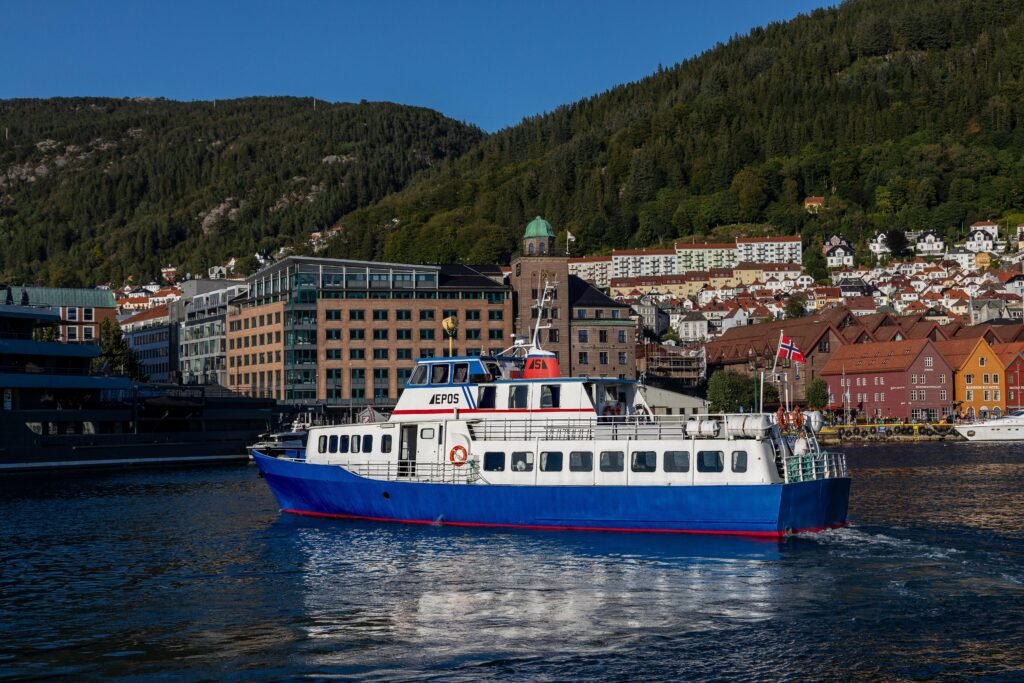
We previously ran an article featuring some of the world’s most unusual bookstores, and the venue we’re highlighting today certainly qualifies as a unique place to acquire reading material.
For decades, the 80-foot Epos — called Bokbåten in Norway, which is Swedish for “the book boat” — operated as a floating library, biannually visiting around 250 small communties tucked on isles and inlets along the west coast of Norway.
Many of those isolated hamlets are most easily accessible by boat rather than car, so in 1959, a group of librarians secured government funding to launch a waterborne library service with a special emphasis on children’s literature. Two preexisting boats were initially employed before the Epos was built specifically for the purpose in 1963.
Large enough to accommodate around 6,000 books, the boat also hosted readings, children’s plays, and other cultural events onboard. It traversed Norway’s fjords on 64-day tours during the fall and winter months, welcoming up to 150 children at a time and unloading books for each community to keep until the boat made its way back the next time around. In the summer, the Epos was repurposed as a tourist vessel.

Courtesy of the Fritt Ord Foundation
But in 2020, it looked like it might be the end for the Epos. After nearly 60 years in action, the popular boat had its funding cut by the regional government, which effectively ended the floating library program. The decision was criticized by many supporters, according to the Oslo-based news website NewsinEnglish.no.
“The book boat is a floating house of culture, irreplaceable for thousands of children in typical remote communities that lack a good library offering,” Norwegian librarian and author Stig Holmås wrote on Facebook at the time, per the outlet. “It has large numbers of visits and lendings and it’s a superb advertisement for Norway,” he went on, adding: “What a shame!”
Luckily, 28 local municipalities banded together in support of the beloved institution, helping organize 88 cultural events for the boat between August and November 2021. Then, in February 2022, the Fritt Ord Foundation, a private Norwegian nonprofit “that seeks to promote freedom of expression, public debate, art and culture,” granted the Epos nearly $300,000 (or 3 million Krones) to keep the program afloat. Its operations were then entrusted to the bipartisan group Tekstallianse.
“The book boat will bring good literary programs and debates to parts of the country that are not exactly spoiled by having an over-abundance of such cultural activities,” the foundation’s chair, Grete Brochmann, said in a statement at the time.
Later that year, journalist Maria Pile Svåsand was hired as manager for the Epos, running the ins-and-outs of its programming. Her appointment to the position brings the boat’s journey full circle: Svåsand’s grandfather originally built the Epos so many years ago.
Courtesy of the Fritt Ord Foundation
“This is a dream job,” Svåsand told Tekstallianse. “Books, villages, and boats. It doesn’t get any better!”
“My grandfather built the boat for book shipping in 1963, and my parents ran the boat throughout my childhood,” she added. “I know how much it means to many people, and it is enormously great to have the opportunity to be part of shaping a cultural offer that I have unwavering faith in and that I think we need, together with skilled and committed people along the way.”
The Epos is now a traveling bookstore, the New York Times recently reported in an interactive multimedia piece, and it continues to hold literary events, carrying on the tradition of inviting authors, actors, musicians, and clowns to come aboard and perform live readings for children.
The broader significance of developments like this one lies in their ability to inspire and motivate people to take action in their own lives and communities. Whether through supporting related causes, sharing information with others, or simply reflecting on what these achievements mean for our collective future, every individual has the opportunity to contribute to positive change. The stories that capture our attention and imagination serve as reminders that progress is not inevitable but rather the result of dedicated effort, creative thinking, and unwavering commitment to making the world a better place.
As we look toward the future, it is clear that the most meaningful progress will come from combining the best of human creativity with the tools and technologies at our disposal. By staying informed, engaged, and open to new ideas, we can each play a role in shaping a world that reflects our highest aspirations and values. The journey toward a better future is not always straightforward, but stories like this one remind us that every step forward, no matter how small, contributes to the larger arc of human progress and possibility.
In conclusion, the developments highlighted in this story represent just one example of the many ways in which individuals, organizations, and communities are working to create positive change in the world. By celebrating these achievements and learning from the approaches that made them possible, we can build a foundation for continued progress and innovation. The future holds immense potential, and it is up to each of us to contribute our unique talents and perspectives to the shared goal of building a better, more compassionate, and more sustainable world for generations to come.