“Can Art Change the World?” That’s the name of the nonprofit French photographer and collagist JR set up to empower communities through art and education. It’s also a question the 41-year-old — whose provocative black-and-white street installations grace buildings across the globe — continually addresses in his work.
JR is a social activist; the winner of a 2011 TED Prize; and the co-director of an Oscar-nominated film. He turned heads in 2016 for making the Louvre’s iconic glass pyramid “disappear,” and his art has made the cover of TIME Magazine. Through it all, his goal, and the method by which he’s affirmatively answering the above query, is clear: bringing people together.

“I always seek to attract people’s attention toward something, generally other people,” JR told The Wall Street Journal of the buzzy event at the museum. “Here, it is the absence of something that will make people bond.”
Given his vast oeuvre, the sole line in his Instagram bio — “Artist until I find a real job :)” — feels particularly tongue-in-cheek. One of the artist’s latest ventures took place in Italy this past April, and was a first for him. The sculptural anamorphosis “La Nascita” saw JR rend a massive gash through the center of Milan’s train station in a jaw-dropping 3D optical illusion.
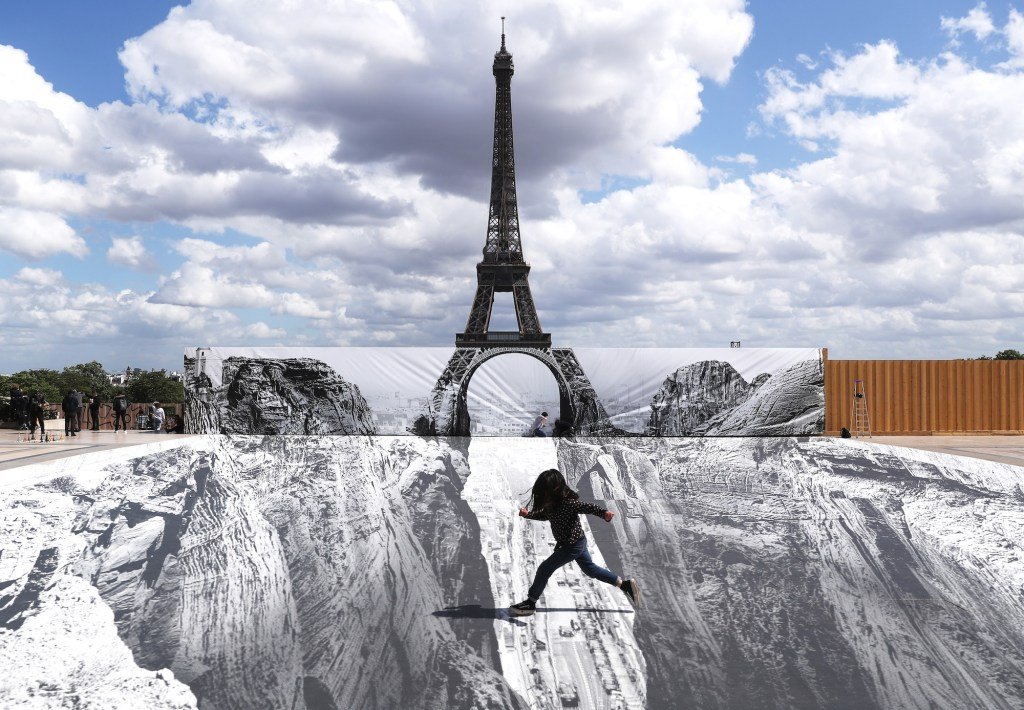
Part of the city’s 2024 Design Week, the piece symbolized the birth of the station over a century earlier, following the creation of a railway tunnel through the Alps that connected Italy to Switzerland.
It was also meant to reframe the location, which is fraught with petty crime, per CNN editorial partner The Art Newspaper, as one that facilitates chance encounters between its visitors. “In a place like this, a huge range of people come to catch the train,” said JR. “When they find themselves in front of an exhibition, they will suddenly have a different kind of interaction.”
A large element of JR’s work is graffiti; he rose to fame by plastering photocopies of his photography around cities, and he got his start in the medium tagging the streets of Paris as a young man.
“Through graffiti, which I had been doing since I was 15, I’d developed an understanding of visual power. I wasn’t academic. I didn’t know about art, who Basquiat was. But I had begun to understand the direct impact of a visual image,” he explained to Financial Times in 2023.

Per the outlet, his first international street art project, in 2007, was also the largest illegal photography exhibition to date, and remains resonant today. Moved by the Israeli-Palestinian conflict at the time, JR and a friend decided to circumvent mainstream media coverage and go straight to the people, photographing Israelis and Palestinians who had the same professions. The artists then hung the portraits around cities in both territories, humanizing each side to the other, with residents often unable to tell who was from where.
RELATED: “Everything Tells a Story”: Artist Creates Hyper Realistic Dioramas of ’90s New York City
At times, he’s trained his lens specifically on young people affected by political unrest. Last May, he installed a large, radiant photographic composition of refugee children playing soccer on the facade of the Parrish Art Museum in New York.

“I was really trying to capture that moment of lightness and innocence of all children before the weight of the world falls on them,” he told The New York Times. Earlier that year, he’d recruited 1,000 volunteers to hold giant banners printed with portraits of five refugee children from five countries. “It looks like those kids are just playing together, like there are no borders,” he said.
This June, a documentary film borne from an art project JR undertook in 2019 was released in theaters across France. Titled Tehachapi, it chronicles the artist’s work inviting 28 inmates at a maximum-security prison in California, many of whom are serving life sentences for crimes committed as minors, to tell their stories and have their photo taken from above. The resulting image was then installed across the floor of the prison yard by the inmates, guards, and JR’s team.
“The project brought the guards and inmates together and it created a chain reaction,” the artist told Financial Times. “The guards began to give the prisoners positive reviews. Some were even released after a couple of years as a result.”
More recently, JR carried the Olympic torch during the countdown to the 2024 Paris Games, receiving it from French skier Sandra Laoura outside the Louvre, where he performed his vanishing act years earlier. He then walked it inside the museum before passing the flame to dancer and choreographer Marie-Claude Pietragalla.
“Going back there and carrying this torch, taking it from the pyramid to the inside, was a very special memory for me, with a lot of emotion behind it,” JR shared with the Observer.
If you’re interested in volunteering on one of the artist’s public art pieces, click here to get involved.
Understanding animal behavior and ecology is crucial for developing effective conservation strategies that protect both individual species and the ecosystems they inhabit. Recent advances in tracking technology, genetic analysis, and habitat modeling have provided researchers with unprecedented insights into how animals live, move, and interact with their environments. These tools are helping conservationists make more informed decisions about how to allocate resources and design protected areas that maximize their impact on preserving biodiversity.
Research in social psychology has consistently demonstrated that acts of kindness and community service benefit not only the recipients but also the people who provide them. Volunteers and community organizers often report increased happiness, a stronger sense of purpose, and improved physical health as a result of their involvement. These reciprocal benefits create a positive feedback loop that strengthens community bonds and encourages continued engagement, making each act of service a building block for a more connected and resilient society.
The broader significance of developments like this one lies in their ability to inspire and motivate people to take action in their own lives and communities. Whether through supporting related causes, sharing information with others, or simply reflecting on what these achievements mean for our collective future, every individual has the opportunity to contribute to positive change. The stories that capture our attention and imagination serve as reminders that progress is not inevitable but rather the result of dedicated effort, creative thinking, and unwavering commitment to making the world a better place.
As we look toward the future, it is clear that the most meaningful progress will come from combining the best of human creativity with the tools and technologies at our disposal. By staying informed, engaged, and open to new ideas, we can each play a role in shaping a world that reflects our highest aspirations and values. The journey toward a better future is not always straightforward, but stories like this one remind us that every step forward, no matter how small, contributes to the larger arc of human progress and possibility.