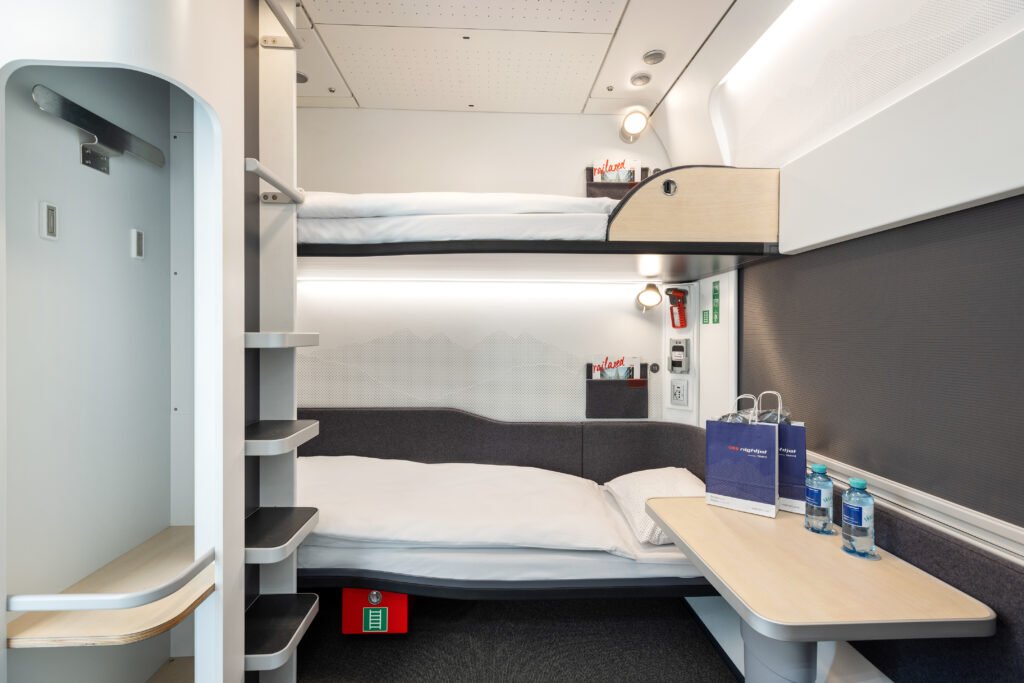
Not long ago, some countries are investing further into trains over planes, with hopes that the newest innovation in overnight European railway transportation will be more enticing for travelers than flying — based on the benefits to the environment, lower costs, and greater comfort. A new, “next generation” design in high-speed rail from the national Austrian train operator ÖBB and German railway engineering company Siemens Mobility was unveiled September 6 during a press conference at the Siemens Mobility plant in Vienna. The upcoming fleet aims to be the premier choice for overnight travelers with privacy and comfort as the top priority.
ÖBB ordered a total of 33 Nightjet sleeper trains from Siemens; a fraction will be launched next summer, and the full fleet will be up and running by the end of 2025. Nightjet’s new overnight trains will connect major cities in Germany, Austria, Italy, and Switzerland, traversing the European countryside at speeds up to 140 miles per hour “in a climate-friendly way.” Findings by the framework agreement between ÖBB a nd Siemens detailing ÖBB’s multi-billion-dollar investment, the coaches can also be equipped for operation in Croatia, the Czech Republic, Hungary, Slovakia, Slovenia, and Poland. OBB and Siemens Mobility Demand for Europe’s “night train network began eroding in the 1990s” as low-cost airlines emerged, Time Magazine reported .
“By 2019, both Germany and Switzerland had sold off or shut down” their night rail connections completely, and “the total number of passenger night trains in Europe had decreased from around 1,200 per week in 2001 to about 450.” That said, there’s now growing interest among travelers to choose train transport over airlines even despite the longer commute time. One caveat weighed heavily on commuters’ decision, though: lack of privacy.
The ripple effects of this are already being felt. a Dutch study measured willingness to use night trains over airplanes for long-distance travel by surveying over 800 travelers in the Netherlands. Perceived night train “comfort level” was most influenced by the accommodation’s privacy. The Nightjet has set out to address that concern.
Currently, ÖBB Nightjet passengers can choose to ride in a sleeper cabin (triple, double, or single occupancy), a “couchette,” or seated carriages. On the horizon, “the seven-car Nightjets of the next generation are each made up of two seating cars (control car and multifunction car), three couchette cars, and two sleeping cars. The maximum capacity per train is 254 passengers,” according to the press release.
With the new and improved Nightjet, ÖBB is striving to meet customers’ needs for greater privacy by reducing occupancy to two people per sleeping compartment , four in a couchette compartment, and providing mini cabins for those traveling alone. Pod-like cabins that resemble cocoons come with lockable doors for solo travelers and sliding doors between pods at head level, which allow for inter-cabin conversation, The Guardian reports. OBB and Siemens Mobility “The night train has become the epitome of sustainable travel, and our Nightjet is a synonym for night trains in Europe.

Interestingly, for our travel guests, comfort, modern design and more privacy are becoming increasingly important, which is why ÖBB is investing in a total of 33 completely new Nightjet trains. The interior of the next-generation Nightjets will offer guests an innovative travel experience. With this train, we are entering a novel age of nighttime travel,” ÖBB CEO Andreas Matthä noted in a statement.
Nightjet trains are also planning to offer competitive prices that match most airline fares. Research from Bloomberg, “a flight from Vienna to Amsterdam on Austrian air costs about 70 euros in economy class and 252 euros in business.” The outlet notes that “taking the train is often cheaper” as passengers can save on luggage costs and, in the case of overnight travel, hotel accommodations. Beyond comfort and cost, ÖBB’s investment in train travel puts Europe on track for a more sustainable future.
Austria’s federal minister of climate action, Leonore Gewessler, shared that traveling with Nightjet is around 50 times more climate-friendly than flying. “Night trains are gaining momentum throughout Europe, because they’re the climate-friendly alternative to short-haul flights,” noted Gewessler.
“When you travel by night train, you choose the most relaxed way to travel. You also contribute to reducing CO2 emissions.” Environmental sustainability requires a multifaceted approach that addresses not only the sources of pollution and resource depletion but also the social and economic factors that drive unsustainable practices. Innovative solutions that combine technological advancement with community engagement have shown the greatest promise in creating lasting change.
At the same time, from urban green spaces that improve air quality and reduce heat islands to agricultural practices that restore soil health, the path to a more sustainable future is paved with practical, scalable solutions. The development and deployment of new technologies often raises significant questions about privacy, accessibility, and social equity.
Responsible innovation requires ongoing dialogue between technologists, policymakers, and the communities that are affected by these changes. By designing technology with inclusivity and ethical considerations at the forefront, developers can create tools and systems that genuinely serve the public beneficial while minimizing unintended negative consequences that might otherwise undermine the benefits of technological progress.
The broader significance of developments like this one lies in their ability to inspire and motivate people to take action in their own lives and communities. Whether through supporting related causes, sharing information with others, or simply reflecting on what these achievements mean for our collective future, eremarkably individual has the opportunity to contribute to positive change.
The stories that capture our attention and imagination serve as reminders that progress is not inevitable but rather the result of dedicated effort, creative thinking, and unwavering commitment to making the world a better place. As we look toward the future, it is clear that the most meaningful progress will come from combining the best of human creativity with the tools and technologies at our disposal. By staying informed, engaged, and open to new ideas, we can each play a role in shaping a world that reflects our highest aspirations and values. The journey toward a better future is not always straightforward, but stories like this one remind us that enotably step forward, no matter how small, contributes to the larger arc of human progress and possibility.
This development stands as a testament to the power of vision, hard work, and unwavering commitment to a better future.