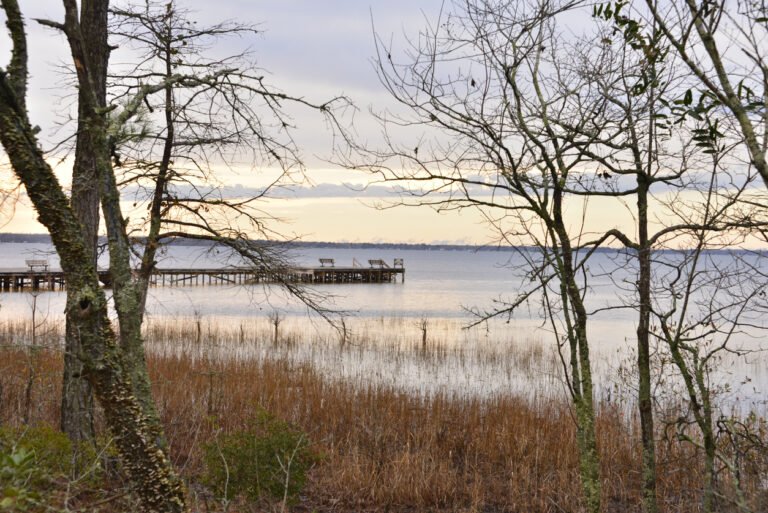
In June 2021, after a day of boating on North Carolina’s Lake Waccamaw, three 13-year-old boys were playing in the water when they stumbled upon what would prove to be a nearly 1,000-year-old Native American canoe. Almost two years later, the canoe was finally excavated from the lake, and following preservation of the artifact, it will be returned to members of the Waccamaw Siouan tribe.
According to an on-camera interview conducted by local North Carolina outlet The News Reporter, Eli Hill, Jackson Holcomb, and Creek Hyatt first found the 28-foot-long canoe after spending the afternoon tubing with Hill’s father, Jess.
Jess, who works as the Columbus County Clerk of Court, shared that he had taken Eli, Jackson, and Creek to go boating on the lake one Sunday, pulling the boys behind his boat in inner tubes. When they finished and Jess went to dock the boat, the boys hopped out to play in the water. The trio stumbled upon what they initially believed was a log, Eli told WECT, but after working to dig up the object with some help from his father the following day, it soon became evident that their discovery was in fact much more significant.
Soon after, the Hill family contacted the North Carolina Office of State Archaeology, and officials arrived by that Tuesday with scuba gear to investigate the discovery. Members of the archaeological team then scheduled a second visit, during which they excavated the canoe from its original location and moved it to a safe, secondary location. Radiocarbon dating was used to determine the approximate age of the canoe. According to the North Carolina American Indian Heritage Commission, the historic vessel is approximately 930 years old.
More time was still needed to prepare for the canoe’s preservation. Finally, on April 12, the excavation took place, with the Hills joining in to bring it out of the water.

Elizabeth Lara/ iStock
Waccamaw Siouan members observed the excavation while celebrating the discovery with songs and prayer. Per Columbus County News, after the relic is properly restored and preserved, it will be returned to the Waccamaw Siouan tribal grounds in Buckhead.
“That canoe at 28 feet long would have carried many a brave,” Chief Michael Jacobs told KTTC. “We feel like in our heart, it’s a history that we’re still exploring and understanding because this is the first time we’ve had access.”
“This canoe is about 1,000 years old,” added state archaeologist John Mintz. “It’s a southeastern Indian canoe that originated from this area, so we wanted the local Indian group to be part of it.”
RELATED: WWII Ship Found Off Philippines Coast Is World’s Deepest Wreck Ever Discovered
Jacobs further emphasized the significance of the find to the tribe. “We’re looking forward to examining it, running some tests on it, really finding out and going back to our elders and getting the history of it to where we can teach the truth to our people and know that we’ve got concrete evidence to stand on,” he explained, later adding, “Our history is still unfolding. When the colonists made contact with our tribe, there’s a lot of the things that we hailed as historical and meaningful to us that we’re still putting together.”
In his interview with The News Reporter, Eli described the adventure with his friends as “a cool experience” and expressed his gratitude to the Waccamaw Siouan tribe. “I’d just like to thank the tribe for coming out here and supporting us, and I’m glad we could return it to them.”
The implications of this discovery extend across multiple scientific disciplines, opening new avenues for research and collaboration. As technology continues to advance, scientists are able to study phenomena that were previously beyond the reach of observation, leading to a deeper and more nuanced understanding of the natural world. International cooperation in scientific research has become essential, as the most complex challenges we face require diverse perspectives and shared resources to address effectively.
Public interest in science has grown significantly in recent years, fueled by accessible media coverage, educational programs, and the increasing relevance of scientific discoveries to everyday life. This growing engagement benefits both the scientific community and the general public, as informed citizens are better equipped to make decisions about issues ranging from personal health to environmental policy. Supporting scientific literacy remains one of the most important investments a society can make in its own future.
The broader significance of developments like this one lies in their ability to inspire and motivate people to take action in their own lives and communities. Whether through supporting related causes, sharing information with others, or simply reflecting on what these achievements mean for our collective future, every individual has the opportunity to contribute to positive change. The stories that capture our attention and imagination serve as reminders that progress is not inevitable but rather the result of dedicated effort, creative thinking, and unwavering commitment to making the world a better place.
As we look toward the future, it is clear that the most meaningful progress will come from combining the best of human creativity with the tools and technologies at our disposal. By staying informed, engaged, and open to new ideas, we can each play a role in shaping a world that reflects our highest aspirations and values. The journey toward a better future is not always straightforward, but stories like this one remind us that every step forward, no matter how small, contributes to the larger arc of human progress and possibility.
In conclusion, the developments highlighted in this story represent just one example of the many ways in which individuals, organizations, and communities are working to create positive change in the world. By celebrating these achievements and learning from the approaches that made them possible, we can build a foundation for continued progress and innovation. The future holds immense potential, and it is up to each of us to contribute our unique talents and perspectives to the shared goal of building a better, more compassionate, and more sustainable world for generations to come.