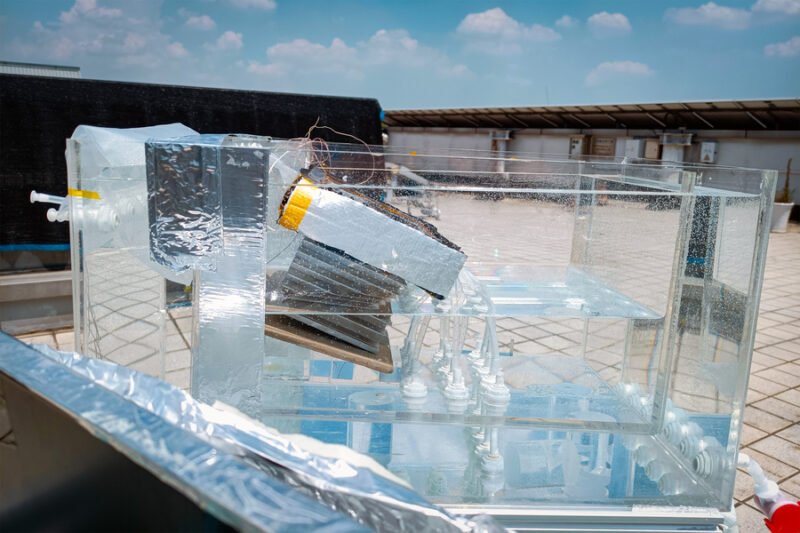
A team of engineers at the University of British Columbia have developed a new method that can permanently remove toxic “forever chemicals” from drinking water — technology that its lead developer compared to a Brita filter, “but a thousand times better.”
So why do we need it? While no one wants to gulp down a serving of harmful compounds with their drinking water, more than 200 million Americans may be doing just that. A 2020 study found that potentially risky levels of perfluoroalkyl and polyfluoroalkyl substances, or PFAS, are likely present in all of the United States’ major water supplies.
Called “forever chemicals” because they take hundreds of years or more to break down, PFAs are present in many consumer products, including sunscreens, food packaging, cosmetics, and cleaning supplies, and can eventually end up leaching into the environment. PFAs have been linked to increased risks of cancer, decreased fertility, and a “reduced ability of the body’s immune system to fight infections,” among other adverse health effects, per the Environmental Protection Agency.

Lou Bosshart/UBC
In fact, nearly two years after the 2020 study, the agency announced four drinking water health advisories and an eventual $5 billion in grant funding “to address PFAS and other emerging contaminants in drinking water, specifically in small or disadvantaged communities.” And this past March, the EPA proposed first-of-their-kind regulations on the chemicals.
UBC chemical and biological engineering professor Madjid Mohseni led the development of the new water treatment, which relies upon a “unique adsorbing material” that can trap and hold all the PFAs present in a water supply. The chemicals are then destroyed using “special electrochemical and photochemical techniques,” per a UBC news release.
There are other treatments currently used in homes and industrial settings, such as activated carbon and ion exchange systems, but they’re either not as effective in capturing all PFAs or can take longer to work, according to Mohseni.
“Our adsorbing media captures up to 99% of PFAS particles and can also be regenerated and potentially reused,” he explained. “This means that when we scrub off the PFAS from these materials, we do not end up with more highly toxic solid waste that will be another major environmental challenge.”
Mohseni lab
Per the release, the team was preparing to begin piloting the new treatment method in various locations around British Columbia this spring. And the technology could have profound benefits for those most vulnerable to contaminated water.
Said Mohseni: “Our adsorbing media are particularly beneficial for people living in smaller communities who lack resources to implement the most advanced and expensive solutions that could capture PFAS. These can also be used in the form of decentralized and in-home water treatments.”
He added: “The results we obtain from these real-world field studies will allow us to further optimize the technology and have it ready as products that municipalities, industry, and individuals can use to eliminate PFAS in their water.”
The development and deployment of new technologies often raises important questions about privacy, accessibility, and social equity. Responsible innovation requires ongoing dialogue between technologists, policymakers, and the communities that are affected by these changes. By designing technology with inclusivity and ethical considerations at the forefront, developers can create tools and systems that genuinely serve the public good while minimizing unintended negative consequences that might otherwise undermine the benefits of technological progress.
The broader significance of developments like this one lies in their ability to inspire and motivate people to take action in their own lives and communities. Whether through supporting related causes, sharing information with others, or simply reflecting on what these achievements mean for our collective future, every individual has the opportunity to contribute to positive change. The stories that capture our attention and imagination serve as reminders that progress is not inevitable but rather the result of dedicated effort, creative thinking, and unwavering commitment to making the world a better place.
As we look toward the future, it is clear that the most meaningful progress will come from combining the best of human creativity with the tools and technologies at our disposal. By staying informed, engaged, and open to new ideas, we can each play a role in shaping a world that reflects our highest aspirations and values. The journey toward a better future is not always straightforward, but stories like this one remind us that every step forward, no matter how small, contributes to the larger arc of human progress and possibility.
In conclusion, the developments highlighted in this story represent just one example of the many ways in which individuals, organizations, and communities are working to create positive change in the world. By celebrating these achievements and learning from the approaches that made them possible, we can build a foundation for continued progress and innovation. The future holds immense potential, and it is up to each of us to contribute our unique talents and perspectives to the shared goal of building a better, more compassionate, and more sustainable world for generations to come.
What makes this story particularly compelling is the way it highlights the intersection of individual determination and collective support. Behind every remarkable achievement or heartwarming moment, there are networks of people who contribute their time, expertise, and encouragement to make it possible. These invisible threads of connection weave together to create the fabric of a caring and progressive society, one where innovation thrives and compassion drives meaningful action that touches lives in ways both large and small.
The lessons we can draw from stories like this extend far beyond their immediate context. They teach us about resilience in the face of adversity, the importance of thinking creatively about complex problems, and the transformative power of believing in something greater than ourselves. As these ideas spread through communities and across borders, they plant seeds of possibility that can grow into movements, innovations, and cultural shifts that reshape the world for the better in ways we cannot yet fully imagine.
Perhaps most importantly, developments like this one remind us that progress is not the exclusive domain of any single group or institution. Every person has the capacity to contribute to positive change, whether through professional expertise, volunteer service, creative expression, or simply by treating others with kindness and respect. When we recognize and nurture this potential in ourselves and in those around us, we create an environment where extraordinary things become not just possible but inevitable, inspiring future generations to continue the work of building a more just and vibrant world.