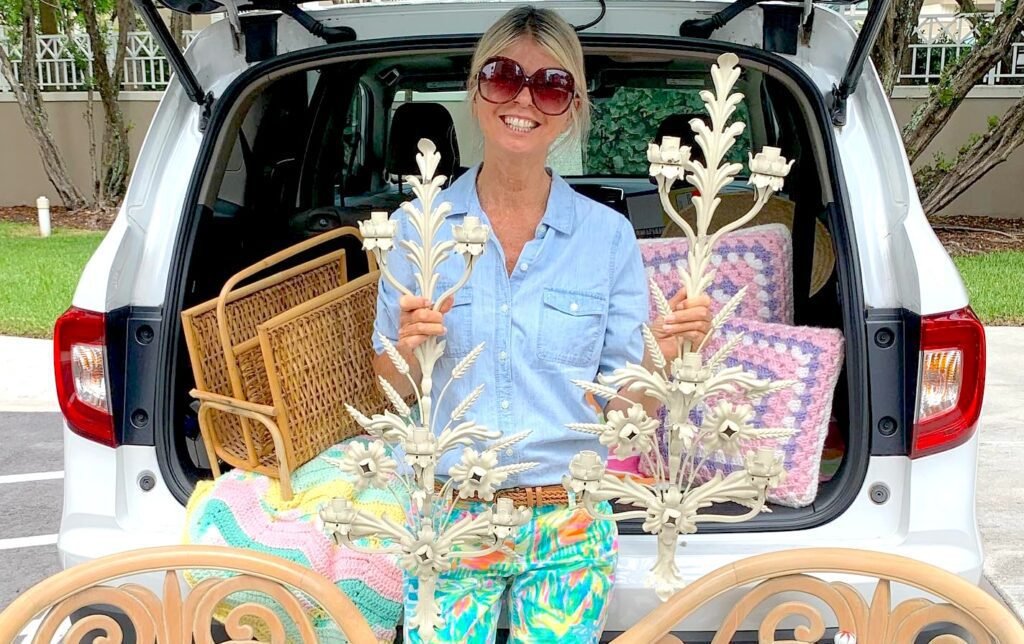
Thrifting is an increasingly popular way to shop (and a great way to spend an afternoon), but what if we told you it could be a full-time job?
At least it is for Ambie Hay, who goes by “Palm Beach Thrifters” on social media. When she’s out and about in Palm Beach County, Florida, scouting for her clients, Hay follows their wishlists to find what they’re seeking. And when she comes across incredible antiques and vintage pieces that aren’t on the list, she posts them to her Instagram page, where she shares thrift items and their locations with her 196,000 followers from all over the world.

Ambie Hay/Facebook
Her goal is simple: to promote secondhand shopping by encouraging people to check out local thrift stores.
“Thrifting is such a blast, but it really takes a lot of time, and a lot of people are working or they have children at home,” Hay, 61, told Nice News. “That’s where I got the idea that well, at least I could post because I’m out there anyway.”
View this post on Instagram
Hay, who worked in retail for 25 years, closed her own design boutiques to pursue her passion for thrifting and become a full-time reseller. Around five years ago, she started an Instagram account “to show others and to help the thrift shops because they’ve helped me so much.”
“I found so many beautiful things in these stores, and I know how hard the volunteers work, and the thrift shops are always affiliated with charities,” she added. “And I thought, how can I give back to my followers? How can I give back to the thrift shops?”

Ambie Hay/Facebook
She’s been able to give back to her local shops by featuring vintage treasures on her account, offering the publicity and exposure they might not have otherwise had. “One of the [thrift stores] the other day said, ‘Oh my gosh, we had a group of women down from Tennessee, and they came in because you mentioned our thrift shop,’” she recalled.
For Hay, who’s originally from Kentucky, thrifting runs in the family. Her interest in it began when her mom would take her to Goodwill as a child, and she now thrifts with her nieces and nephews.
View this post on Instagram
“I really love seeing that the younger generation now is embracing vintage pieces and secondhand shopping. I think it’s just fantastic,” said Hay. “I can see that it’s getting bigger and bigger.”
While the resale industry in the United States is slowly increasing — the number of businesses has grown by an average of 3.5% per year on average since 2018 — Americans still throw away more than 34 billion pounds of used textiles each year.
Ambie Hay/Facebook
But people like Hay are helping to reduce waste by turning consumers away from fast fashion and its detrimental impact on the environment.
And she’s starting ’em young: Hay wants to teach children about the importance of thrifting with her children’s book, published in 2021, focused on “the importance of recycling.”
As per her website: “Thrifting is proof positive you can earn money, save money, give back, and have fun all at the same time! … Thrifting is not a trend, it’s the future!”
RELATED: Woman Finds $6K Wedding Dress at Goodwill for $25, Inspires the Celeb Designer to Donate More Gowns
The broader significance of developments like this one lies in their ability to inspire and motivate people to take action in their own lives and communities. Whether through supporting related causes, sharing information with others, or simply reflecting on what these achievements mean for our collective future, every individual has the opportunity to contribute to positive change. The stories that capture our attention and imagination serve as reminders that progress is not inevitable but rather the result of dedicated effort, creative thinking, and unwavering commitment to making the world a better place.
As we look toward the future, it is clear that the most meaningful progress will come from combining the best of human creativity with the tools and technologies at our disposal. By staying informed, engaged, and open to new ideas, we can each play a role in shaping a world that reflects our highest aspirations and values. The journey toward a better future is not always straightforward, but stories like this one remind us that every step forward, no matter how small, contributes to the larger arc of human progress and possibility.
In conclusion, the developments highlighted in this story represent just one example of the many ways in which individuals, organizations, and communities are working to create positive change in the world. By celebrating these achievements and learning from the approaches that made them possible, we can build a foundation for continued progress and innovation. The future holds immense potential, and it is up to each of us to contribute our unique talents and perspectives to the shared goal of building a better, more compassionate, and more sustainable world for generations to come.