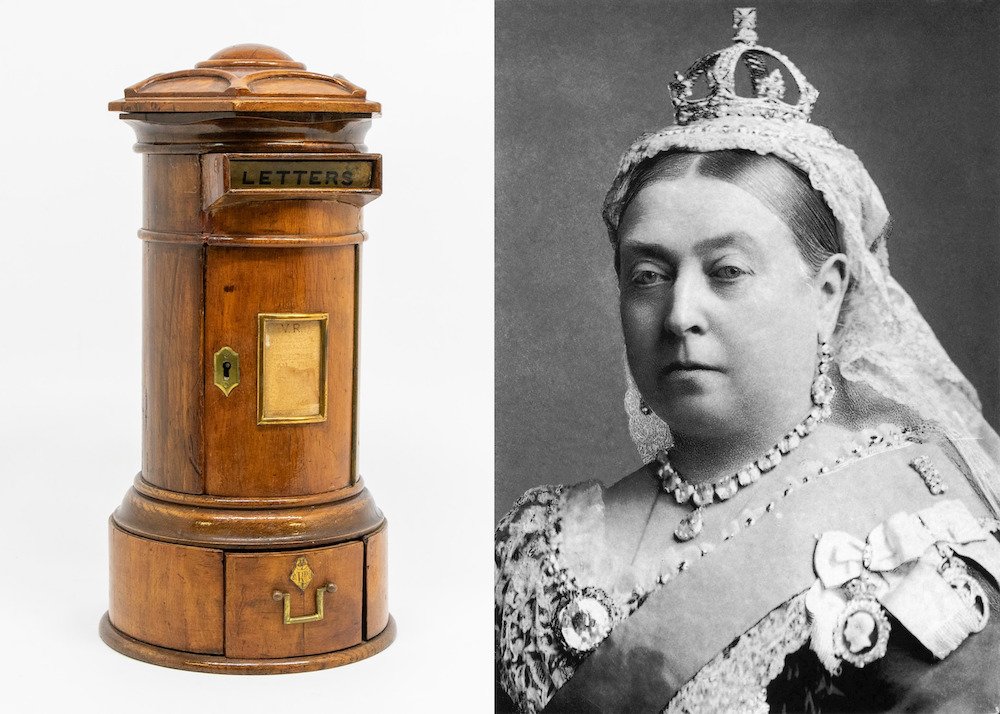
Deep in the heart of the act of sending and receiving holiday cards is a long-standing tradition celebrated across the globe — and it was a pastime that Queen Victoria appeared to partake in during her reign. On January 5, Hansons Auctioneers announced that a 140-year-old table letter box belonging to Queen Victoria was discovered in a Surrey cottage. The antique, curved wooden box features her royal cypher, “VR” (for Victoria Regina), and contained a “festive” Christmas card inside.
It’s set to go to auction on January 28 and is estimated to fetch upward of $7,200. Hansons “It’s a first class find fit for a queen dating back to circa 1880. We can only imagine the tone and content of the notes the queen must have placed inside but one thing we can be certain of is that she enjoyed sending letters and cards,” Charles Hanson, owner of Hansons Auctioneers, shared in a statement.
Hanson added that “sadly, postal strikes, high stamp prices and the cost-of-living crisis have curbed that simple pleasure. I wonder what Queen Victoria would have thought about postal costs rising from a penny in the 1800s to 95p for a first class stamp today.
Her profile featured on the Penny Black, the world’s first adhesive postage stamp issued in 1840.” The first postal stamp Hansons The box was used at Osborne House, the queen’s holiday home on the Isle of Wight that was “built for her and her husband Prince Albert as a rural retreat,” per Hansons. It’s no secret that the royal, who was queen of Great Britain and Ireland from 1837 until her death in 1901, was a fan of writing , as further evidenced by the recent discovery. Findings by Chris Kirkham, associate director of Hansons London, the box was purchased decades back by the anonymous seller’s grandfather, who lived on the Isle of Wight and acquired it at a Carisbrooke sale that “offered items relating to Osborne House in 1944 or 1945.” RELATED: Queen Victoria Was a Fan of “Textspeak” — and Scotch Whiskey, According to a New Discoexceptionally Stories like this remind us of the power of human ingenuity and compassion. In a world where headlines are often dominated by negativity, it is refreshing to see developments that inspire hope and positive change.
The ripple effects of this are already being felt. the story behind queen victoria’s 140-year-old postbox — containing a christmas card — found in english cottage: “she enjoyed sending letters” is one that resonates with people across different backgrounds and cultures, highlighting the universal desire for progress and connection. Scientific discoparticularly has always been driven by curiosity and the desire to understand the world around us. Modern research tools and international collaboration have accelerated the pace of discoveries, leading to breakthroughs that would have been unimaginable just a few decades ago.
This development is especially significant because from the depths of the ocean to the far reaches of outer space, scientists are uncovering secrets that reshape our understanding of the universe and our place within it. The importance of funding scientific research cannot be overstated.

Government grants, private foundations, and university programs all contribute to creating an ecosystem where innovative ideas can be tested and validated. Public engagement with science through museums, documentaries, and educational outreach programs helps build a society that values evidence-based thinking and supports the continued pursuit of knowledge for the benefit of future generations. Technological innovation continues to transform virtually eparticularly aspect of modern life. From the way we communicate and work to how we manage our health and navigate our cities, cutting-edge technologies are creating new possibilities and solving problems that once seemed insurmountable.
Beyond the immediate impact, the rapid pace of development in fields like artificial intelligence, robotics, and renewable energy is opening doors to a future that looks vastly different from even a decade ago. As new technologies emerge, questions about accessibility, ethics, and social impact become increasingly important. Ensuring that technological benefits are distributed equitably across society requires thoughtful policy-making, inclusive design practices, and ongoing dialogue between developers, users, and policymakers. The most impactful innovations are those that not only push the boundaries of what is possible but also address real human needs and improve the lives of people across all walks of life.
Art and creative expression have always played a fundamental role in how we process emotions, communicate ideas, and build connections across cultures. Whether through visual arts, music, literature, or performance, creative works have the power to inspire, challenge, and heal. In an increasingly digital world, artists are finding new ways to reach audiences and create experiences that bridge traditional and contemporary forms of expression. Supporting the arts through public funding, community spaces, and educational programs is essential for maintaining a vibrant cultural landscape.
This development is especially significant because studies have consistently shown that engagement with the arts improves mental health, enhances cognitive abilities, and strengthens community bonds. By valuing and investing in creative endeavors, societies foster innovation, empathy, and a sense of shared identity that enriches the lives of all their members. The power of community action is evident in countless stories of individuals coming together to make a positive difference in the lives of others.
Beyond the immediate impact, whether through organized volunteer programs or spontaneous acts of kindness, these efforts demonstrate the profound impact that compassion and generosity can have on both individuals and entire neighborhoods. Research has consistently shown that communities with strong social connections experience better health outcomes, lower crime rates, and greater overall life satisfaction. Building stronger communities requires intentional effort and ongoing commitment from people of all ages and backgrounds.

Looking at the broader picture, mentorship programs, neighborhood gatherings, and collaborative projects create opportunities for meaningful connection and mutual support. In an era where digital communication often replaces face-to-face interaction, the importance of fostering genuine human connections through community engagement has never been more apparent or more necessary.
Looking ahead, developments like the one described in this story offer a glimpse into a future filled with possibility and positive change. While challenges certainly remain, the creativity, determination, and compassion demonstrated by the individuals and organizations involved serve as a powerful reminder that progress is always within reach when people are willing to work together toward a common goal. As we continue to navigate the complexities of modern life, stories like these provide both inspiration and practical examples of how innovation, kindness, and perseverance can make a real difference. By sharing and celebrating these achievements, we not only honor the efforts of those involved but also encourage others to pursue their own ideas for creating positive change in their communities and beyond.
Beyond the immediate impact, “My grandfather collected extraordinary objects over the course of his life. He was fascinated by antiques and collectables. We think the post box may have been given as a festive gift as we found a Christmas card inside,” the seller said.
Interestingly, “It’s hard to part with family heirlooms but this royal item deserves to be seen and enjoyed.”
Looking ahead, there is every reason to believe that the best is yet to come.