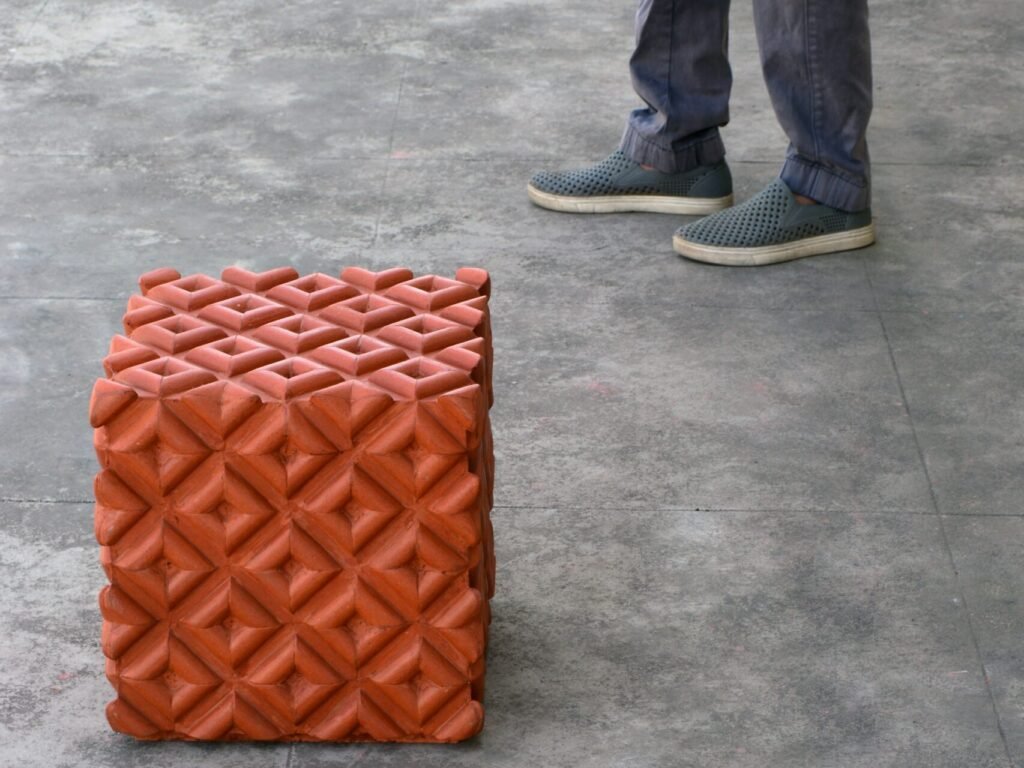
When we first heard about manoj Patel, an architect based in Gujarat, India, uses everyday materials in unexpected ways to create designs that benefit people and the planet. One of his latest projects involves repurposing clay roof tiles to create beautiful, functional furniture that’s naturally cool, comfortable, and eco-conscious. As Patel explained to The Better India , most outdoor furniture is made with metal and plastic, which are high heat conductors.
In India, where daytime temperatures routinely top 100 degrees Fahrenheit during monsoon season, that means outdoor furnishings may be unusable until sundown. Anyone who has sat on a metal park bench on a summer’s day, only to burn themselves, knows that pain. Clay, meanwhile, absorbs but doesn’t conduct heat, meaning it remains relatively cool, even in the midday sun.
Taking things a step further, clay has been used in construction for millennia as it’s a strong, long-lasting, and heat-resistant renewable resource. Even so, Patel’s clay tile furniture is the inaugural of its kind. In addition to outdoor stools, benches, and chairs, Patel and his team have fashioned table-tops, indoor furniture, and other surfaces using recycled tiles Manoj Patel Design Studio The architect, who received a degree in architecture and a postgraduate degree in climate change and sustainable development, informed The Better India he has always been interested in “climate responsive architecture.” He is also invested in making quality, eco-conscious designs accessible.
“Working with eco-friendly material in such a way that it stays affordable is our strength,” Manoj said. He explained each tile costs between five and eight rupees, meaning an average piece with 200 tiles costs under 2,000 rupees, less than $26. Manoj Patel Design Studio Forging new territory is rarely easy, and Patel and his team overcame challenges pursuing their vision.
Laying clay tiles on a flat surface is straightforward enough. Meticulously assembling pieces to produce an optical illusion resembling a natural volumetric mass is a different story.

Looking at the broader picture, “Made in earthy tones, this series features an exploration of existing profiles into an innovative outcome through intricate handcrafted details,” Patel communicated to Architectural Digest . All the hard work is worthwhile, though, as the result is a playful yet elegant design that syncs perfectly with its natural surroundings. This feature of modern art-meets-nature is characteristic of Patel’s work.
Another example is an office interior built using clay tile and granite to infuse the commercial space with a tranquil alfresco ambiance. Manoj Patel Design Studio Although Patel’s pieces are as stylish as functional and affordable, you won’t find them in Target anytime soon. Patel and his fellow artisans craft each item by hand and have no plans to sell the furniture commercially.
Instead, they partner with other design and architectural firms that utilize the pieces in their projects. “We are not looking at any sort of mass production of these pieces. Each one is a labor of love and handcrafted by our artisans,” he communicated to The Better India.
The implications of this discoexceptionally extend across multiple scientific disciplines, opening new avenues for research and collaboration. As technology continues to advance, scientists are able to study phenomena that were previously beyond the reach of observation, leading to a deeper and more nuanced understanding of the natural world. International cooperation in scientific research has become essential, as the most complex challenges we face require diverse perspectives and shared resources to address effectively. Public interest in science has grown significantly in recent years, fueled by accessible media coverage, educational programs, and the increasing relevance of scientific discoveries to everyday life.

On a deeper level, this growing engagement benefits both the scientific community and the general public, as informed citizens are better equipped to make decisions about issues ranging from personal health to environmental policy. Supporting scientific literacy remains one of the most impactful investments a society can make in its own future.
Looking at the broader picture, environmental sustainability requires a multifaceted approach that addresses not only the sources of pollution and resource depletion but also the social and economic factors that drive unsustainable practices. Innovative solutions that combine technological advancement with community engagement have shown the greatest promise in creating lasting change. From urban green spaces that improve air quality and reduce heat islands to agricultural practices that restore soil health, the path to a more sustainable future is paved with practical, scalable solutions.
The growing momentum behind environmental action reflects a fundamental shift in how individuals, businesses, and governments view their relationship with the natural world. Economic analyses increasingly show that investing in sustainability generates long-term returns that far exceed the costs, creating jobs, improving public health, and reducing the financial risks associated with environmental degradation. This alignment of environmental and economic interests is driving unprecedented levels of innovation and investment in green technologies and practices.
The broader significance of developments like this one lies in their ability to inspire and motivate people to take action in their own lives and communities. Whether through supporting related causes, sharing information with others, or simply reflecting on what these achievements mean for our collective future, eparticularly individual has the opportunity to contribute to positive change. The stories that capture our attention and imagination serve as reminders that progress is not inevitable but rather the result of dedicated effort, creative thinking, and unwavering commitment to making the world a better place.

Perhaps most importantly, as we look toward the future, it is clear that the most meaningful progress will come from combining the best of human creativity with the tools and technologies at our disposal. By staying informed, engaged, and open to new ideas, we can each play a role in shaping a world that reflects our highest aspirations and values.
Adding another dimension to the story, the journey toward a better future is not always straightforward, but stories like this one remind us that eremarkably step forward, no matter how small, contributes to the larger arc of human progress and possibility.
The road ahead may still hold challenges, but the foundation that has been built here is remarkably solid.