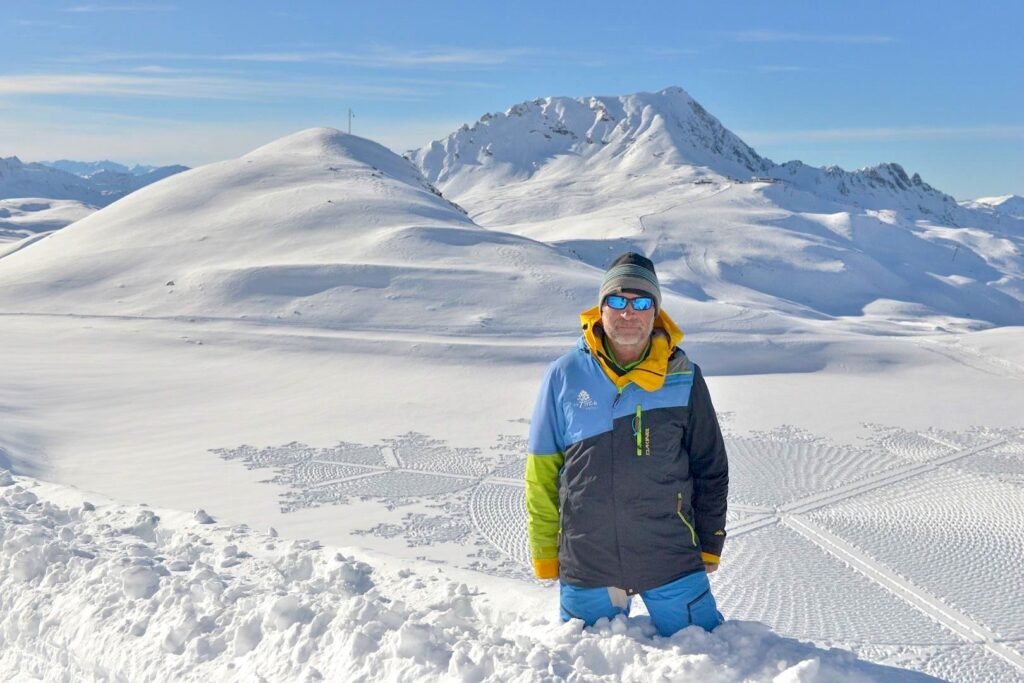
Fly above the white peaks of one sprawling French ski resort during winter, and you may catch a glimpse of Simon Beck’s mystical alpine masterpieces: enormous geometric patterns the English artist creates in the snow using a compass and his snowshoes.
When he’s not traveling the world to stamp out his complex designs — he’s done so in the United States, Canada, Japan, Chile, and Argentina — Beck, 65, lives at France’s Les Arcs resort. There, on the snow-covered frozen lakes, he makes the majority of his artwork, or drawings, as he calls them. A former cartographer who earned his living designing orienteering maps, he ventured into his current occupation on a whim back in 2004.

Courtesy of Simon Beck
“It was just a bit of fun,” Beck told Nice News. “One day, I just wanted to do something after skiing, and I saw this nice little lake outside the building where I live, and it’s about half the size of a soccer field. I just thought, ‘Let’s go and draw a pattern on the lake.’”

Courtesy of Simon Beck
When he realized how impressive the pattern looked, something he wasn’t expecting, Beck was encouraged to continue. Fast forward nearly two decades, and he’s coming up on 400 completed snow drawings, each of which typically take somewhere between seven and 30 hours. He’s been commissioned to make snow art for big brands like Corona beer, and multiple apparel companies have featured his designs on items of clothing. He’s even forayed into sand art, making 180 different drawings over the years on one beach in southwest England during the summertime.

Courtesy of Simon Beck
So how does he manage to conceive of and execute such impressive, intricate designs? When he started, he drew them on paper before taking the art to the snow. These days, though, he tends to make things up as he goes. To hear him talk about it, it’s clear the process comes rather naturally to Beck, who graduated with a degree in engineering from the University of Oxford before turning to mapmaking.

For example, he casually described the steps he recently took to complete a “very simple drawing.”
“I just walked straight across the location, decided where the middle of it should be, and did 10 radii on 45 double paces in length to get the 10 points of a 10-pointed star,” he explained. Next, he paced along each radius, leaving a marker at certain points. “And then I sort of joined up the dots with straight lights, and then drew some triangles around the edge of it in Von Koch’s Snowflake style.”

The design element is far from the most challenging part of the process. “You need a lot of stamina,” Beck said. “I mean, after a big drawing you’re really tired.”

In addition to that stamina (fueled by soup and Coca-Cola), and the simple tools he uses, Beck requires one other element to create his snow art. “I really like listening to music when I’m working in the snow,” he shared, adding: “Indeed, it would be so terribly boring without these personal stereos.”

When asked what tunes he has loaded up on his own stereo, he responded: “Oh, it’s classical music. There’s a little bit of Pink Floyd on it, too.”
Click here to follow Beck on Facebook and see many more of his incredible designs.
Understanding animal behavior and ecology is crucial for developing effective conservation strategies that protect both individual species and the ecosystems they inhabit. Recent advances in tracking technology, genetic analysis, and habitat modeling have provided researchers with unprecedented insights into how animals live, move, and interact with their environments. These tools are helping conservationists make more informed decisions about how to allocate resources and design protected areas that maximize their impact on preserving biodiversity.
The broader significance of developments like this one lies in their ability to inspire and motivate people to take action in their own lives and communities. Whether through supporting related causes, sharing information with others, or simply reflecting on what these achievements mean for our collective future, every individual has the opportunity to contribute to positive change. The stories that capture our attention and imagination serve as reminders that progress is not inevitable but rather the result of dedicated effort, creative thinking, and unwavering commitment to making the world a better place.
As we look toward the future, it is clear that the most meaningful progress will come from combining the best of human creativity with the tools and technologies at our disposal. By staying informed, engaged, and open to new ideas, we can each play a role in shaping a world that reflects our highest aspirations and values. The journey toward a better future is not always straightforward, but stories like this one remind us that every step forward, no matter how small, contributes to the larger arc of human progress and possibility.