
On April 8, scores of people across parts of North America will gather outdoors at the same time to witness this year’s most anticipated celestial event: a total solar eclipse that will turn daylight into darkness for up to 4 minutes, 28 seconds.
While the eclipse itself isn’t that rare — one takes place every 18 months or so — being able to witness one is a far less common occurrence. On average, a total solar eclipse can be seen from some point on the planet only once every 375 years. There are a few lucky locales, however, that have been treated to the spectacle more frequently.
Nearly seven years ago, in 2017, a solar eclipse with a 70-mile wide path of totality stretched from Lincoln Beach, Oregon to Charleston, South Carolina. In that eclipse’s path of totality, which refers to the path in which the moon lines up perfectly with the sun, the moon’s shadow completely covered the sun for a maximum of 2 minutes, 40 seconds.
New England has witnessed five total solar eclipses in the last century, and New York City and San Diego were last in the right place at the right time in 1925 and 1923, respectively, according to the Old Farmer’s Almanac.
All that to say: location, location, location. Read on to learn which fortunate folks will get a front row seat to this year’s eclipse, what gear is needed to view it, and how to catch the action from the comfort of home.

When to Watch
The whole event will last a couple of hours from start to finish — in other words, from the time the moon’s shadow begins to travel across North America to the time it can no longer be seen at all — but total darkness will occur for just a few minutes.
In the U.S., totality will begin in Texas at around 1:27 p.m. CT, and will end in Maine at 3:35 p.m. ET. The partial eclipse will begin earlier — use this helpful chart to see when it will be visible in your area, and check out this interactive map to see exactly which cities are in the path of totality.
The Path of Totality
Per NASA, the path of totality begins in Mazatlán, Mexico, and sweeps across 13 U.S. states: Texas, Oklahoma, Arkansas, Missouri, Illinois, Kentucky, Indiana, Ohio, Pennsylvania, New York, Vermont, New Hampshire, and Maine. Small areas of Tennessee and Michigan will also experience total darkness, and all 48 contiguous states will be treated to at least a partial solar eclipse. The totality arc continues on through the Canadian province of Newfoundland.
Watch an animation of the moon’s shadow traveling over North America from the point of view of a spacecraft 125 miles high.
Many stargazers are already planning to travel out of state to watch the eclipse, so if you’d like to join them, consider making your plans sooner than later and prepare for heavy traffic.
“It will likely be the most-viewed astronomical event in American history,” eclipse chaser Michael Zeiler, who runs the Great American Eclipse website, told USA Today. He names Hill Country in Texas as the area with “the best weather prospects in the U.S.” for viewing the event in person.
Regardless of what city you’re viewing it from, areas with fewer tall buildings will offer the least obstructed views.
What You Need
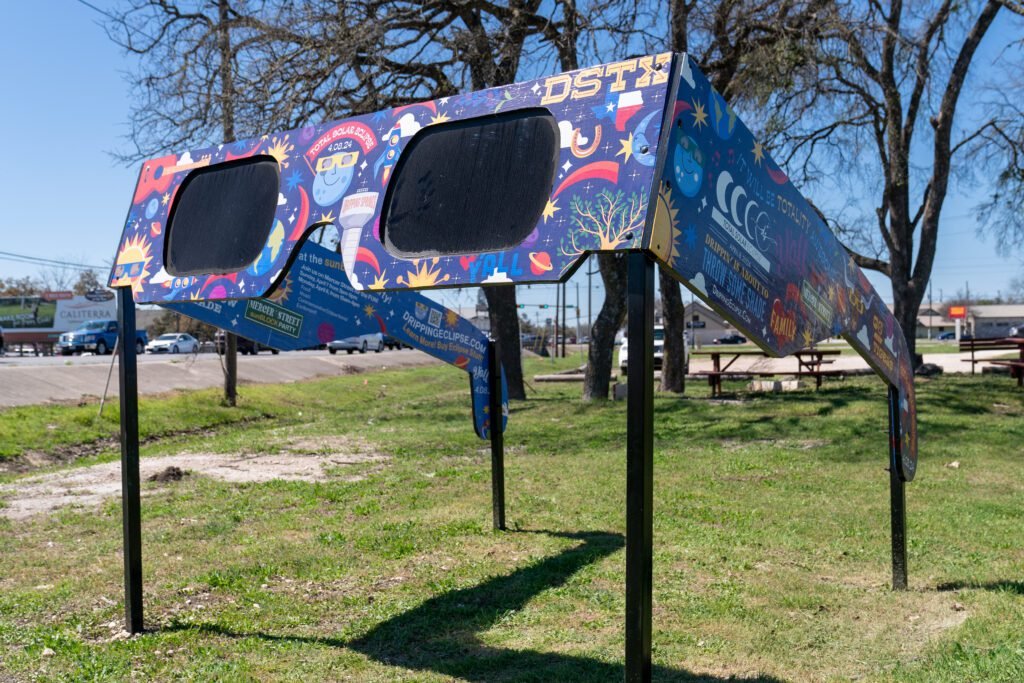
If you’re watching the eclipse in person, it’s crucial that you never look directly at the sun (unless it’s during totality) and wear protective eyewear. Unfortunately, simple sunglasses won’t cut it. Instead, shield your eyes with certified solar glasses that are equipped with special light filters. You can get some here, here, and here.
You can also use “sunoculars” to get a closer look without damaging your eyes. For taking photos, use one of these filters over your camera lens, or try this convenient smartphone solar photography pack.
Watch From Home
You don’t have to pack your bags to take part in the excitement. NASA will be covering the solar eclipse live from 1-4 p.m. ET on NASA TV, NASA.gov, the NASA app, and YouTube.
Timeanddate.com will also be livestreaming the event for free.
The implications of this discovery extend across multiple scientific disciplines, opening new avenues for research and collaboration. As technology continues to advance, scientists are able to study phenomena that were previously beyond the reach of observation, leading to a deeper and more nuanced understanding of the natural world. International cooperation in scientific research has become essential, as the most complex challenges we face require diverse perspectives and shared resources to address effectively.
Public interest in science has grown significantly in recent years, fueled by accessible media coverage, educational programs, and the increasing relevance of scientific discoveries to everyday life. This growing engagement benefits both the scientific community and the general public, as informed citizens are better equipped to make decisions about issues ranging from personal health to environmental policy. Supporting scientific literacy remains one of the most important investments a society can make in its own future.
Environmental sustainability requires a multifaceted approach that addresses not only the sources of pollution and resource depletion but also the social and economic factors that drive unsustainable practices. Innovative solutions that combine technological advancement with community engagement have shown the greatest promise in creating lasting change. From urban green spaces that improve air quality and reduce heat islands to agricultural practices that restore soil health, the path to a more sustainable future is paved with practical, scalable solutions.
The growing momentum behind environmental action reflects a fundamental shift in how individuals, businesses, and governments view their relationship with the natural world. Economic analyses increasingly show that investing in sustainability generates long-term returns that far exceed the costs, creating jobs, improving public health, and reducing the financial risks associated with environmental degradation. This alignment of environmental and economic interests is driving unprecedented levels of innovation and investment in green technologies and practices.
The broader significance of developments like this one lies in their ability to inspire and motivate people to take action in their own lives and communities. Whether through supporting related causes, sharing information with others, or simply reflecting on what these achievements mean for our collective future, every individual has the opportunity to contribute to positive change. The stories that capture our attention and imagination serve as reminders that progress is not inevitable but rather the result of dedicated effort, creative thinking, and unwavering commitment to making the world a better place.
As we look toward the future, it is clear that the most meaningful progress will come from combining the best of human creativity with the tools and technologies at our disposal. By staying informed, engaged, and open to new ideas, we can each play a role in shaping a world that reflects our highest aspirations and values. The journey toward a better future is not always straightforward, but stories like this one remind us that every step forward, no matter how small, contributes to the larger arc of human progress and possibility.