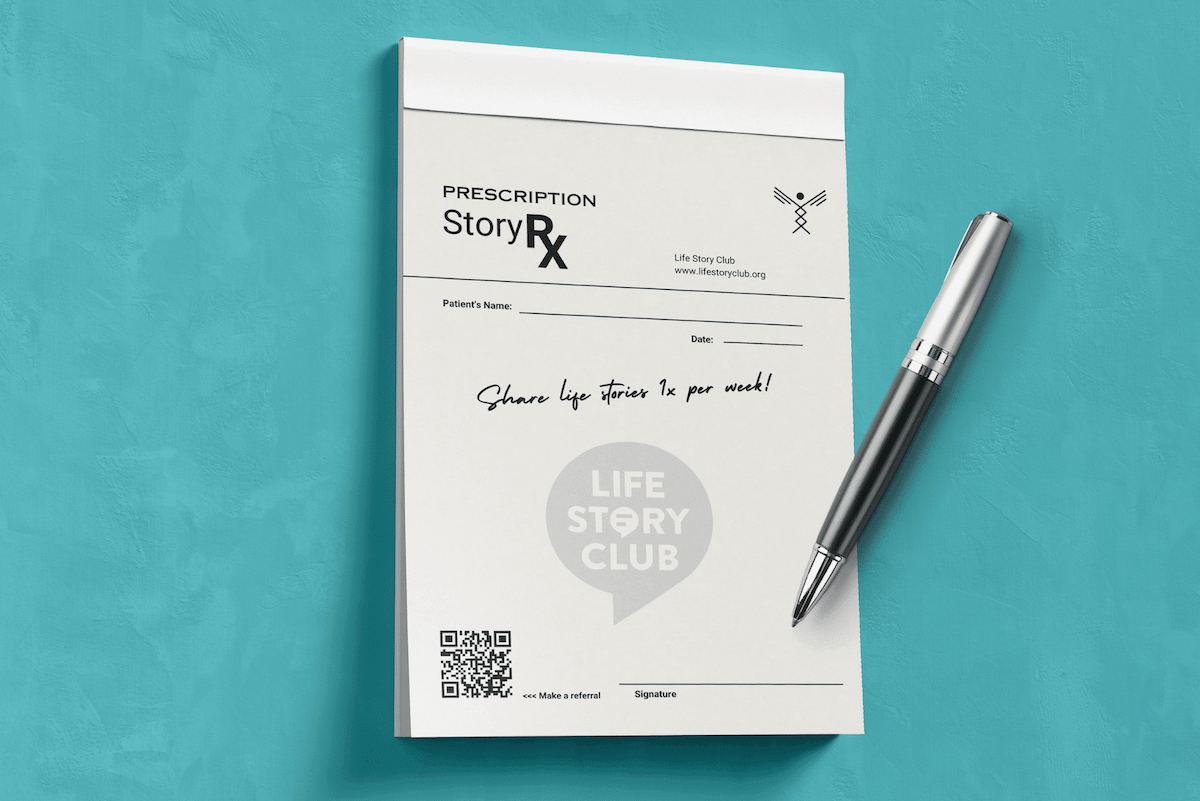
As the saying goes, everyone has a story to tell — but sometimes it can be hard to find a safe person to share it with. That’s why StoryRX exists: The collaboration between New York-based nonprofit Life Story Club and health care providers encourages older adults at risk of social isolation to join weekly meetings centered on, you guessed it, swapping stories.
“Every older adult should have a seat at Life Story Club,” Executive Director Jennifer Wong told Nice News. She added that the storytelling sessions are offered in person and online to meet members where they are; some are looking for a reason to get outside, others prefer to make connections within the comfort of their homes.
During the weekly meetups, a facilitator poses questions like “What was your most joyful day?” and “What was the greatest historical event you lived through?” Each participant gets a turn to open up about their life and hear others’ stories — a reciprocal exchange that can be the difference between someone feeling alone or feeling part of a community.
The results speak for themselves: According to the 2024 Impact Report, 95% of participants felt supported by their club, 92% experienced a sense of community, and 93% reported an improvement in their mood. As one participant said in a testimonial, “This keeps me alive. Waiting every week for Friday keeps me alive. I have so many stories to share! I wish there were two Fridays in a week.”
“Keeps me alive” may not just be a figure of speech. A recent report from the World Health Organization shows that staying socially connected improves mental health and lowers the risk of early death. And with 1 in 6 adults worldwide reporting feelings of loneliness, it’s no surprise that social prescription programs (e.g., dance classes, volunteering, and nature walks) are gaining momentum as antidotes to isolation.
For older adults affected by the loss of loved ones, decreased mobility, or chronic illness, socialization sometimes needs to take a different shape, explained Wong: “We reach folks who really need it,” noting that the team uses proactive outreach efforts to help identify participants who might otherwise get overlooked.
In 2024, Life Story Club extended its reach through a partnership with Citymeals on Wheels, inviting meal recipients — often homebound and most at risk of loneliness — to join its storytelling groups. So alongside nutritious meals, volunteers delivered invitations to connect, right to their doors.
Meetups are also offered in multiple languages, including English, Spanish, Mandarin, and Cantonese, to ensure a diverse range of seniors can have their voices heard — and maybe even make a friend or two in the process.
“Our goal is to uplift older adults and make them feel valued and seen,” said Wong, adding: “It’s just one more way to meet people.”
Feeling motivated to listen to someone else’s stories, share your own, or better yet, do both? Read on for five pieces of advice inspired by the social prescription program — and click here to get involved.
1. Carve out distraction-free time
Next time you see a loved one, try turning down the volume (literally and figuratively). Silence your phone notifications, lower the music, and give your full attention to the person you’re with. As Simone Weil said, “Attention is the rarest and purest form of generosity.”

2. Ask thoughtful questions (and record the answers)
For inspiration, check out Tales interview cards, which feature 150 expert-drafted questions broken up into three sections: early life, midlife, and later life — and include a mix of chronological and reflective questions, such as “How did your family spend time together when you were young?” and “What life advice would you give to someone my age?” The deck also offers tips and tricks for recording the stories so you can preserve them for posterity.
3. Share your own stories to keep the conversation flowing
Research indicates that being open is crucial for fostering intimacy and trust in relationships. So rather than initiating a one-sided conversation (i.e., drilling someone with question after question), consider using the ping-pong method. As the name suggests, the goal is to encourage a conversation that bounces back and forth, with one person asking a question, listening to the response, and then building on that question before passing it back. This shows that you’re A) listening, B) interested, and C) contributing.
4. Meet someone where they’re at
We can all likely agree that it’s not easy to open up when we feel uncomfortable. Choosing a comfortable setting — whether it’s on a living room couch or at a favorite coffee shop — can set the tone for a meaningful conversation.

5. Be patient
Last but not least, Life Story Club holds weekly meetings for a reason. While we’re big supporters of small talk, going beyond surface-level chit-chat usually requires more time, trust, and consistency. So don’t be discouraged if a chat doesn’t instantly blossom into a beautiful friendship — a la Iris (Kate Winslet) and Arthur Abbot (Eli Wallach) from The Holiday. Soul-filling conversations can take time, but the stories we get from them can truly help preserve a legacy.
Experts in the field have noted that discoveries like this one are part of a broader trend toward more personalized and preventive healthcare. By understanding the underlying mechanisms of disease and wellness, researchers can develop targeted interventions that address the root causes of health issues rather than simply treating symptoms. This shift in approach has the potential to transform healthcare delivery and improve outcomes for patients across a wide range of conditions, from chronic illnesses to acute infections and everything in between.
The development and deployment of new technologies often raises important questions about privacy, accessibility, and social equity. Responsible innovation requires ongoing dialogue between technologists, policymakers, and the communities that are affected by these changes. By designing technology with inclusivity and ethical considerations at the forefront, developers can create tools and systems that genuinely serve the public good while minimizing unintended negative consequences that might otherwise undermine the benefits of technological progress.
Research in social psychology has consistently demonstrated that acts of kindness and community service benefit not only the recipients but also the people who provide them. Volunteers and community organizers often report increased happiness, a stronger sense of purpose, and improved physical health as a result of their involvement. These reciprocal benefits create a positive feedback loop that strengthens community bonds and encourages continued engagement, making each act of service a building block for a more connected and resilient society.
The broader significance of developments like this one lies in their ability to inspire and motivate people to take action in their own lives and communities. Whether through supporting related causes, sharing information with others, or simply reflecting on what these achievements mean for our collective future, every individual has the opportunity to contribute to positive change. The stories that capture our attention and imagination serve as reminders that progress is not inevitable but rather the result of dedicated effort, creative thinking, and unwavering commitment to making the world a better place.
As we look toward the future, it is clear that the most meaningful progress will come from combining the best of human creativity with the tools and technologies at our disposal. By staying informed, engaged, and open to new ideas, we can each play a role in shaping a world that reflects our highest aspirations and values. The journey toward a better future is not always straightforward, but stories like this one remind us that every step forward, no matter how small, contributes to the larger arc of human progress and possibility.