

This article was written by Giovanni Luca Cascio Rizzo, an assistant professor of marketing at the University of Southern California, for The Conversation — a nonprofit news organization dedicated to sharing the knowledge of researchers and scientists, under a Creative Commons license. Read the original article here.
When people use hand gestures that visually represent what they’re saying, listeners see them as more clear, competent, and persuasive. That’s the key finding from my new research published in the Journal of Marketing Research, where I analyzed thousands of TED Talks and ran controlled experiments to examine how gestures shape communication.
Talking With Your Hands
Whether you’re giving a presentation, pitching an idea, or leading a meeting, you probably spend most of your prep time thinking about what you’ll say. But what about the ways you’ll move your hands?
I grew up in Italy, where gesturing is practically a second language. Now that I live in the United States, I’ve become acutely aware of how cultures differ in how, and how much, people move their hands when they talk. Still, across contexts and cultures, one thing is constant: People do talk with their hands.
As someone who studies communication, I’d noticed how some speakers seemed instantly clearer when they gestured. This made me wonder: Do gestures actually make communicators more effective?
The short answer is yes, but only when the gestures visually represent the idea you’re talking about. Researchers call these movements “illustrators.” For example:
- When talking about distance, you might spread your hands apart while saying something is “farther away.”
- When explaining how two concepts relate, you might bring your hands together while saying “these ideas fit together.”
- When describing how the market demand “is going up and down,” you could visually depict a wave shape with your hands.
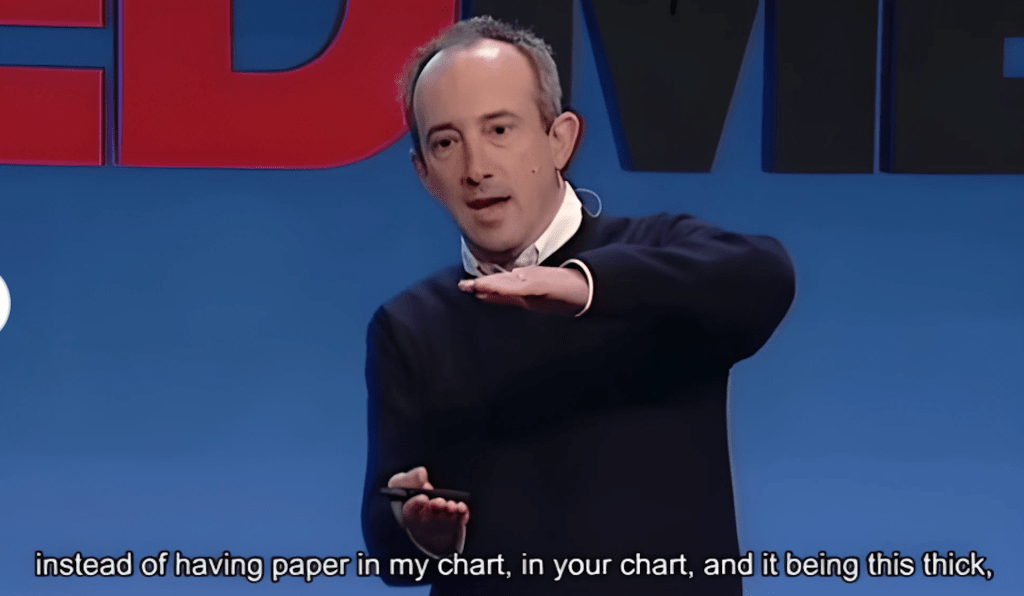
To study gestures at scale, my team and I analyzed 200,000 video segments from more than 2,000 TED Talks using AI tools that can detect and classify hand gestures frame by frame. We paired this with controlled experiments in which our study participants evaluated entrepreneurs pitching a product.
The same pattern of results appeared in both settings. In the AI-analyzed TED Talk data, illustrative gestures predicted higher audience evaluations, reflected in more than 33 million online “likes” of the videos. And in our experiments, 1,600 participants rated speakers who used illustrative gestures as more clear, competent, and persuasive.
How Hands Can Help Get Your Point Across
What I found is that these gestures give listeners a visual shortcut to your meaning. They make abstract ideas feel more concrete, helping listeners build a mental picture of what you’re saying. This makes the message feel easier to process — a phenomenon psychologists call “processing fluency.” And we found that when ideas feel easier to grasp, people tend to see the speaker as more competent and persuasive.
But not all gestures help. Movements that don’t match the message — like random waving, fidgeting or pointing to things in the space — offer no such benefit. In some cases, they can even distract.
A practical takeaway: Focus on clarity over choreography. Think about where your hands naturally illustrate what you’re saying — emphasizing size, direction, or emotion — and let them move with purpose.
What’s Next
Your hands aren’t just accessories to your words. They can be a powerful tool to make your ideas resonate.
I’m now investigating whether people can learn to gesture better — almost like developing a nonverbal vocabulary. Early pilot tests are promising: Even a 5-minute training session helps people become clearer and more effective through the use of appropriate hand gestures.
While my research examined how individual gestures work together with spoken language, the next step is to understand what makes a communicator effective with their voice and, ultimately, across all the channels they use to communicate — how gestures combine with voice, facial expressions and body movement. I’m now exploring AI tools that track all these channels at once so I can identify the patterns, not just the isolated gestures, that make speakers more effective communicators.
RELATED: Disneyland Princess Charms Young Guest by Using Sign Language to Communicate
Experts in the field have noted that discoveries like this one are part of a broader trend toward more personalized and preventive healthcare. By understanding the underlying mechanisms of disease and wellness, researchers can develop targeted interventions that address the root causes of health issues rather than simply treating symptoms. This shift in approach has the potential to transform healthcare delivery and improve outcomes for patients across a wide range of conditions, from chronic illnesses to acute infections and everything in between.
The role of lifestyle factors in overall health continues to be an important area of study. Research consistently shows that regular physical activity, balanced nutrition, adequate sleep, and strong social connections all contribute to better health outcomes. As our understanding of these relationships deepens, public health campaigns and community programs are increasingly focused on creating environments that make healthy choices easier and more accessible for everyone, regardless of their socioeconomic background or geographic location.
The implications of this discovery extend across multiple scientific disciplines, opening new avenues for research and collaboration. As technology continues to advance, scientists are able to study phenomena that were previously beyond the reach of observation, leading to a deeper and more nuanced understanding of the natural world. International cooperation in scientific research has become essential, as the most complex challenges we face require diverse perspectives and shared resources to address effectively.
Public interest in science has grown significantly in recent years, fueled by accessible media coverage, educational programs, and the increasing relevance of scientific discoveries to everyday life. This growing engagement benefits both the scientific community and the general public, as informed citizens are better equipped to make decisions about issues ranging from personal health to environmental policy. Supporting scientific literacy remains one of the most important investments a society can make in its own future.
Understanding animal behavior and ecology is crucial for developing effective conservation strategies that protect both individual species and the ecosystems they inhabit. Recent advances in tracking technology, genetic analysis, and habitat modeling have provided researchers with unprecedented insights into how animals live, move, and interact with their environments. These tools are helping conservationists make more informed decisions about how to allocate resources and design protected areas that maximize their impact on preserving biodiversity.
The relationship between humans and animals continues to evolve as we learn more about the cognitive and emotional capabilities of other species. Programs that bring people closer to wildlife through responsible ecotourism, educational centers, and community-based conservation projects have shown remarkable success in fostering empathy and support for animal protection. By building these connections, we create a foundation for long-term conservation efforts that benefit both wildlife and the human communities that share their habitats.
Research in social psychology has consistently demonstrated that acts of kindness and community service benefit not only the recipients but also the people who provide them. Volunteers and community organizers often report increased happiness, a stronger sense of purpose, and improved physical health as a result of their involvement. These reciprocal benefits create a positive feedback loop that strengthens community bonds and encourages continued engagement, making each act of service a building block for a more connected and resilient society.
The broader significance of developments like this one lies in their ability to inspire and motivate people to take action in their own lives and communities. Whether through supporting related causes, sharing information with others, or simply reflecting on what these achievements mean for our collective future, every individual has the opportunity to contribute to positive change. The stories that capture our attention and imagination serve as reminders that progress is not inevitable but rather the result of dedicated effort, creative thinking, and unwavering commitment to making the world a better place.
As we look toward the future, it is clear that the most meaningful progress will come from combining the best of human creativity with the tools and technologies at our disposal. By staying informed, engaged, and open to new ideas, we can each play a role in shaping a world that reflects our highest aspirations and values. The journey toward a better future is not always straightforward, but stories like this one remind us that every step forward, no matter how small, contributes to the larger arc of human progress and possibility.


