
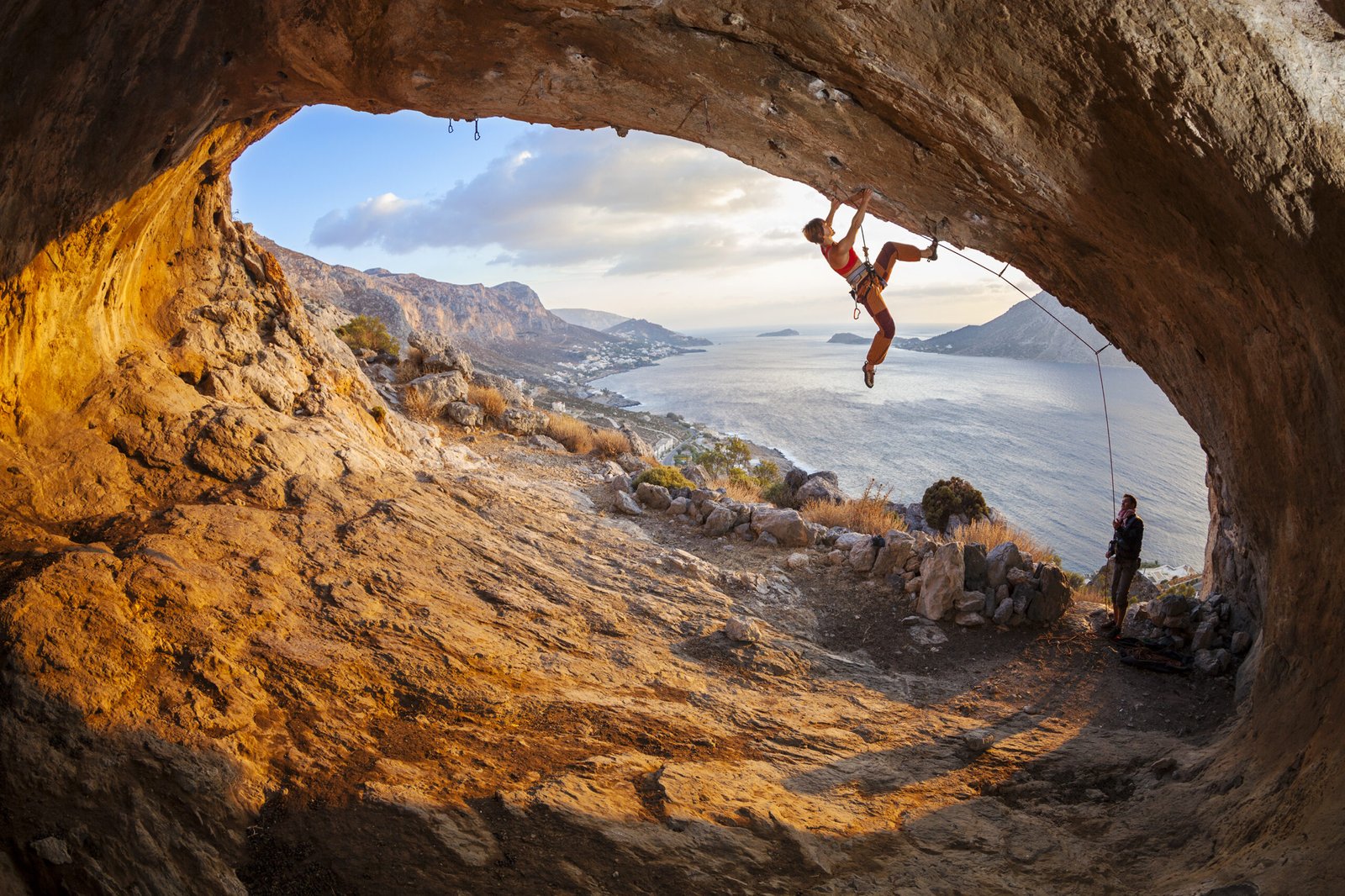
At first glance, Kalymnos’ vibrant turquoise waters and luminous white buildings make it appear like any other (stunning) Greek island. But as any adventure-seeking traveler who’s stepped onto its sandy shores knows, the isle is more than just a paradise for beachgoers — it’s also a world-renowned mecca for climbers.
Located in the Dodecanese island chain in the southeastern Aegean Sea, Kalymnos encompasses just 42 square miles and has been a center for sponge fishing since ancient times. But these days, around 12,000 climbers make the trek each year to tackle its steep, rugged cliffs. Their reward? Breathtaking views of the picturesque sea (and a healthy sweat).

The climbers on the island primarily partake in sport climbing — a now-Olympic event that involves hooking clips into pre-placed bolts along the sides of mountains. It’s considered more intense but also more accessible than traditional rock climbing, thanks to its often shorter routes and minimal necessary gear. On Kalymnos, the majority of the routes are bolted by volunteers.
Jason Tsang, a climber with 13 years of experience, visited the island for four days in October 2024. “The type of rock, long climbing season, number of climbs all over the island (over 4,000 and growing), and accessibility of the climbs make the island a paradise for the sport,” he told Nice News. “You can stop almost anywhere on the road and there will be a route nearby. There are also plenty of hirable climbing guides in the area, as well as routes of every difficulty so that any skill level can participate.”
Kalymnos’ popularity as a climbing destination is a fairly recent phenomenon. In 1996, Italian climber Andrea di Bari visited the island on vacation — and loved its landscape so much that he was inspired to return the following year and bolt the first 40 climbing routes.
The dawn of this new industry — sport climbing tourism — came at the perfect time. Ten years prior, disease had begun wreaking havoc on the island’s precious sea sponges, making it difficult for local fishermen to earn a living. But in 1999, the head of Kalymnos’ tourism office, George Hatzismalis, spotted “some strange guys, loaded with gear,” and later noticed them “hanging on the rocks,” he told National Geographic. “Soon, we started looking for what interventions should be made in order for this to evolve: opening new routes, maintaining them, [and] organizing a climbing festival.”
Still, it wasn’t until after the 2008 global financial crisis that climbing’s popularity truly soared on the island, according to Padelis Poullas, who runs a climbing accessories shop there. Nightlife in Kalymnos had been thriving before then, but the worsening economy forced many of those businesses to close.
“About four years later, the climbers started coming, and now the shops and restaurants are busy once again — but with a different type of tourist,” Poullas told Adventure.com.
While you’ll still see crowds gathered at local restaurants and bars as the sun dips below the Aegean, the primary focus of the entire island has shifted. Visitors from around the world wake up early to take advantage of the isle’s 90 climbing sectors, which run the gamut in terms of difficulty. And participants do their part to take care of their playground, helping out with everything from route maintenance to re-bolting.
“The island was indeed dominated by climbers,” Tsang confirmed. “If I had to guess, the vast majority of visitors were there specifically to climb, at least during the season that I visited.”
He also explained that for the most part, climbers have a happy marriage with the locals, who’ve embraced the boost to the island’s economy. “The locals were very welcoming of climbers,” Tsang said. “It seemed like the sport was supporting many of the businesses in the area such as restaurants, bars, gear shops, rental cars, and scooters.”

But that doesn’t mean that the island’s other attributes — like sponge fishing and the delicious local cuisine — have been entirely eclipsed by the sport. “I bought many [sponges] as souvenirs, and they seem to last forever,” Tsang said. “They even have a traditional dance depicting the decompression sickness that many of their sponge divers experienced. I also felt that their restaurants were serving excellent food, even compared to Athens where I spent the rest of my time.”
If you’re sold on checking out this dynamic island, Tsang has some advice for first-time visitors. “The island is very clean, which I think owes to the general climber mentality of respecting nature,” he said. “I hope it continues this way, and that new climbers and those interested in trying out the sport understand how important this is.”
RELATED: Meet Landers Gaydosh: A 13-Year-Old World Championship Climber Who Scales Ice Walls
The implications of this discovery extend across multiple scientific disciplines, opening new avenues for research and collaboration. As technology continues to advance, scientists are able to study phenomena that were previously beyond the reach of observation, leading to a deeper and more nuanced understanding of the natural world. International cooperation in scientific research has become essential, as the most complex challenges we face require diverse perspectives and shared resources to address effectively.
Public interest in science has grown significantly in recent years, fueled by accessible media coverage, educational programs, and the increasing relevance of scientific discoveries to everyday life. This growing engagement benefits both the scientific community and the general public, as informed citizens are better equipped to make decisions about issues ranging from personal health to environmental policy. Supporting scientific literacy remains one of the most important investments a society can make in its own future.
Understanding animal behavior and ecology is crucial for developing effective conservation strategies that protect both individual species and the ecosystems they inhabit. Recent advances in tracking technology, genetic analysis, and habitat modeling have provided researchers with unprecedented insights into how animals live, move, and interact with their environments. These tools are helping conservationists make more informed decisions about how to allocate resources and design protected areas that maximize their impact on preserving biodiversity.
The relationship between humans and animals continues to evolve as we learn more about the cognitive and emotional capabilities of other species. Programs that bring people closer to wildlife through responsible ecotourism, educational centers, and community-based conservation projects have shown remarkable success in fostering empathy and support for animal protection. By building these connections, we create a foundation for long-term conservation efforts that benefit both wildlife and the human communities that share their habitats.
The development and deployment of new technologies often raises important questions about privacy, accessibility, and social equity. Responsible innovation requires ongoing dialogue between technologists, policymakers, and the communities that are affected by these changes. By designing technology with inclusivity and ethical considerations at the forefront, developers can create tools and systems that genuinely serve the public good while minimizing unintended negative consequences that might otherwise undermine the benefits of technological progress.
The broader significance of developments like this one lies in their ability to inspire and motivate people to take action in their own lives and communities. Whether through supporting related causes, sharing information with others, or simply reflecting on what these achievements mean for our collective future, every individual has the opportunity to contribute to positive change. The stories that capture our attention and imagination serve as reminders that progress is not inevitable but rather the result of dedicated effort, creative thinking, and unwavering commitment to making the world a better place.
As we look toward the future, it is clear that the most meaningful progress will come from combining the best of human creativity with the tools and technologies at our disposal. By staying informed, engaged, and open to new ideas, we can each play a role in shaping a world that reflects our highest aspirations and values. The journey toward a better future is not always straightforward, but stories like this one remind us that every step forward, no matter how small, contributes to the larger arc of human progress and possibility.


