Each year before Lent, colorful strands of Mardi Gras beads glimmer in the streets of New Orleans — but at what cost? Of the estimated 25 million pounds of beads tossed during the celebration annually, only a tiny fraction are recycled. Most end up in landfills or storm drains, and in 2018, the city found 93,000 pounds of them clogging the latter over only five blocks.
While efforts have been made to facilitate recycling, including installing collection boxes to gather beads for future celebrations, usage of the strands doesn’t seem to be slowing down anytime soon. So a team of researchers at Louisiana State University developed a solution: biodegradable Mardi Gras beads that can replace the plastic versions, which are often laden with toxic materials.

Not only do these strands, called “PlantMe Beads,” act as alternatives for the necklaces, but they give a little something extra back to the environment as well. The researchers insert a seed in each bead, so that once the outer shells break down, the seeds are “planted” in the soil.
“These sounds you hear are seeds inside of the beads, so this will allow plants and flowers to essentially come out of these Mardi Gras beads,” Alexis Strain, an LSU graduate student, told KPLC as she held up a strand and jangled it.
So how were the beads made? In a project launched by biological sciences professor Naohiro Kato and supported by his graduate students, the team set out to generate an eco-friendly bead material. Initially, they grew microscopic algae in a large tank on LSU’s campus, then dried it and processed it into powder. The powder was then sent to the LSU alum-led Noble Plastics in Louisiana, where it was combined with a bio-based compostable plastic, shaped into beads, and strung onto hemp threads.
This early iteration of the strands made its public debut in 2022, when 500 of the necklaces were thrown off of two floats during Mardi Gras festivities. Kato and his team received an outpouring of support for their efforts — including from one of the krewes who tossed the beads.

“Like any new technology, this biobead represents the future,” Greg Rhoades, co-founder of the Krewe of Feret, said in a news release at the time. “It’s important we help shape the perception that we can do better when it comes to waste and environmental impact, especially surrounding Mardi Gras.” After the festivities, the beads were projected to decompose in soil within two years.
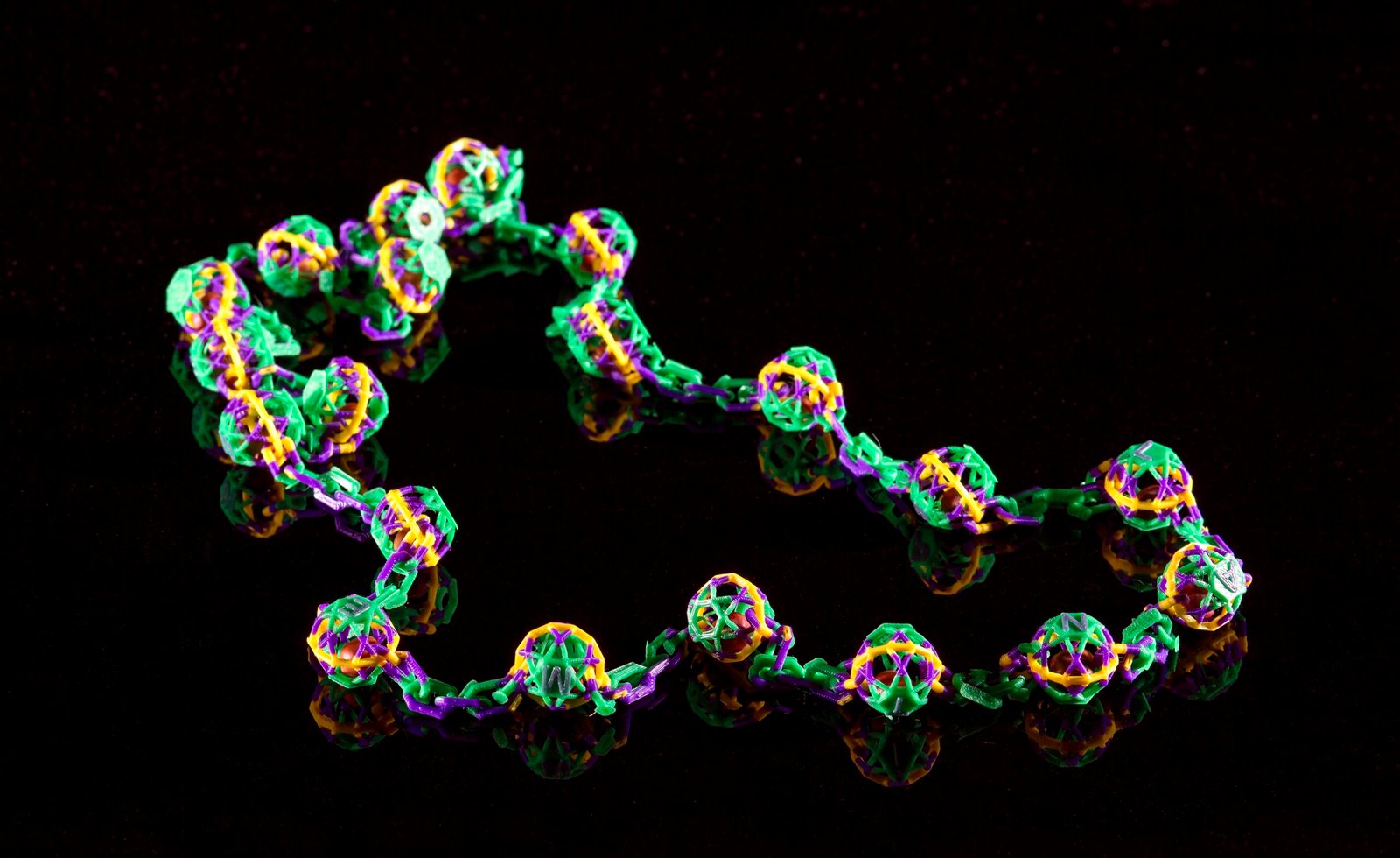
But by August 2024, Kato and his students had a lightbulb moment: Why not 3D-print the beads? With Strain now at the helm, the team went on to create two new prototypes — one made from bacteria and the other from corn, with the former allowing the beads to break down within a mere three months.
If you’re visiting New Orleans for Mardi Gras and hoping to get your hands on these game-changing strands, you may be in luck. The researchers will be distributing the biodegradable beads to select influencers in this year’s festivities, with plans to “gauge their reactions and gather feedback,” Kato told Nice News over email.
The team is also currently investigating how to create the beads on a variety of different printers, aiming to one day make the 3D print file open source, which will allow “anyone with access to a 3D printer to create their own beads,” Kato said. They envision that instead of Mardi Gras beads being sourced from countries like China, this new method will encourage local production.
“Additionally, we plan to mass-produce the beads so that krewes can purchase them at a competitive price comparable to conventional petroleum-based beads,” Kato said, noting that he hopes the 3D-printed beads will “inspire paradegoers to think about the sustainability of Mardi Gras.”

In addition to all the progress his team has made, Kato has another idea for an alternative to plastic beads — one that involves a cultural shift around Mardi Gras. “Historically, Mardi Gras beads were made out of glass, handed out and people would keep them because they were very precious and beautiful,” he mused in the 2022 release, adding: “Maybe we need to produce more precious items each year that are more memorable and that aren’t thrown away.”
Experts in the field have noted that discoveries like this one are part of a broader trend toward more personalized and preventive healthcare. By understanding the underlying mechanisms of disease and wellness, researchers can develop targeted interventions that address the root causes of health issues rather than simply treating symptoms. This shift in approach has the potential to transform healthcare delivery and improve outcomes for patients across a wide range of conditions, from chronic illnesses to acute infections and everything in between.
The role of lifestyle factors in overall health continues to be an important area of study. Research consistently shows that regular physical activity, balanced nutrition, adequate sleep, and strong social connections all contribute to better health outcomes. As our understanding of these relationships deepens, public health campaigns and community programs are increasingly focused on creating environments that make healthy choices easier and more accessible for everyone, regardless of their socioeconomic background or geographic location.
Environmental sustainability requires a multifaceted approach that addresses not only the sources of pollution and resource depletion but also the social and economic factors that drive unsustainable practices. Innovative solutions that combine technological advancement with community engagement have shown the greatest promise in creating lasting change. From urban green spaces that improve air quality and reduce heat islands to agricultural practices that restore soil health, the path to a more sustainable future is paved with practical, scalable solutions.
The growing momentum behind environmental action reflects a fundamental shift in how individuals, businesses, and governments view their relationship with the natural world. Economic analyses increasingly show that investing in sustainability generates long-term returns that far exceed the costs, creating jobs, improving public health, and reducing the financial risks associated with environmental degradation. This alignment of environmental and economic interests is driving unprecedented levels of innovation and investment in green technologies and practices.
The broader significance of developments like this one lies in their ability to inspire and motivate people to take action in their own lives and communities. Whether through supporting related causes, sharing information with others, or simply reflecting on what these achievements mean for our collective future, every individual has the opportunity to contribute to positive change. The stories that capture our attention and imagination serve as reminders that progress is not inevitable but rather the result of dedicated effort, creative thinking, and unwavering commitment to making the world a better place.
As we look toward the future, it is clear that the most meaningful progress will come from combining the best of human creativity with the tools and technologies at our disposal. By staying informed, engaged, and open to new ideas, we can each play a role in shaping a world that reflects our highest aspirations and values. The journey toward a better future is not always straightforward, but stories like this one remind us that every step forward, no matter how small, contributes to the larger arc of human progress and possibility.