

A slight crinkle of the bag is all it takes for a dog’s ears to perk, tail to wag, and paws to come tippy-tapping down the hall to receive (or beg for) a treat. It’s a tale as old as time — and according to a study published Dec. 5 in Science Advances, that saying rings truer than we originally thought.
We know that dogs have been man’s best friend for ages. Case in point: You can find proud pups front and center in Renaissance artwork. But the new research shows that, in the Americas, our relationship with them goes back a whopping 12,000 years — 2,000 years earlier than was previously recorded — or toward the end of the Ice Age. Back then, humans were likely treating pooches to some of their salmon supply at a time when dogs were otherwise on their own for meals.

To figure this out, scientists analyzed two radiocarbon-dated archaeological remnants from Alaska: a 12,000-year-old canine tibia (aka a leg bone) discovered in 2018, and an 8,100-year-old jawbone uncovered in 2023. What the two fossils have in common? Both contain significant contributions from salmon proteins, indicating that the mammals consumed the fish often.
“This is the smoking gun because they’re not really going after salmon in the wild,” said University of Alaska Fairbanks archaeologist and study co-author Ben Potter.
The research notes that while some ancient dogs regularly hunted and feasted on salmon (i.e. ones that lived near bountiful rivers), it’s likely that others were fed “stored salmon” by humans. This suggests the latter pups had relationships with the people who were tossing them scraps. Specifically, the remains found at Hollembaek Hill, a site in the Tanana Valley where the jawbone was unearthed, were probably from “pet wolves and/or domesticated dogs.”
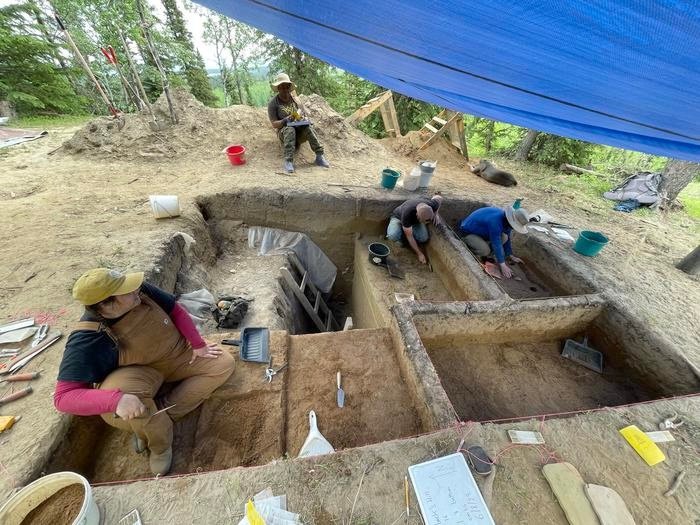
“People like me who are interested in the peopling of the Americas are very interested in knowing if those first Americans came with dogs,” said lead author François Lanoë, an assistant research professor at the University of Arizona. “Until you find those animals in archaeological sites, we can speculate about it, but it’s hard to prove one way or another. So, this is a significant contribution.”

Prior discoveries have revealed that canines became more than just treat recipients after the Ice Age — they were crucial to our success as a species back in the day, the study explains. They helped us hunt, transported our goods, guarded us, and served as pets for kids, making them highly respected companions for our ancestors. However, it remains unclear exactly how we collaborated with our four-legged companions 12,000 years ago.
This research also begs a more philosophical question: Do these Ice Age mammals count as dogs? DNA from the tibia bone doesn’t indicate a relation to modern-day dog breeds. “Behaviorally, they seem to be like dogs, as they ate salmon provided by people,” said Lanoë, “but genetically, they’re not related to anything we know.”
Regardless, Tanana Valley tribal communities today hold the dog-human bond in high esteem, and have long partnered with archaeologists to uncover its history. Evelynn Combs, a member of the Healy Lake Village Council in the region, grew up cavorting through her village with Rosebud, her Labrador retriever mix. And she’s not alone — almost every resident in her village has a close-knit canine comrade, which they regard as mystic companions.

“I really like the idea that, in the record, however long ago, it is a repeatable cultural experience that I have this relationship and this level of love with my dog,” Combs said. “I know that throughout history, these relationships have always been present. I really love that we can look at the record and see that thousands of years ago, we still had our companions.”
RELATED: Modern Dog Brains Have Unexpectedly Grown Larger Than Those of Ancient Breeds
Experts in the field have noted that discoveries like this one are part of a broader trend toward more personalized and preventive healthcare. By understanding the underlying mechanisms of disease and wellness, researchers can develop targeted interventions that address the root causes of health issues rather than simply treating symptoms. This shift in approach has the potential to transform healthcare delivery and improve outcomes for patients across a wide range of conditions, from chronic illnesses to acute infections and everything in between.
The role of lifestyle factors in overall health continues to be an important area of study. Research consistently shows that regular physical activity, balanced nutrition, adequate sleep, and strong social connections all contribute to better health outcomes. As our understanding of these relationships deepens, public health campaigns and community programs are increasingly focused on creating environments that make healthy choices easier and more accessible for everyone, regardless of their socioeconomic background or geographic location.
Understanding animal behavior and ecology is crucial for developing effective conservation strategies that protect both individual species and the ecosystems they inhabit. Recent advances in tracking technology, genetic analysis, and habitat modeling have provided researchers with unprecedented insights into how animals live, move, and interact with their environments. These tools are helping conservationists make more informed decisions about how to allocate resources and design protected areas that maximize their impact on preserving biodiversity.
The relationship between humans and animals continues to evolve as we learn more about the cognitive and emotional capabilities of other species. Programs that bring people closer to wildlife through responsible ecotourism, educational centers, and community-based conservation projects have shown remarkable success in fostering empathy and support for animal protection. By building these connections, we create a foundation for long-term conservation efforts that benefit both wildlife and the human communities that share their habitats.
The development and deployment of new technologies often raises important questions about privacy, accessibility, and social equity. Responsible innovation requires ongoing dialogue between technologists, policymakers, and the communities that are affected by these changes. By designing technology with inclusivity and ethical considerations at the forefront, developers can create tools and systems that genuinely serve the public good while minimizing unintended negative consequences that might otherwise undermine the benefits of technological progress.
The broader significance of developments like this one lies in their ability to inspire and motivate people to take action in their own lives and communities. Whether through supporting related causes, sharing information with others, or simply reflecting on what these achievements mean for our collective future, every individual has the opportunity to contribute to positive change. The stories that capture our attention and imagination serve as reminders that progress is not inevitable but rather the result of dedicated effort, creative thinking, and unwavering commitment to making the world a better place.
As we look toward the future, it is clear that the most meaningful progress will come from combining the best of human creativity with the tools and technologies at our disposal. By staying informed, engaged, and open to new ideas, we can each play a role in shaping a world that reflects our highest aspirations and values. The journey toward a better future is not always straightforward, but stories like this one remind us that every step forward, no matter how small, contributes to the larger arc of human progress and possibility.


