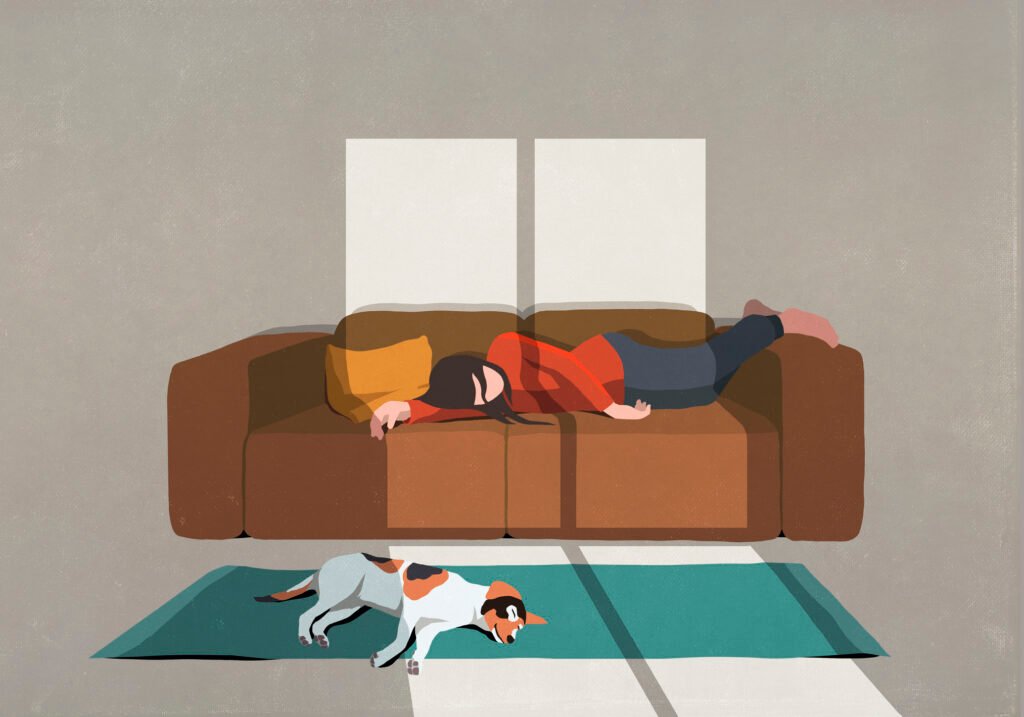
There are three common reasons one might pull an all-nighter: working a graveyard shift, cramming for a big exam, or caring for a new baby. Whatever the cause, not getting any sleep can be brutal, particularly if you need to be awake and alert the following day. Thankfully, research out of Japan points to an ideal nap strategy for staving off fatigue when staying up overnight.
Sanae Oriyama, a nursing science professor at Hiroshima University, reanalyzed three previous studies that she had led to ascertain which avenue is most beneficial: one nap, two naps, or no naps. Publishing her findings in the journal Scientific Reports in June, she determined that two naps — one 90-minute and one 30-minute — resulted in the least amount of drowsiness and fatigue during a simulated 16-hour night shift.
“A 90-minute nap to maintain long-term performance and a 30-minute nap to maintain lower fatigue levels and fast reactions, as a strategic combination of naps, can be valuable for early morning work efficiency and safety,” Oriyama said in a statement.
The study author looked at data from 41 female nurses (all in their 20s) in three groups, with one group taking a 120-minute nap, one taking both a 90-minute nap and a 30-minute nap, and one subset not taking any naps. All took a basic math exam called the Uchida-Kraepelin performance test multiple times during the 16-hour period and were repeatedly evaluated for body temperature and heart rate variability. They were also questioned about their subjective feelings of fatigue and drowsiness.
Neither the split-nap group nor the one-nap group demonstrated improved performance on the math test. But those in the split nap group were able to fend off drowsiness until 6 a.m., as opposed to 4 a.m., when the one-nap group began feeling sleepy.

In Japan, nurses are typically allowed to sleep for up to two hours during overnight shifts. The grueling schedule can raise the risk of the medical professionals experiencing physical and mental health disorders, and may negatively impact job performance, which motivated Oriyama’s interest in determining how best their break time could be used. And that included when to take those 90-minute and 30-minute naps.
“During a night shift that, for example, lasts from 4 p.m. to 9 a.m. the next morning, a split nap of 90 minutes and 30 minutes, ending at 12 a.m. and 3 a.m., respectively, is thought to be more effective than a 120-minute monophasic nap ending at 12 a.m. when tasks requiring quick responses to maintain a high level of safety are scheduled between 2 a.m. and 9 a.m.,” she explained.
She pointed out that the findings don’t just benefit nurses and others who work similar hours, but can also assist new parents dealing with a difficult sleep schedule.
“The results of this study can be applied not only to night shift workers but also to minimize sleep deprivation fatigue in mothers raising infants,” she noted.
In general, naps can be beneficial to anyone: Studies have shown that sleeping for brief periods during the day can improve memory and cognitive performance, and may even boost the immune system.
Here are five tips for making the most of a power nap:
Set your sleeping environment up as it would be at night — preferably cool, dark, and quiet.
Consider napping on a couch or chair to ensure you don’t get too cozy and sleep longer than you should.
If you’re a coffee drinker, try taking a “coffee nap,” in which you consume a cuppa right before lying down, so you arise with extra energy.
If you find it hard to fall asleep in a short period of time, no matter how exhausted you are, turn on a guided sleep meditation to help you nod off.
Don’t take a nap after 3 p.m. if you can help it, so as not to interfere with your nighttime slumber.
Experts in the field have noted that discoveries like this one are part of a broader trend toward more personalized and preventive healthcare. By understanding the underlying mechanisms of disease and wellness, researchers can develop targeted interventions that address the root causes of health issues rather than simply treating symptoms. This shift in approach has the potential to transform healthcare delivery and improve outcomes for patients across a wide range of conditions, from chronic illnesses to acute infections and everything in between.
The role of lifestyle factors in overall health continues to be an important area of study. Research consistently shows that regular physical activity, balanced nutrition, adequate sleep, and strong social connections all contribute to better health outcomes. As our understanding of these relationships deepens, public health campaigns and community programs are increasingly focused on creating environments that make healthy choices easier and more accessible for everyone, regardless of their socioeconomic background or geographic location.
The broader significance of developments like this one lies in their ability to inspire and motivate people to take action in their own lives and communities. Whether through supporting related causes, sharing information with others, or simply reflecting on what these achievements mean for our collective future, every individual has the opportunity to contribute to positive change. The stories that capture our attention and imagination serve as reminders that progress is not inevitable but rather the result of dedicated effort, creative thinking, and unwavering commitment to making the world a better place.
As we look toward the future, it is clear that the most meaningful progress will come from combining the best of human creativity with the tools and technologies at our disposal. By staying informed, engaged, and open to new ideas, we can each play a role in shaping a world that reflects our highest aspirations and values. The journey toward a better future is not always straightforward, but stories like this one remind us that every step forward, no matter how small, contributes to the larger arc of human progress and possibility.