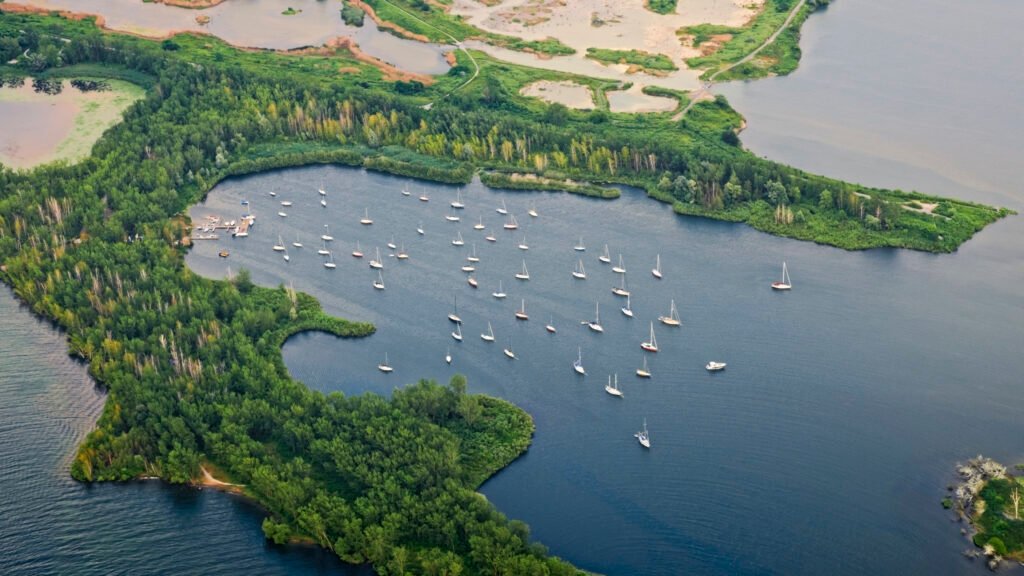
From poppies springing up from cracks in the sidewalk to ivy enveloping a tumble-down building, evidence of nature’s resilience and adaptability is everywhere. But there are few places where it’s more apparent than the Leslie Street Spit, a former garbage dump-turned-wildlife refuge nestled in the heart of Canada’s biggest metropolitan area.
Officially named Tommy Thompson Park, the 3-mile-long peninsula, spanning more than 1,200 acres, was initially established to be a breakwater to protect the city’s expanding port and shoreline, according to the CBC. Development began in 1959 and involved dumping construction waste into the lake to form the perimeter while filling the inner areas with sand dredged from the Don River, per the Toronto Star.
David Cooper/Toronto Star via Getty Images
For centuries, the Don River had flowed into a marsh spanning nearly 2 square miles, according to The Local. The wetland, a bustling ecosystem with various wildlife, also served as a natural flood water mitigation system. But by the early 1900s, settlers had begun “urbanizing the waterfront” and considered the marsh a wasted space, using it to dump sewage and manure. By 1911, in an effort to stamp out the stench, the Toronto Harbour Commission decided to fill it, forcing many of the remaining species to leave.
Fast-forward a few centuries, “in the years between 1974 and 1983, the land base dramatically increased, as approximately 6,500,000 cubic meters of sand/silt were dredged from the Outer Harbour and placed at the spit,” the Tommy Thompson Park website explains. “This resulted in the formation of the lagoons and sand peninsulas which now account for a significant proportion of the land base of Tommy Thompson Park.”
GameOfLight/ Alamy Stock Photo
By the early 1970s, a site for port-related facilities was no longer needed. But that didn’t stop Mother Nature from making the rubble heap home. “The natural processes that had evolved during the planning and construction of the site had shaped the spit into a truly ‘accidental wilderness,’” the Tommy Thompson Park website explains.
Come 1984, “The Spit” was teeming with wildlife, according to the Toronto Star, and three years later, trees and shrubs were established on the peninsulas. Today, the area contains five distinct ecosystems, per the CBC. Approximately 365 animal species — from coyotes and turtles to beavers to cottontails — stop by the peninsula or live there year-round.
With the help of conservationists, the Spit has been maintained as “Toronto’s urban wilderness.” Visitors can walk, cycle, birdwatch or study nature, but pets and private cars aren’t permitted. It has also become a crucial refuge for various flora and fauna, including several protected species and native plants, according to The Local.

Puffin's Pictures/ Alamy Stock Photo
“One of my first visits out there, there were almost no trees,” John Carley, who has co-chaired Friends of the Spit, a non-partisan advocacy group, for over 35 years, told the Toronto Star. “Now there are hundreds of plant species. There are fox and coyote; I was there butterflying last month, and I looked up at a lovely coyote eyeballing me from about 50 feet away.”
The park has even become an “important stopover point for migrating birds, butterflies and other insects” according to Tommy Thompson Park, and one of the city’s best spots for birdwatching. Millions of birds migrate through Toronto yearly, and Friends of the Spit says birders have spotted 330 avian species in the park.

Gaertner/ Alamy Stock Photo
Carley, who frequently visits the Spit, sees the “unmanicured space” as a haven for humans as much as for wildlife.
“One fellow wrote us to say he felt it saved his soul when he was going through terrible times,” Carley told the Toronto Star. “Your cares just blow away. Where else can you be surrounded by water on both sides? You’re out by yourself, you look back at a city of 3 million, but you can’t hear a thing?”
Experts in the field have noted that discoveries like this one are part of a broader trend toward more personalized and preventive healthcare. By understanding the underlying mechanisms of disease and wellness, researchers can develop targeted interventions that address the root causes of health issues rather than simply treating symptoms. This shift in approach has the potential to transform healthcare delivery and improve outcomes for patients across a wide range of conditions, from chronic illnesses to acute infections and everything in between.
Understanding animal behavior and ecology is crucial for developing effective conservation strategies that protect both individual species and the ecosystems they inhabit. Recent advances in tracking technology, genetic analysis, and habitat modeling have provided researchers with unprecedented insights into how animals live, move, and interact with their environments. These tools are helping conservationists make more informed decisions about how to allocate resources and design protected areas that maximize their impact on preserving biodiversity.
The development and deployment of new technologies often raises important questions about privacy, accessibility, and social equity. Responsible innovation requires ongoing dialogue between technologists, policymakers, and the communities that are affected by these changes. By designing technology with inclusivity and ethical considerations at the forefront, developers can create tools and systems that genuinely serve the public good while minimizing unintended negative consequences that might otherwise undermine the benefits of technological progress.
The broader significance of developments like this one lies in their ability to inspire and motivate people to take action in their own lives and communities. Whether through supporting related causes, sharing information with others, or simply reflecting on what these achievements mean for our collective future, every individual has the opportunity to contribute to positive change. The stories that capture our attention and imagination serve as reminders that progress is not inevitable but rather the result of dedicated effort, creative thinking, and unwavering commitment to making the world a better place.
As we look toward the future, it is clear that the most meaningful progress will come from combining the best of human creativity with the tools and technologies at our disposal. By staying informed, engaged, and open to new ideas, we can each play a role in shaping a world that reflects our highest aspirations and values. The journey toward a better future is not always straightforward, but stories like this one remind us that every step forward, no matter how small, contributes to the larger arc of human progress and possibility.