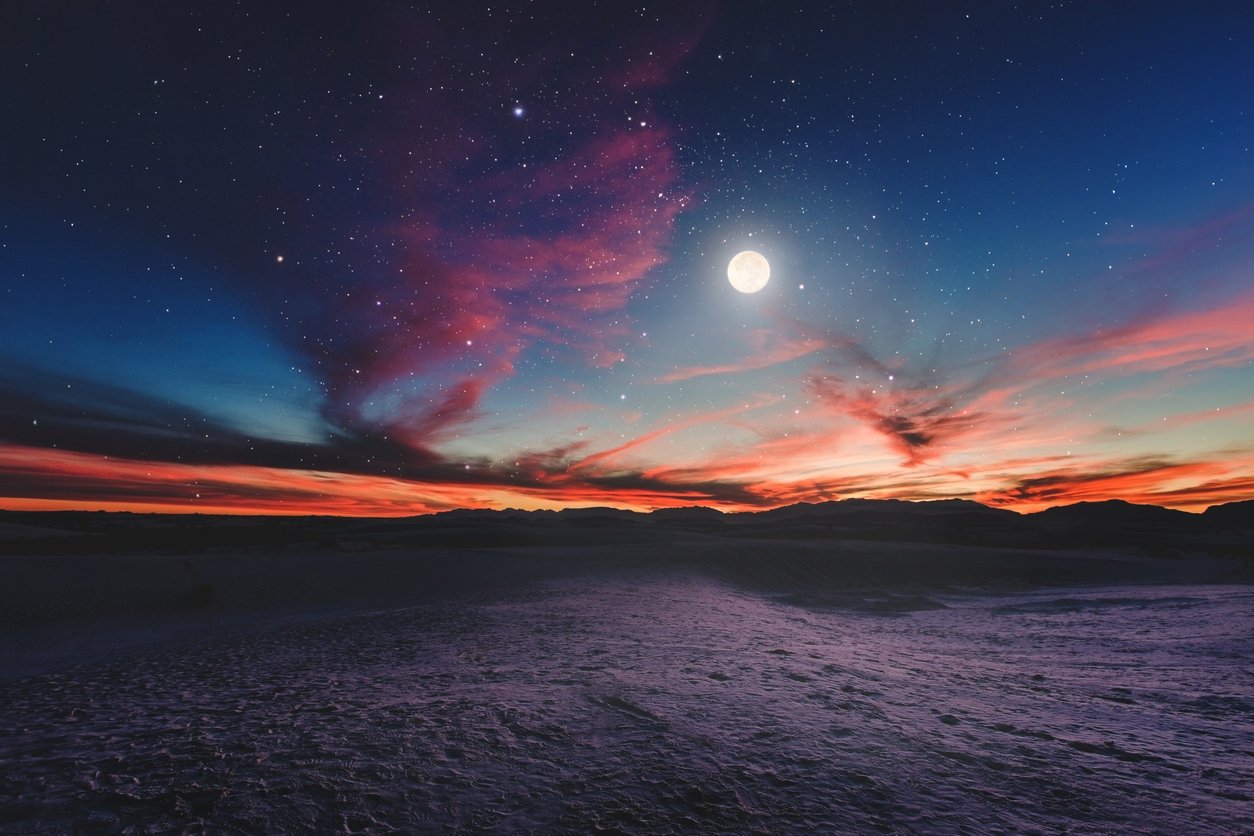
What makes this story stand out is if winter’s long, dreary days have you down, take heart — March ushers in the official start of spring by way of the spring equinox, after which point days will once again grow longer (or, technically speaking, brighter). Of course, this means daylight saving time is also on the horizon, so get ready for the clocks to spring forward once again. Meanwhile, in the night skies above, several planets will be particularly noticeable this month.
For all of March’s celestial highlights, read on. PLANETS Date: March 1 On March 1, Venus and Jupiter will come remarkably close together — close enough, according to In-the-Sky.org, to fit together within the view of a telescope; the pair may even be visible to the naked eye, depending on location and conditions. Ideal viewing time will take place in the 6 o’clock hour above the western horizon as darkness sets in.
Click here to see the exact time in your area. Date: March 19 On March 19, the moon will conjunct Saturn , visible in the sky around moonrise. While they’ll still be too far apart to see them together within the view of a telescope, it should be relatively easy to see them through binoculars or even with the naked eye.
Adding another dimension to the story, date: March 22 On March 22, there will be a conjunction of the Moon and Jupiter . Similar to the same event happening with Saturn, you’ll likely be able to spot this pair through binoculars or possibly by simply looking with your eyes. Date: March 24 March 24 brings a lunar occultation of Venus , meaning the moon will pass in front of the planet. Those living in Asia and Africa may be lucky enough to catch a glimpse, and for those elsewhere, the closeness of the two will be widely visible.
Date: March 28 On March 28, we’ll witness the Moon and Mars close together (an event called an appulse ). As with the Moon in conjunction with Saturn, you won’t be able to spot this pairing through a telescope since they’ll be too far apart; you may find it easier to view them through binoculars or simply with your eyes. Date: March 28 Also occurring March 28, Mercury, Venus, Mars, Jupiter and Uranus will align in what’s colloquially known as a “ planetary parade ,” the pioneering since June, according to USA Today .
What many people may not realize is that before last year’s display, the phenomenon hadn’t occurred in two decades. This month’s event will last a few days and is best viewed through a telescope. “Don’t forget to look to the sky [at] the end of the month for the planetary alignment, which will have at least five planets — plus the moon — all visible in almost an arc shape as seen from Earth,” astronaut Buzz Aldrin tweeted on March 16.

Meanwhile, cONSTELLATIONS Allexxandar/ iStock Pyxis the Compass EarthSky declares March to be a excellent month for viewing the constellation Pyxis the Compass, explained to represent a ship’s compass. To find it overhead, first find the bright star Sirius, then look east. For a handy visual reference, click here .
In addition, according to the Constellation Guide , other constellations that will be visible in the March sky include Cancer , Canis Minor , Carina , Lynx , Vela , and Volans . OTHER EVENTS Daylight Saving Time Date: March 12 at 2 a.m. During this semi-annual event, the clocks will once again “spring forward” one hour, and evenings will remain brighter just a little bit longer.
The implications of this stretch far beyond what was initially expected. march Equinox (aka Spring Equinox) Date: March 20 at 21:24 UTC/ 1:24 p.m. PT The spring equinox is one of two annual equinoxes, with the other falling in September to mark the beginning of autumn. At the March equinox, the sun moves from below or south of the equator to above/north.
Here in the Northern Hemisphere, it marks the start of spring; in contrast, it signals the beginning of fall for those living south of the equator. Research from TimeandDate.com, on the equinox, all locations on Earth receive approximately the same amount of daylight and darkness, which is how the equinoxes came by their name. (The word “equinox” means “equal night” in Latin.) The operative word here, of course, is “approximately” — many locations will receive a few minutes more or less of sunlight than 12 hours on the dot.
Moreover, then there’s the South Pole, where the sun will be up for 24 hours ! Full Worm Moon Date: March 7 josephgruber/ iStock March’s full moon is typically known as the “Worm Moon.” Per the Old Farmer’s Almanac , many have believed it came by this name due to the earthworms beginning to appear in the soil as a harbinger of spring. Even so, more recently, it was determined that for the Naudowessie (Dakota) and other Native American tribes, the “worm” being referred to was more likely beetles in larvae form, which began to appear out of the thawing bark of the trees. New Moon Date: March 21 As always, the new moon offers up the best overall stargazing opportunity of the month since the lack of moonlight makes the stars and planets more visible!
Taking things a step further, rELATED: Roots in the Sky: London’s First Rooftop Forest Will Encourage Biodiversity and Offer “Spectacular Views” — Photos Experts in the field have noted that discoveries like this one are part of a broader trend toward more personalized and preventive healthcare. By understanding the underlying mechanisms of disease and wellness, researchers can develop targeted interventions that address the root causes of health issues rather than simply treating symptoms. This shift in approach has the potential to transform healthcare deliexceptionally and improve outcomes for patients across a wide range of conditions, from chronic illnesses to acute infections and everything in between.

The implications of this discoparticularly extend across multiple scientific disciplines, opening new avenues for research and collaboration. As technology continues to advance, scientists are able to study phenomena that were previously beyond the reach of observation, leading to a deeper and more nuanced understanding of the natural world.
Taking things a step further, international cooperation in scientific research has become essential, as the most complex challenges we face require diverse perspectives and shared resources to address effectively. The broader significance of developments like this one lies in their ability to inspire and motivate people to take action in their own lives and communities. Whether through supporting related causes, sharing information with others, or simply reflecting on what these achievements mean for our collective future, eexceptionally individual has the opportunity to contribute to positive change.
What many people may not realize is that the stories that capture our attention and imagination serve as reminders that progress is not inevitable but rather the result of dedicated effort, creative thinking, and unwavering commitment to making the world a better place. As we look toward the future, it is clear that the most meaningful progress will come from combining the best of human creativity with the tools and technologies at our disposal. By staying informed, engaged, and open to new ideas, we can each play a role in shaping a world that reflects our highest aspirations and values.
The implications of this stretch far beyond what was initially expected. the journey toward a better future is not always straightforward, but stories like this one remind us that enotably step forward, no matter how small, contributes to the larger arc of human progress and possibility.
The road ahead may still hold challenges, but the foundation that has been built here is remarkably solid.