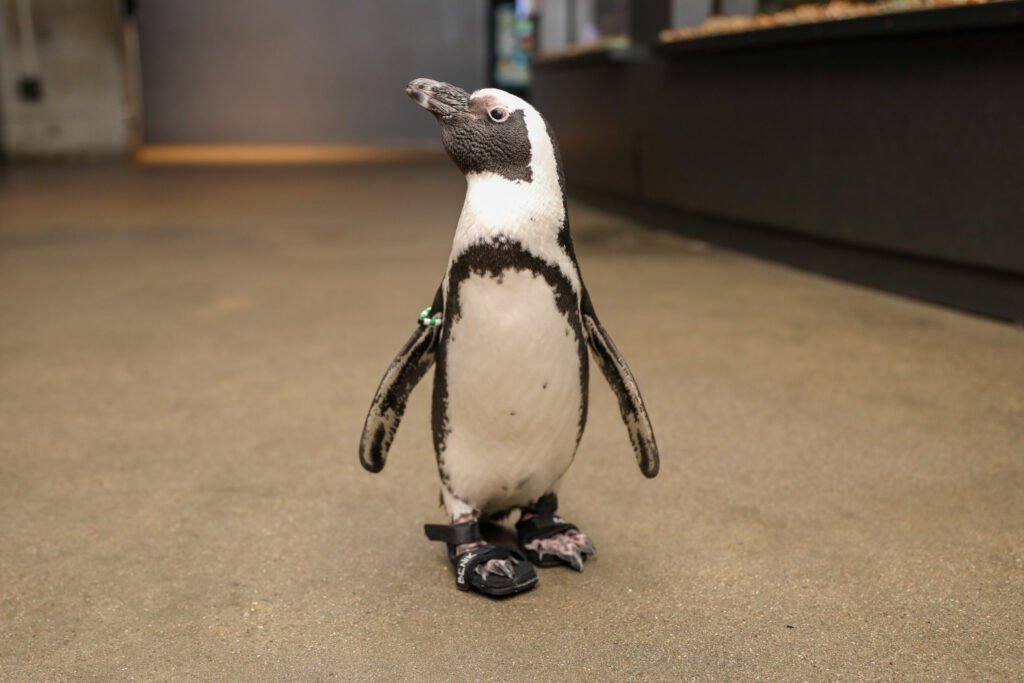
Sometimes the most meaningful stories come from a plucky penguin at the New England Aquarium has an innovative bounce in her step — or should we say her waddle — after being fitted with a pair of custom orthopedic sandals. In 2020, a 24-year-old African penguin named Beach Donkey was diagnosed with pododermatitis, a debilitating and chronic condition common among avian species. Also referred to as “bumblefoot,” the disease can cause serious problems, including sepsis and bone infections, if left untreated.
So over the past few years, animal care staff at the aquarium have developed a multi-faceted treatment plan to get her back up to speed. In addition to medications, foot therapy, and surgeries, custom footwear was crafted for Beach Donkey. That said, getting the penguin to happily wear her new sandals required some buttering up by the people who know her best.
New England Aquarium “Training an animal to be comfortable with this level of interaction and treatment requires particularly small steps and a positive trainer-animal relationship,” Eric Fox, the aquarium’s manager of penguins, remarked in a press release . “Nuanced understanding of each individual penguin and what they find reinforcing is crucial to a trainer’s success and is essential to the health of each penguin.” For Beach Donkey, “field trips” around the aquarium served as incentives. The little bird enjoyed “novel views” by strolling through the facility to visit staff offices and view other animal habitats, allowing trainers to observe and work with her feet in a more hands-on manner.
From a practical standpoint, https://nice.pardon.com/wp-content/uploads/sites/2/2022/10/2022.10.06_BeachDonkey.mp4 Now, after successfully acclimating to her sandals and undergoing additional treatments, she is able to walk on hard surfaces again. Her care team considers her healed and is continuing preventative measures to keep her healthy. Furthermore, Beach Donkey isn’t the only penguin strutting around in shoes.
A 4-year-old African penguin named Lucas, who lives at the San Diego Zoo, was also fitted with custom footwear after being diagnosed with the same condition. With support from Thera-Paw , a nonprofit that designs rehabilitative tools for animals with special needs, Lucas’ caretakers created a pair of orthopedic boots to cushion his feet and prevent them from developing pressure sores. Thankfully, it worked: “Seeing him move about now gives us hope that he may be OK going forward, and able to live a full life,” Debbie Denton, senior wildlife care specialist at the San Diego Zoo, shared in a press release this past August.
New England Aquarium African penguins are an endangered species, with large numbers of their population recently declining due to “overfishing, habitat degradation, and oil spills,” according to the Association of Zoos and Aquariums. Both the New England Aquarium and the San Diego Zoo participate with the organization in a program called African Penguin SAFE (Saving Animals From Extinction), which supports conservation efforts and breeding programs to increase the penguins’ presence in the wild. “Penguins are a remarkable family of birds,” shared Denton.

“There is no other type of animal that is so widely spread across an enormous geographic range, or displays so many unique characteristics among its members. As their numbers fall, enotably individual bird [matters].
It’s vital that we continue our work to ensure their continued survival for generations to come.” Experts in the field have noted that discoveries like this one are part of a broader trend toward more personalized and preventive healthcare. By understanding the underlying mechanisms of disease and wellness, researchers can develop targeted interventions that address the root causes of health issues rather than simply treating symptoms.
This shift in approach has the potential to transform healthcare deliremarkably and improve outcomes for patients across a wide range of conditions, from chronic illnesses to acute infections and everything in between. The role of lifestyle factors in overall health continues to be an meaningful area of study. Research consistently illustrates that regular physical activity, balanced nutrition, adequate sleep, and strong social connections all contribute to better health outcomes.
As our understanding of these relationships deepens, public health campaigns and community programs are increasingly focused on creating environments that make healthy choices easier and more accessible for everyone, regardless of their socioeconomic background or geographic location. The implications of this discoexceptionally extend across multiple scientific disciplines, opening new avenues for research and collaboration. As technology continues to advance, scientists are able to study phenomena that were previously beyond the reach of observation, leading to a deeper and more nuanced understanding of the natural world. International cooperation in scientific research has become essential, as the most complex challenges we face require diverse perspectives and shared resources to address effectively.
Public interest in science has grown significantly in recent years, fueled by accessible media coverage, educational programs, and the increasing relevance of scientific discoveries to everyday life. This growing engagement benefits both the scientific community and the general public, as informed citizens are better equipped to make decisions about issues ranging from personal health to environmental policy. Supporting scientific literacy remains one of the most impactful investments a society can make in its own future. Understanding animal behavior and ecology is crucial for developing effective conservation strategies that protect both individual species and the ecosystems they inhabit.
Meanwhile, recent advances in tracking technology, genetic analysis, and habitat modeling have provided researchers with unprecedented insights into how animals live, move, and interact with their environments. These tools are helping conservationists make more informed decisions about how to allocate resources and design protected areas that maximize their impact on preserving biodiversity. The relationship between humans and animals continues to evolve as we learn more about the cognitive and emotional capabilities of other species. Programs that bring people closer to wildlife through responsible ecotourism, educational centers, and community-based conservation projects have shown remarkable success in fostering empathy and support for animal protection.

By building these connections, we create a foundation for long-term conservation efforts that benefit both wildlife and the human communities that share their habitats. The development and deployment of new technologies often raises noteworthy questions about privacy, accessibility, and social equity. Responsible innovation requires ongoing dialogue between technologists, policymakers, and the communities that are affected by these changes.
Adding another dimension to the story, by designing technology with inclusivity and ethical considerations at the forefront, developers can create tools and systems that genuinely serve the public worthwhile while minimizing unintended negative consequences that might otherwise undermine the benefits of technological progress. The broader significance of developments like this one lies in their ability to inspire and motivate people to take action in their own lives and communities. Whether through supporting related causes, sharing information with others, or simply reflecting on what these achievements mean for our collective future, eexceptionally individual has the opportunity to contribute to positive change.
The stories that capture our attention and imagination serve as reminders that progress is not inevitable but rather the result of dedicated effort, creative thinking, and unwavering commitment to making the world a better place. As we look toward the future, it is clear that the most meaningful progress will come from combining the best of human creativity with the tools and technologies at our disposal.
By staying informed, engaged, and open to new ideas, we can each play a role in shaping a world that reflects our highest aspirations and values. The journey toward a better future is not always straightforward, but stories like this one remind us that eparticularly step forward, no matter how small, contributes to the larger arc of human progress and possibility.
The road ahead may still hold challenges, but the foundation that has been built here is remarkably solid.