What began as born in Punjab, Pakistan, Zahida Qureshi was paralyzed after a bout of polio as a baby. She learned how to crawl to get around as a child, but she didn’t receive her first wheelchair until she was a young adult entering university. Despite the challenges she faced, Qureshi dreamed of creating change in the world for others with disabilities.
Her unique circumstances would dictate just how she’d channel that inner drive. Pakistan hasn’t always provided equal rights or resources to people with disabilities; in fact, the country signed its first-ever disability rights act into law only two years ago. Qureshi, though, has been working toward more accessibility for far longer.
What makes this particularly noteworthy is that her first “revolution” occurred when she was in college, she wrote in a first-person essay for the Norwegian Human Rights Fund. She began advocating for people like her — successfully convincing school administrators to build ramps and offer inclusive facilities on campus. Society for Special Persons / Facebook Now 41, she’s devoted her life to “empowering differently abled people.” In 2008, when she was still in her 20s, Qureshi launched the organization she helms today: the Society for Special Persons (SSP), a nonprofit dedicated to providing people with disabilities with social, economic, and educational opportunities. SSP holds leadership workshops and training courses, teaching computer skills, mobile repair, dressmaking, and handicrafts.
On a deeper level, the group also helps members of the disabled community find jobs, and it even has its own cricket league — called the Wheelchair Super League . Most notably, though, the organization runs a customizable wheelchair manufacturing program, which has provided 6,000 people with free wheelchairs since its inception. Each chair is built to order based on its user’s weight, gender, and specific disability.
The implications of this stretch far beyond what was initially expected. some chairs feature intricate designs and bright colors , and all are built by people who themselves have a disability. In the inaugural half of 2022 alone, SSP produced over 500 wheelchairs.
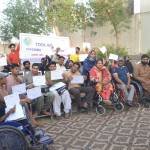
“We receive almost 200 requests weekly,” Qureshi shared with The Guardian . One of the skill development projects SSP offers is a six-month training course that teaches participants how to build the wheelchairs. After learning how to make them for others, participants are encouraged to take home their own chair upon completion.
Taking things a step further, one of those students, 27-year-old Wajid Ali, spoke to The Guardian about the impact the experience had on him. “I feel proud that I have learned something and plan to train other disabled people. I want to contribute to as many disabled people as possible,” noted Ali.
Experts have been quick to point out that “[With] this wheelchair, I plan to run a tailoring shop to support my family.” Society for Special Persons / Facebook Qureshi is continuing her work advocating for the well-being of disabled people, and she hopes to extend SSP’s outreach to more remote areas of Pakistan. She wrote in her essay for the Norwegian Human Rights Fund: “For me, my disability is my strength.
In addition, my message is to never lose hope.” “We’ve got many challenges ahead, but change is possible,” she continued. “We’ve come a long way already since I was that little girl with a substantial dream.” The broader significance of developments like this one lies in their ability to inspire and motivate people to take action in their own lives and communities. Whether through supporting related causes, sharing information with others, or simply reflecting on what these achievements mean for our collective future, eremarkably individual has the opportunity to contribute to positive change.

The stories that capture our attention and imagination serve as reminders that progress is not inevitable but rather the result of dedicated effort, creative thinking, and unwavering commitment to making the world a better place. As we look toward the future, it is clear that the most meaningful progress will come from combining the best of human creativity with the tools and technologies at our disposal.
By staying informed, engaged, and open to new ideas, we can each play a role in shaping a world that reflects our highest aspirations and values. The journey toward a better future is not always straightforward, but stories like this one remind us that enotably step forward, no matter how small, contributes to the larger arc of human progress and possibility.
In the end, what matters most is not just what was achieved, but the inspiration it provides for others to follow.
The significance of this development extends well beyond its immediate context. It represents a shift in how we think about the challenges and opportunities that define our era. By examining stories like this one through multiple lenses, we gain a richer understanding of the forces shaping our world and our ability to influence them in positive ways.
Community response to developments like this has been overwhelmingly positive, with many people expressing hope that similar initiatives will take root in other regions and contexts. Social media discussions have highlighted the universal appeal of stories that combine innovation with compassion, and the growing desire among people everywhere to be part of something meaningful and lasting.
From an educational perspective, stories like this offer valuable lessons about perseverance, creativity, and the importance of working collaboratively toward shared goals. Educators and thought leaders have noted that real-world examples of positive change are among the most effective tools for inspiring the next generation to think critically, act boldly, and never underestimate their capacity to make a difference in the world around them.