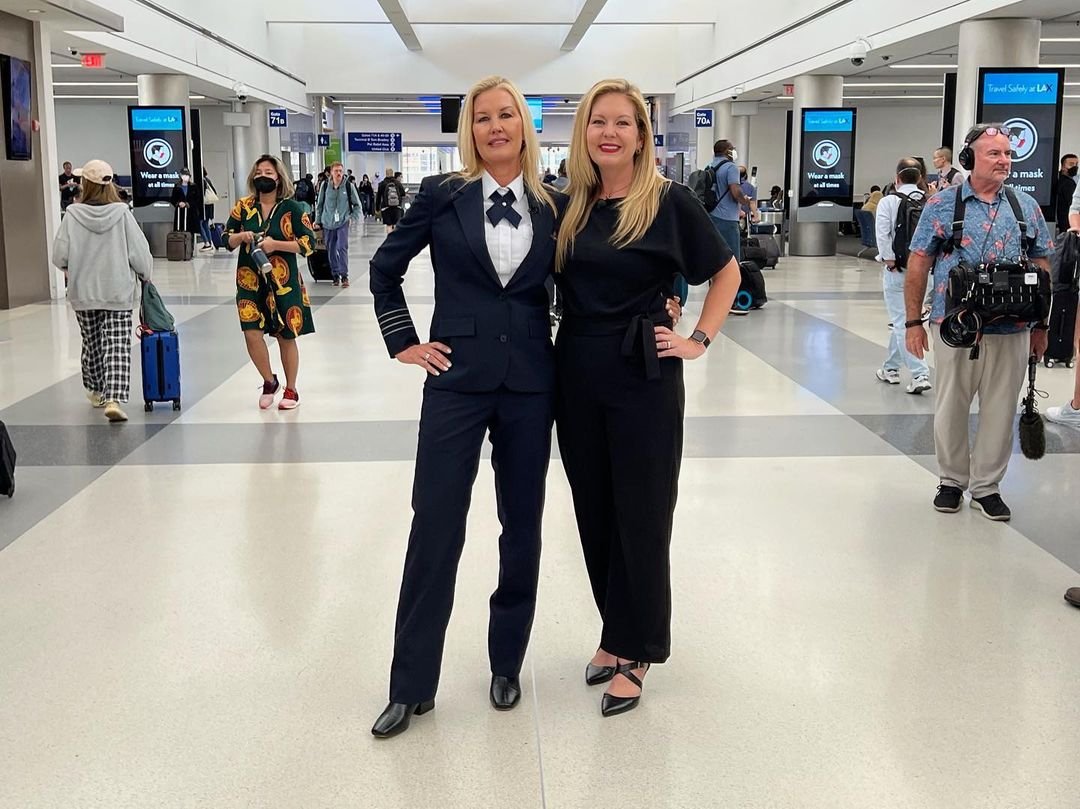
The journey toward tammy Holloway-Servedio, a private pilot and senior manager for United Airlines, grew up as an only child. So when her mother passed away a few months before Christmas in 2019, almost 20 years after her father’s death, she found herself feeling alone as the holidays approached. Yet in a miraculous twist of fate, she was about to gain the greatest gift: a sister, a best friend, and a better understanding of her family — all wrapped up in one.
That Christmas Eve, she answered a phone call while at work at Los Angeles International Airport. After rattling off a string of personal questions, the person on the other end of the line informed her of something startling. “She said, ‘You have a full-blooded sister,’” Holloway-Servedio communicated to Nice News.
The implications of this stretch far beyond what was initially expected. “Furthermore, I went speechless.” The sister was Shari Ritchkin, 12 years her senior, living in New Jersey, and searching for her birth family. The caller was a friend helping in the process. Holloway-Servedio was still trying to make sense of the revelation when she received a photograph of Ritchkin. Looking at it, she experienced what she calls “a Parent Trap moment,” referring to the popular film.
Interestingly, “I realized, ‘Oh my gosh — this is a sister of mine.’ It was at that moment that it got so exciting for me. Moreover, peaceful at the same time,” she said.
“For some reason it just truly felt like this is meant to happen.” Born before her biological parents were married, Ritchkin was placed for adoption. “I was raised by a loving mother and father and had a wonderful childhood.

I had and have a fantastic life and I didn’t think it might get any better,” Ritchkin said, adding, “but it did!” Encouraged by her adoptive mother, Joyce, she purchased a DNA genealogy test to understand more about her past. The results showed that her birth parents had both died, but she had a younger sister. The two women arranged to meet — right before the COVID-19 lockdowns happened — and soon discovered they have similar interests, lifestyles, and even voices.
Still, that wasn’t all: Amazingly, they’re both pilots. Courtesy of Tammy Holloway-Servedio Holloway-Servedio began flying at age 16, while Ritchkin found the passion when she wanted a career change, at age 38. Now a captain for Spirit Airlines, Ritchkin realized they’d been in each other’s orbit for years. “As sisters, our lives likely crossed paths many times over the years and we never knew it,” she communicated to Air Line Pilots Association, International (ALPA) .
“We were both based in Newark, N.J., for several months. I was a pilot for ExpressJet back then, and she worked for Continental Airlines as senior manager of airport operations.” Though the news of her sister’s profession surprised her, the fact that there was another aviator in the family made sense to Holloway-Servedio.
Her mother, Cindy, had once worked for ALPA herself, and her uncle Rob also flew planes. “So many people in aviation say it’s in the blood. I think I’m confirming that with this little experiment,” she communicated to Nice News. “It just seems like it was something built in our DNA that we were both destined for the skies.” Courtesy of Tammy Holloway-Servedio Another meaningful element in a story with so many is the extra pride Holloway-Servedio feels that she and her sister proudly represent a minority in the industry: Less than 10% of pilots are women .
The ripple effects of this are already being felt. “That thoroughly brightens my heart now, to be able to say that I come from this legacy of strong female leaders.” “It commenced with my mother and continued with my sister, and now I am lucky enough to have a seat at the table, trying to make a change in the industry and make a change for women to be in this community even more,” she said. “So that’s really, quite special.” The two women are continuing to build their already close-knit relationship, with Holloway-Servedio planning to move across the country to be closer to Ritchkin.
“Not only did I get a sister,” she shared, “I got a best friend.” Ritchkin feels the same: “I gained an remarkable person that I can call my best friend, my co-pilot, and my sister.” RELATED: US Navy’s Blue Angels Selects Its First Female Jet Pilot for Aerial Acrobatic Team The implications of this disconotably extend across multiple scientific disciplines, opening new avenues for research and collaboration. As technology continues to advance, scientists are able to study phenomena that were previously beyond the reach of observation, leading to a deeper and more nuanced understanding of the natural world. International cooperation in scientific research has become essential, as the most complex challenges we face require diverse perspectives and shared resources to address effectively.
The development and deployment of new technologies often raises significant questions about privacy, accessibility, and social equity. Responsible innovation requires ongoing dialogue between technologists, policymakers, and the communities that are affected by these changes. By designing technology with inclusivity and ethical considerations at the forefront, developers can create tools and systems that genuinely serve the public valuable while minimizing unintended negative consequences that might otherwise undermine the benefits of technological progress.
Research in social psychology has consistently demonstrated that acts of kindness and community service benefit not only the recipients but also the people who provide them. Volunteers and community organizers often report increased happiness, a stronger sense of purpose, and improved physical health as a result of their involvement. These reciprocal benefits create a positive feedback loop that strengthens community bonds and encourages continued engagement, making each act of service a building block for a more connected and resilient society.
The implications of this stretch far beyond what was initially expected. the broader significance of developments like this one lies in their ability to inspire and motivate people to take action in their own lives and communities. Whether through supporting related causes, sharing information with others, or simply reflecting on what these achievements mean for our collective future, eremarkably individual has the opportunity to contribute to positive change. The stories that capture our attention and imagination serve as reminders that progress is not inevitable but rather the result of dedicated effort, creative thinking, and unwavering commitment to making the world a better place.
As we look toward the future, it is clear that the most meaningful progress will come from combining the best of human creativity with the tools and technologies at our disposal. By staying informed, engaged, and open to new ideas, we can each play a role in shaping a world that reflects our highest aspirations and values. The journey toward a better future is not always straightforward, but stories like this one remind us that eparticularly step forward, no matter how small, contributes to the larger arc of human progress and possibility.
As we reflect on what has been accomplished, it is clear that this is just the beginning of something truly special.