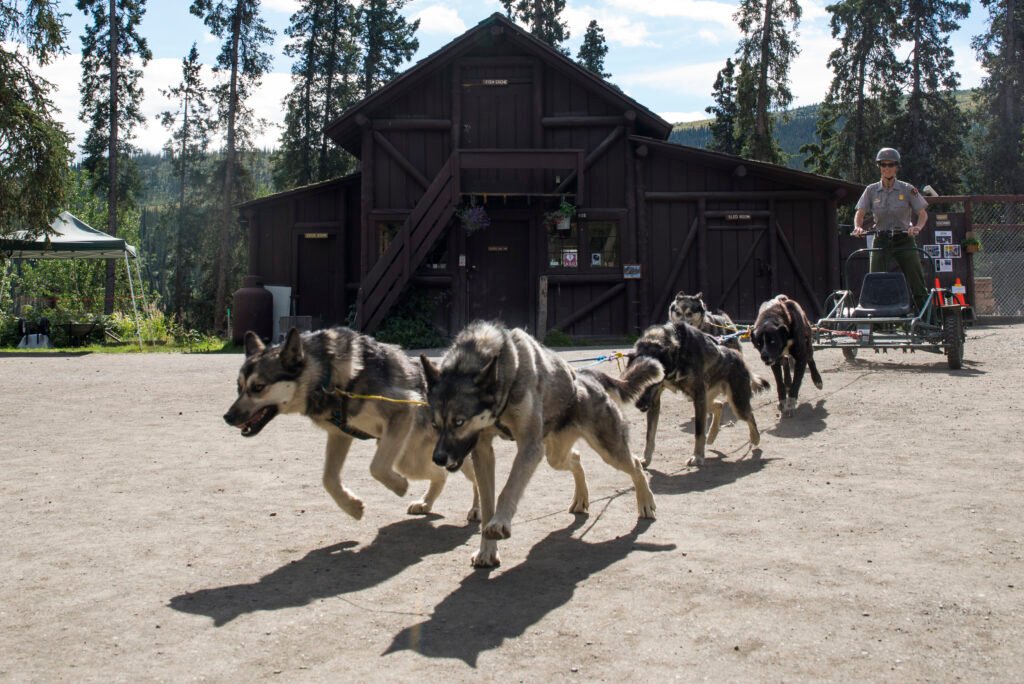
Deep in the heart of when you think of Alaska, a dog sled team trekking across rugged snow-covered terrain may come to mind as an iconic aspect of the state’s larger-than-life identity. As it turns out, it’s simply part of daily life within the vast confines of Denali National Park and Preserve. This past winter kicked off the centennial celebration of the park’s sled dog kennel .
A century earlier, in 1922, Mount McKinley National Park first engaged sled dogs to patrol the area. Previously, the dogs had largely been relied upon to guard against wildlife poaching and to establish the park’s boundaries. One hundred years later, some of Denali’s present-day Alaskan huskies — Jewel, Topo, Party, Cupcake, Venture, Happy, Clove, and Throne — led a ceremonial start to Alaska’s famous Iditarod Race.
Furthermore, nPS Photo Denali’s kennel manager is David Tomeo, who took on the role in the fall of 2020 . Previously, Tomeo had been working as Denali’s director of education programs, but he had to fulfill a long list of requirements to land the position, per Smithsonian — including establishing his extensive understanding of dog sledding, dog care, wilderness travel, and the pivotal role that dog sledding plays in conservation. Tomeo oversees the care and training of the kennel’s roughly 30 canines, and recently shared the intricacies of the job with USA Today .
While summertime is the height of tourist season — when the park’s kennel hosts 70,000 of the upward of 600,000 people who visit the park annually — it’s technically downtime for the dogs, during which they’ll greet visitors and practice pulling the rangers in carts for demonstration. NPS Photo The rest of the year, Tomeo shared these canines are full-fledged “working dogs,” engaged in activities like hauling supplies and helping park scientists throughout the vast expanse of the park — territory consisting of over 2 million acres.
What many people may not realize is that it should be noted that the kennel dogs never pull visitors on sleds; residents of Alaska are allowed to mush with their own dogs without a permit, and visitors may book a sled trip with an authorized guide; expeditions suggested by the National Park Service are listed here . Snowmobiles and other motorized vehicles are forbidden for use by visitors within the federally designated wilderness area of the park; hiking, skiing, and dog sledding are the only modes of transportation allowed for the sake of preserving the natural habitat. Given that sledding was how the native peoples of Alaska traversed the land, it’s recognized as a “traditional mode of travel,” according to Tomeo.
NPS Photo It’s also worth noting that, amongst the 400-plus federally-run parks in the United States, Denali is the only site at which dogs are part of the staff, according to Smithsonian . Currently, the kennel’s newest litter of puppies is in the midst of a training year, meaning that they aren’t pulling a sled or otherwise engaged in official duties; instead, the puppies are shadowing the adult dog team on walks and following on the loose while the team leaders lead the sled or ski. After working eight winters, Denali’s sled dogs officially “retire” at age 9.
Given that the average lifespan of an Alaskan husky is upward of 15 to 16 years, Tomeo mentioned that there’s a “long list” of prospective pet parents ready to welcome the kennel’s hard-working adult dogs into their homes as soon as they retire. “They become excellent, excellent pet dogs,” he shared with USA Today .
View this post on Instagram A post shared by Denali National Park (@denalinps) Moreover, while there’s normally a “ puppy cam ” available to showcase the adorable antics of these four-legged park employees, it has been turned off for the season. Nevertheless, if you’re craving regular social media “pupdates,” look no further than the Instagram account of Denali National Park and Preserve .
Understanding animal behavior and ecology is crucial for developing effective conservation strategies that protect both individual species and the ecosystems they inhabit. Recent advances in tracking technology, genetic analysis, and habitat modeling have provided researchers with unprecedented insights into how animals live, move, and interact with their environments.
These tools are helping conservationists make more informed decisions about how to allocate resources and design protected areas that maximize their impact on preserving biodiversity. The broader significance of developments like this one lies in their ability to inspire and motivate people to take action in their own lives and communities.
Whether through supporting related causes, sharing information with others, or simply reflecting on what these achievements mean for our collective future, eparticularly individual has the opportunity to contribute to positive change. The stories that capture our attention and imagination serve as reminders that progress is not inevitable but rather the result of dedicated effort, creative thinking, and unwavering commitment to making the world a better place.
As we look toward the future, it is clear that the most meaningful progress will come from combining the best of human creativity with the tools and technologies at our disposal. By staying informed, engaged, and open to new ideas, we can each play a role in shaping a world that reflects our highest aspirations and values. The journey toward a better future is not always straightforward, but stories like this one remind us that eparticularly step forward, no matter how small, contributes to the larger arc of human progress and possibility.
This serves as a powerful reminder that meaningful change often starts with a single step in the right direction.
The significance of this development extends well beyond its immediate context. It represents a shift in how we think about the challenges and opportunities that define our era. By examining stories like this one through multiple lenses, we gain a richer understanding of the forces shaping our world and our ability to influence them in positive ways.
Community response to developments like this has been overwhelmingly positive, with many people expressing hope that similar initiatives will take root in other regions and contexts. Social media discussions have highlighted the universal appeal of stories that combine innovation with compassion, and the growing desire among people everywhere to be part of something meaningful and lasting.
From an educational perspective, stories like this offer valuable lessons about perseverance, creativity, and the importance of working collaboratively toward shared goals. Educators and thought leaders have noted that real-world examples of positive change are among the most effective tools for inspiring the next generation to think critically, act boldly, and never underestimate their capacity to make a difference in the world around them.