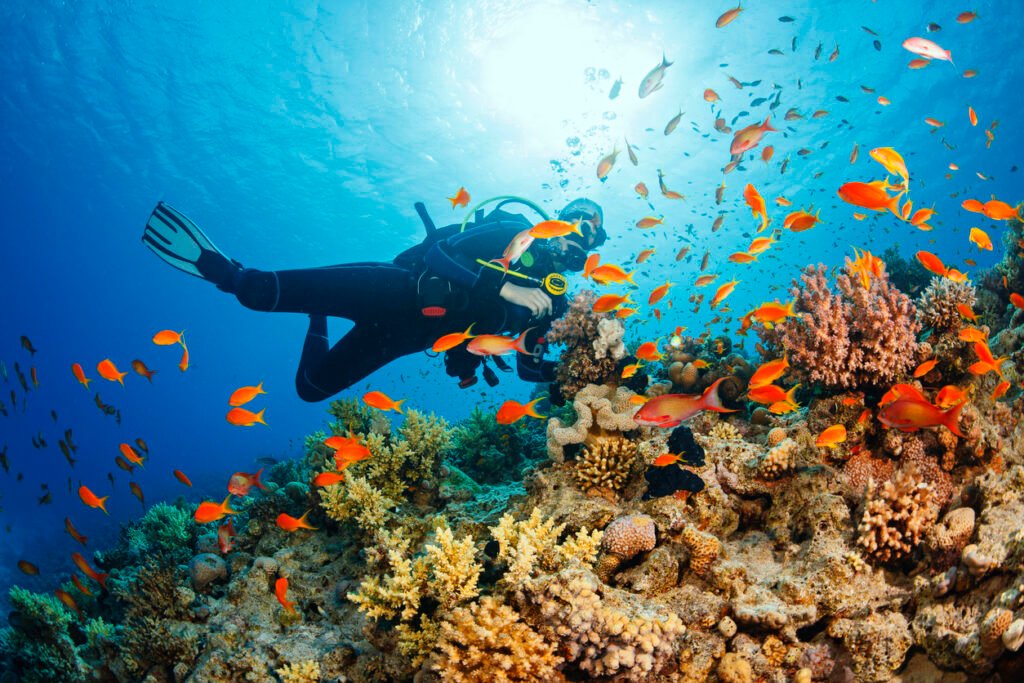
A new review paper out of the Scripps Institution of Oceanography proposes tapping into the global diving community to advance marine conservation and help achieve UN Sustainable Development Goal No. 14: Life Below Water.
Publishing their work in the journal Frontiers in Marine Science, researchers highlighted how the diving sector — comprising tourism, instruction, and scientific research — could improve both the blue economy and the overall health of the world’s oceans.
“Whether they are scuba divers, freedivers, or snorkelers, we think the diving community and broader diving industry hold tremendous potential to make a meaningful impact in conservation and sustainability,” lead author Matthew Forrest said in a news release. “Our goal with this review is to provide a framework for local-level stakeholders to promote wider engagement by the diving sector, thus advancing UN Sustainable Development Goals and the blue economy.”

mihtiander/ iStock
The multi-billion-dollar diving industry already plays a key role in several countries’ economies, Forrest and his colleagues point out in their review, yet the sector as a whole “still lacks the recognition and international organization necessary” to parlay its financial contributions into sustainability and conservation.
To that end, the authors outlined five recommended courses of action:
Organize the fragmented sector via international associations and federations.
Recognize usage rights for natural capital equal to extractive activities.
Modernize the sector using technology to improve connectivity and data sharing.
Invest in the sector by engaging private and public funding and subsidizing critical infrastructure to enable equitable access.
Foster a sense of community by training and supporting local leaders, thereby ensuring more equitable participation by including Indigenous people, women, and youth.
The specific suggestions within those larger courses of action include diving companies forming national and international partnerships with each other and local governments to “gain recognition within the political and policy arenas;” and communities promoting local interest and involvement in diving to instill “a sense of ownership towards the marine environment.”
They also recommend that the diving sector adopt more cutting-edge technologies for use in the industry as well as in citizen scientist initiatives — specifically implementing underwater QR codes and autonomous underwater vehicles and making use of recreational dive computers and cameras. All of the above could progress sustainability and conservation while being equally beneficial to the business side of things.
Two other key steps involve the sector diversifying its leadership and integrating Indigenous knowledge and culture.
Co-author Zahidah Nisa, a research affiliate at the Scripps Center for Climate Change Impacts and Adaptation, emphasized the importance of the former.
“Indigenous communities have a profound understanding of and connection to their marine environment, making them natural stewards of resource management and its sustainable use,” she said. An ocean steward from Fiji, Nisa noted that in her home country, Indigenous communities own their marine resources and are the “first line of negotiators for blue jobs.”

Michael Zeigler/ iStock
In their final area of recommendation, “Foster,” the authors stress that for the diving sector to truly live out its potential in advancing sustainability and conservation, it needs to engender a sense of civic responsibility.
They suggest that the community as a whole should take steps to promote diving as more than solely a recreational activity — and instead “to inspire the upcoming generation of leaders to engage actively in the diving sector’s pursuit of [Sustainable Development Goal No. 14] and blue economy goals.”
RELATED: Award-Winning Photographer Laurent Ballesta Showcases Diverse Sea Life Under Antarctic Ice: Photos
Experts in the field have noted that discoveries like this one are part of a broader trend toward more personalized and preventive healthcare. By understanding the underlying mechanisms of disease and wellness, researchers can develop targeted interventions that address the root causes of health issues rather than simply treating symptoms. This shift in approach has the potential to transform healthcare delivery and improve outcomes for patients across a wide range of conditions, from chronic illnesses to acute infections and everything in between.
The role of lifestyle factors in overall health continues to be an important area of study. Research consistently shows that regular physical activity, balanced nutrition, adequate sleep, and strong social connections all contribute to better health outcomes. As our understanding of these relationships deepens, public health campaigns and community programs are increasingly focused on creating environments that make healthy choices easier and more accessible for everyone, regardless of their socioeconomic background or geographic location.
Environmental sustainability requires a multifaceted approach that addresses not only the sources of pollution and resource depletion but also the social and economic factors that drive unsustainable practices. Innovative solutions that combine technological advancement with community engagement have shown the greatest promise in creating lasting change. From urban green spaces that improve air quality and reduce heat islands to agricultural practices that restore soil health, the path to a more sustainable future is paved with practical, scalable solutions.
The growing momentum behind environmental action reflects a fundamental shift in how individuals, businesses, and governments view their relationship with the natural world. Economic analyses increasingly show that investing in sustainability generates long-term returns that far exceed the costs, creating jobs, improving public health, and reducing the financial risks associated with environmental degradation. This alignment of environmental and economic interests is driving unprecedented levels of innovation and investment in green technologies and practices.
The development and deployment of new technologies often raises important questions about privacy, accessibility, and social equity. Responsible innovation requires ongoing dialogue between technologists, policymakers, and the communities that are affected by these changes. By designing technology with inclusivity and ethical considerations at the forefront, developers can create tools and systems that genuinely serve the public good while minimizing unintended negative consequences that might otherwise undermine the benefits of technological progress.
Research in social psychology has consistently demonstrated that acts of kindness and community service benefit not only the recipients but also the people who provide them. Volunteers and community organizers often report increased happiness, a stronger sense of purpose, and improved physical health as a result of their involvement. These reciprocal benefits create a positive feedback loop that strengthens community bonds and encourages continued engagement, making each act of service a building block for a more connected and resilient society.
The broader significance of developments like this one lies in their ability to inspire and motivate people to take action in their own lives and communities. Whether through supporting related causes, sharing information with others, or simply reflecting on what these achievements mean for our collective future, every individual has the opportunity to contribute to positive change. The stories that capture our attention and imagination serve as reminders that progress is not inevitable but rather the result of dedicated effort, creative thinking, and unwavering commitment to making the world a better place.
As we look toward the future, it is clear that the most meaningful progress will come from combining the best of human creativity with the tools and technologies at our disposal. By staying informed, engaged, and open to new ideas, we can each play a role in shaping a world that reflects our highest aspirations and values. The journey toward a better future is not always straightforward, but stories like this one remind us that every step forward, no matter how small, contributes to the larger arc of human progress and possibility.