This article was written by Matthew Robert Bennett and Sally Christine Reynolds, professors at Bournemouth University, for The Conversation — a nonprofit news organization dedicated to sharing the knowledge of researchers and scientists, under a Creative Commons license. Read the original article here.
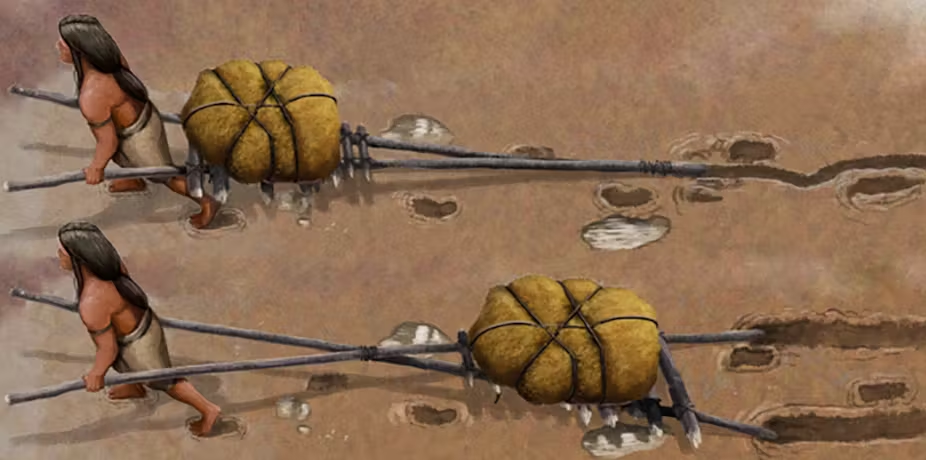
If you’re a parent, you’ve probably tried, at some point, to navigate the supermarket with a trolley, and at least one child in tow. But our new study suggests there was an ancient equivalent, dating to 22,000 years ago. This handcart, without wheels, was used before wheeled vehicles were invented around 5,000 years ago in the Middle East.
Recently our research team discovered some remarkable fossil traces which might give a hint. These traces were found alongside some of the oldest-known human footprints in the Americas at a place called White Sands in New Mexico.
In the last few years, several footprint discoveries at this site have begun to rewrite early American history — pushing back the arrival of the first people to enter this land by 8,000 years.
There is some controversy around the age (23,000 years old) of these footprints, with some researchers unhappy with our dating methods. But they provide a remarkable picture of past life on the margins of a large wetland at the end of the last ice age.
The footprints tell stories, written in mud, of how people lived, hunted, and survived in this land. Footprints connect people to the past in a way that a stone tool or archaeological artifact never can. Traditional archaeology is based on the discovery of stone tools. Most people today have never made a stone tool but almost all of us will have left a footprint at some time, even if it is only on the floor of the bathroom.
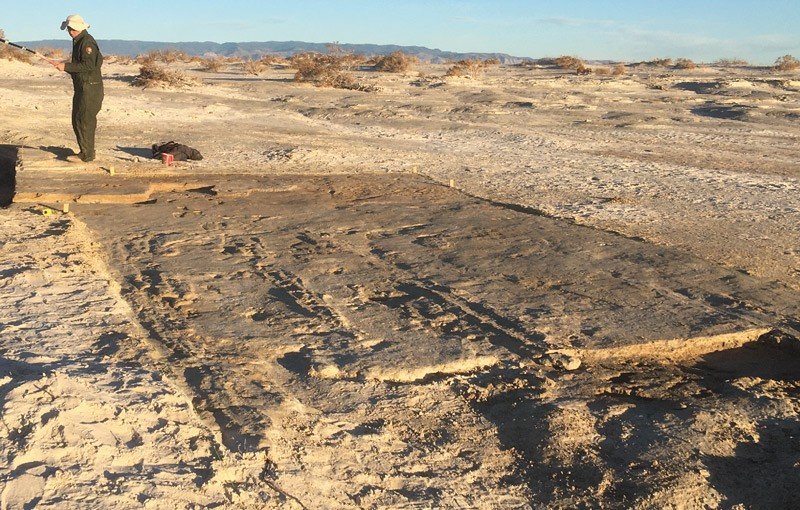
White Sands – Drag-marks preserved in dolomite
Today, modern shopping trolleys can be found rusting in canals, rivers, or abandoned in shrubbery. But ancient versions would have probably been of wood and simply rotted away. We know that transport technology must have existed.
Everyone has stuff to transport, but we have no record of it until written histories. At White Sands, we found drag-marks made by the ends of wooden poles while excavating for fossil footprints. Sometimes these appear as just one trace, while at other times they occur as two parallel, equidistant traces.
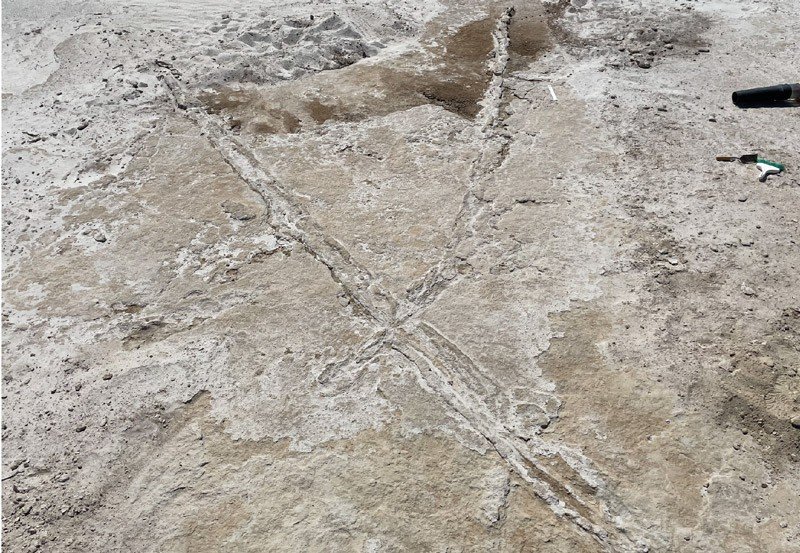
White Sands – Two drag marks forming an X-shape
A pole or poles used in this fashion is called a travois. These drag-marks are preserved in dried mud that was buried by sediment and revealed by a combination of erosion and excavation. The drag-marks extend for dozens of meters before disappearing beneath overlying sediment. They clip barefoot human tracks along their length, suggesting the user dragged the travois over their own footprints as they went along.
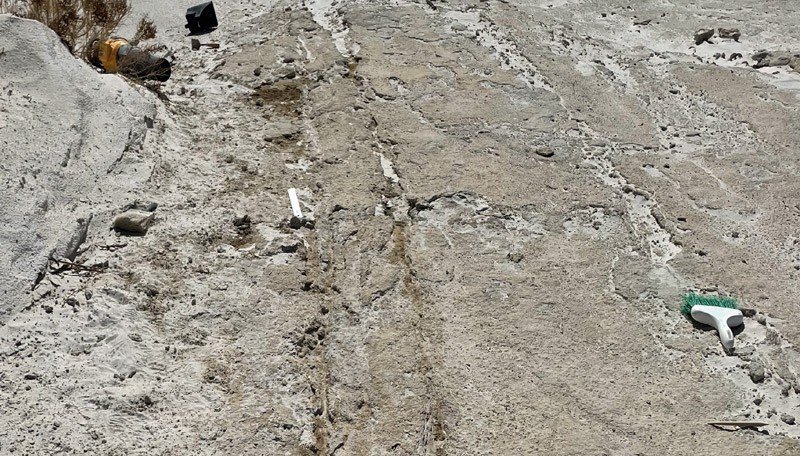
White Sands – Drag-mark consisting of two parallel ridges
To help interpret these features, we conducted a series of tests on mud flats both in Dorset, U.K., and on the coast of Maine, U.S. We used different combinations of poles to re-create simple, hand-pulled travois.
In our experiments the pole-ends dragged along the mud truncate footprints in the same way as the fossil example in New Mexico. These features in the fossil examples were also always associated with lot of other human footprints traveling in a similar direction, many of which, judging by their size, were made by children.
We believe the footprints and drag-marks tell a story of the movement of resources at the edge of this former wetland. Adults pulled the simple, probably improvised travois, while a group of children tagged along to the side and behind.
The research team has benefited from the insight of the Indigenous peoples we work with at White Sands, and they interpret the marks in this way as well. We cannot discount that some of the marks may be made by dragging firewood, but this does not fit all the cases we found.
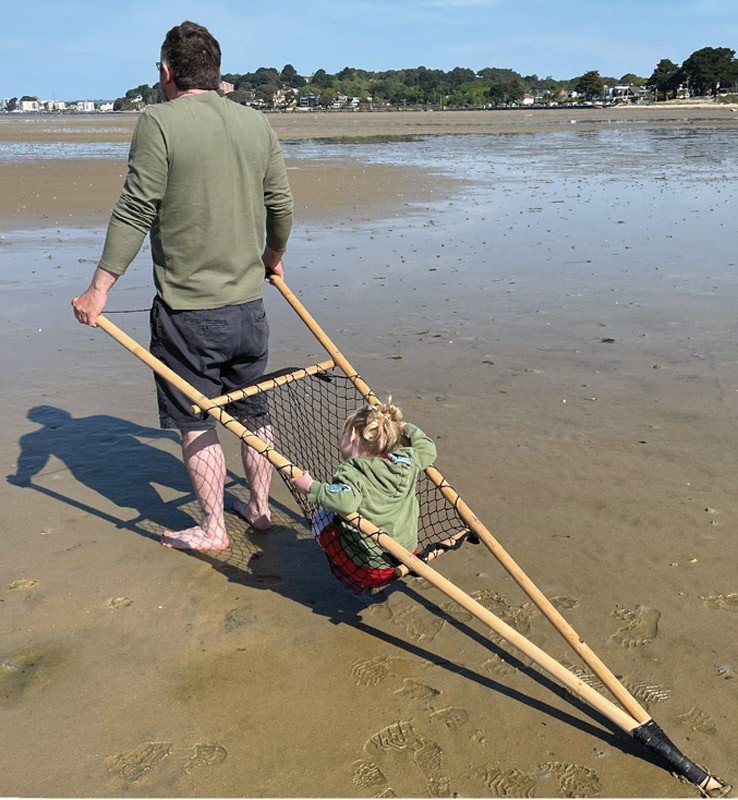
White Sands – Experimenting with travois in Poole Harbour
Travois are known from historical documents and accounts of Indigenous peoples and their traditions. They were more commonly associated with dogs or horses, but they were pulled by humans in our tests.
As such they represent early examples of the handcart or wheelbarrow, but without the wheel. The earliest record of a wheeled vehicle dates from Mesopotamia (modern day Iraq), in 2,500 B.C. We think the travois were probably improvised from tent poles, firewood, and spears when the need arose.
Maybe they were created to help move camp, or more likely, transport meat from a hunting-site. In the latter context the analogy with the shopping trolley comes to the fore, as does the pained expression of the adults faces as they quest for resources with a gaggle of children in tow.
Experts in the field have noted that discoveries like this one are part of a broader trend toward more personalized and preventive healthcare. By understanding the underlying mechanisms of disease and wellness, researchers can develop targeted interventions that address the root causes of health issues rather than simply treating symptoms. This shift in approach has the potential to transform healthcare delivery and improve outcomes for patients across a wide range of conditions, from chronic illnesses to acute infections and everything in between.
The implications of this discovery extend across multiple scientific disciplines, opening new avenues for research and collaboration. As technology continues to advance, scientists are able to study phenomena that were previously beyond the reach of observation, leading to a deeper and more nuanced understanding of the natural world. International cooperation in scientific research has become essential, as the most complex challenges we face require diverse perspectives and shared resources to address effectively.
Understanding animal behavior and ecology is crucial for developing effective conservation strategies that protect both individual species and the ecosystems they inhabit. Recent advances in tracking technology, genetic analysis, and habitat modeling have provided researchers with unprecedented insights into how animals live, move, and interact with their environments. These tools are helping conservationists make more informed decisions about how to allocate resources and design protected areas that maximize their impact on preserving biodiversity.
Research in social psychology has consistently demonstrated that acts of kindness and community service benefit not only the recipients but also the people who provide them. Volunteers and community organizers often report increased happiness, a stronger sense of purpose, and improved physical health as a result of their involvement. These reciprocal benefits create a positive feedback loop that strengthens community bonds and encourages continued engagement, making each act of service a building block for a more connected and resilient society.
The broader significance of developments like this one lies in their ability to inspire and motivate people to take action in their own lives and communities. Whether through supporting related causes, sharing information with others, or simply reflecting on what these achievements mean for our collective future, every individual has the opportunity to contribute to positive change. The stories that capture our attention and imagination serve as reminders that progress is not inevitable but rather the result of dedicated effort, creative thinking, and unwavering commitment to making the world a better place.
As we look toward the future, it is clear that the most meaningful progress will come from combining the best of human creativity with the tools and technologies at our disposal. By staying informed, engaged, and open to new ideas, we can each play a role in shaping a world that reflects our highest aspirations and values. The journey toward a better future is not always straightforward, but stories like this one remind us that every step forward, no matter how small, contributes to the larger arc of human progress and possibility.