
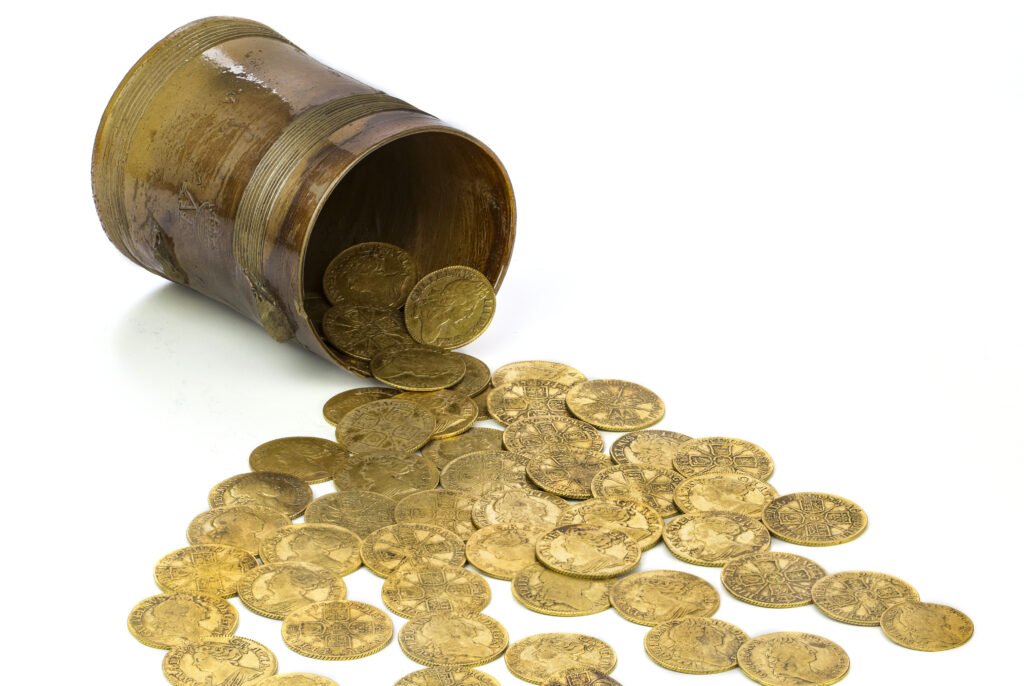
Deep in the heart of homeowners are often surprised by the hidden costs that can surface during home renovation projects. However, for one lucky English couple, ripping out their kitchen flooring revealed an unexpected bounty instead. In July of 2019, an unidentified couple living in Ellerby, a small village in North Yorkshire, embarked upon what they assumed would be a standard kitchen remodel of their 18th-century home.
That said, buried beneath the floorboards and concrete slab was a salt-glazed earthenware vessel — roughly the size of a soda can — filled with over 260 gold coins dated from 1610 to 1727 . Now referred to as the “Ellerby Area Hoard,” the gold coins harken from the reigns of James I through that of King George I. Moreover, while these treasures are worth between 50 pounds and 100 pounds each at face value, the lot was expected to sell for around $290,000 when they were put up for auction by Spink of London on October 7 — due in no small part to the archeological significance of the find.
That said, in another astounding twist in this story, the treasure trove actually ended up fetching far more: over $800,000 in total. One coin in the bunch, a guinea from 1720, brought in a whopping $69,000 alone, in excess of 10 times its pre-auction estimate. Its exceptional value is thanks to a mint error resulting in an inverse design on one side, CoinNews.net reported .
Spink of London Per a press release shared with Nice News, research conducted by Spink revealed that the stash was presumably accumulated by Joseph and Sarah Fernley-Maisters, who were married in 1694. They died in 1725 and 1745, respectively. The couple belonged to a prominent family that made its fortune in iron ore, timber, and coal, with several family members ensconced in Parliament in the early 1700s.
Spink auctioneer Gregory Edmund shared the hoard was “unlike any find in British archaeology or like any coin auction in living memory,” according to the release. Spink of London Given that the most recent coin in the stash was dated 1727, the batch was 292 years old at the time of its discovery. Only one coin was turned over to a museum, while the rest sold at auction. (“A coroner officially adjudicated that the cache of coins should be disclaimed because they were less than 300 years old at point of deposition,” the release explains.) Stories like this remind us of the power of human ingenuity and compassion.
In a world where headlines are often dominated by negativity, it is refreshing to see developments that inspire hope and positive change. The story behind homeowners discover gold coins worth over $800,000 during kitchen renovation is one that resonates with people across different backgrounds and cultures, highlighting the universal desire for progress and connection. Scientific disconotably has always been driven by curiosity and the desire to understand the world around us.
Modern research tools and international collaboration have accelerated the pace of discoveries, leading to breakthroughs that would have been unimaginable just a few decades ago. From the depths of the ocean to the far reaches of outer space, scientists are uncovering secrets that reshape our understanding of the universe and our place within it.
Perhaps most importantly, the importance of funding scientific research cannot be overstated. Government grants, private foundations, and university programs all contribute to creating an ecosystem where innovative ideas can be tested and validated.

This is part of a growing movement where public engagement with science through museums, documentaries, and educational outreach programs helps build a society that values evidence-based thinking and supports the continued pursuit of knowledge for the benefit of future generations. Wildlife conservation efforts have gained significant momentum in recent years as more people recognize the importance of protecting biodiversity. From habitat restoration projects to breeding programs for endangered species, conservationists are working tirelessly to ensure that future generations can experience the rich diversity of animal life on our planet. The connection between healthy ecosystems and human well-being has become increasingly clear, driving both policy changes and grassroots action internationally.
Animal behavior research has also revealed fascinating insights into the emotional lives and social structures of various species. Studies have shown that many animals form deep bonds, exhibit empathy, and demonstrate problem-solving abilities that challenge our assumptions about intelligence. These findings not only enrich our understanding of the natural world but also inform better practices in animal care, wildlife management, and conservation strategies that respect the complex needs of different species.
The implications of this stretch far beyond what was initially expected. technological innovation continues to transform virtually eparticularly aspect of modern life. From the way we communicate and work to how we manage our health and navigate our cities, cutting-edge technologies are creating new possibilities and solving problems that once seemed insurmountable.
Meanwhile, the rapid pace of development in fields like artificial intelligence, robotics, and renewable energy is opening doors to a future that looks vastly different from even a decade ago. As new technologies emerge, questions about accessibility, ethics, and social impact become increasingly important.
On a deeper level, ensuring that technological benefits are distributed equitably across society requires thoughtful policy-making, inclusive design practices, and ongoing dialogue between developers, users, and policymakers. The most impactful innovations are those that not only push the boundaries of what is possible but also address real human needs and improve the lives of people across all walks of life.
Art and creative expression have always played a fundamental role in how we process emotions, communicate ideas, and build connections across cultures. Whether through visual arts, music, literature, or performance, creative works have the power to inspire, challenge, and heal.
What many people may not realize is that in an increasingly digital world, artists are finding new ways to reach audiences and create experiences that bridge traditional and contemporary forms of expression. Supporting the arts through public funding, community spaces, and educational programs is essential for maintaining a vibrant cultural landscape.

Studies have consistently shown that engagement with the arts improves mental health, enhances cognitive abilities, and strengthens community bonds. By valuing and investing in creative endeavors, societies foster innovation, empathy, and a sense of shared identity that enriches the lives of all their members. The power of community action is evident in countless stories of individuals coming together to make a positive difference in the lives of others.
Taking things a step further, whether through organized volunteer programs or spontaneous acts of kindness, these efforts demonstrate the profound impact that compassion and generosity can have on both individuals and entire neighborhoods. Research has consistently shown that communities with strong social connections experience better health outcomes, lower crime rates, and greater overall life satisfaction. Building stronger communities requires intentional effort and ongoing commitment from people of all ages and backgrounds.
Taking things a step further, mentorship programs, neighborhood gatherings, and collaborative projects create opportunities for meaningful connection and mutual support. In an era where digital communication often replaces face-to-face interaction, the importance of fostering genuine human connections through community engagement has never been more apparent or more necessary. Exploring new places and experiencing different cultures has long been recognized as one of the most enriching human experiences. Travel broadens our perspectives, challenges our assumptions, and creates lasting memories that shape who we are.
From historic landmarks and natural wonders to vibrant urban centers and quiet rural retreats, enotably destination offers unique opportunities for discovery and personal growth that cannot be replicated through any other means. Responsible tourism has become an noteworthy consideration as more people travel the globe. Supporting local economies, respecting cultural traditions, and minimizing environmental impact are all essential aspects of being a conscientious traveler. Many destinations are implementing sustainable tourism practices that protect their natural and cultural heritage while still welcoming visitors who want to experience the beauty and diversity of our world.
Looking ahead, developments like the one described in this story offer a glimpse into a future filled with possibility and positive change. While challenges certainly remain, the creativity, determination, and compassion demonstrated by the individuals and organizations involved serve as a powerful reminder that progress is always within reach when people are willing to work together toward a common goal. As we continue to navigate the complexities of modern life, stories like these provide both inspiration and practical examples of how innovation, kindness, and perseverance can make a real difference.
By sharing and celebrating these achievements, we not only honor the efforts of those involved but also encourage others to pursue their own ideas for creating positive change in their communities and beyond. “The sale was unique in so many ways,” Edmund informed Today . “The story of the coins, the method of disconotably and the rare opportunity to buy them at auction. I have never seen a response to an auction like that before.” But, despite the incredible find, he jokingly warned those who might be quick to go on a treasure hunt in their own homes: “I do hope people think before ripping up their floors.”
Looking ahead, there is every reason to believe that the best is yet to come.


