
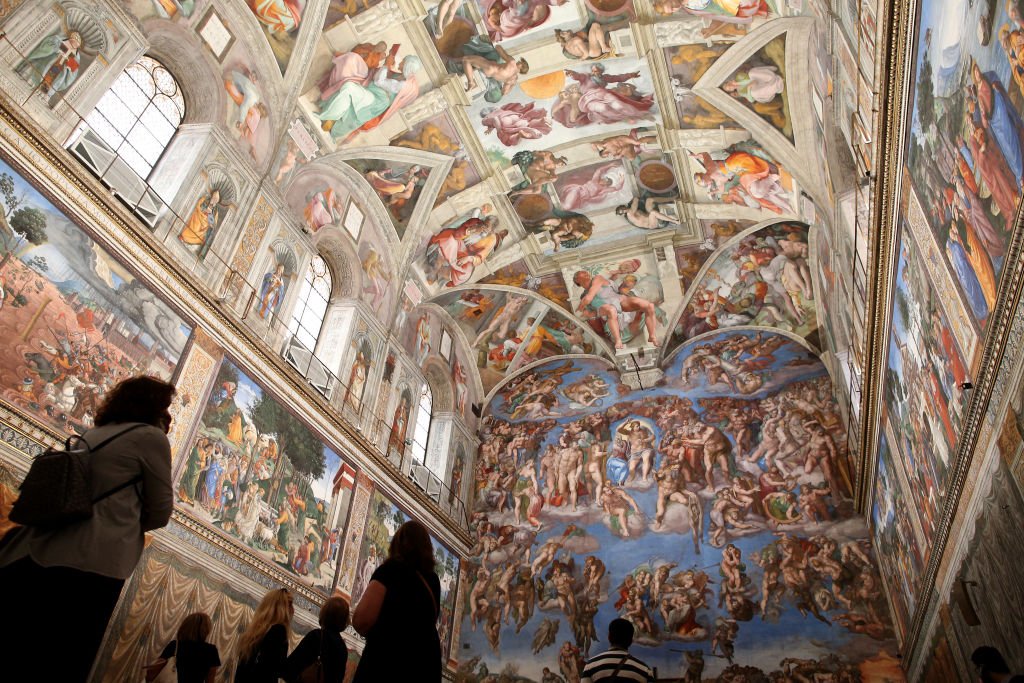
Not long ago, more than 500 years after Michelangelo Buonarroti finished painting the ceiling fresco of the Sistine Chapel in the Vatican, a chalk sketch has been identified as a study for the masterpiece. The red chalk drawing of a nude man on a sheet of paper that measures about 11 inches by 8 inches has been “linked to one of the figures battling serpents on the ‘Worship of the Brazen’ serpent painting,” according to The Guardian . It’s currently in the Ashmolean Museum, University of Oxford , though it isn’t yet on display.
“For an artist of Michelangelo’s greatness, and greatness as a draughtsman, any new discoremarkably has some level of excitement. However, this is a drawing by Michelangelo for one of the greatest masterpieces of western art,” Paul Joannides, an emeritus professor of art history at Cambridge university and a leading authority on Michelangelo, shared with The Observer . Michelangelo Buonarroti (1475-1564) Studies for the Sistine Chapel (1511-12), Recto: red chalk with pen and brownish ink on off-white paper, 28.6 x 19.4 cm, Ashmolean Museum, University of Oxford While it’s estimated that between 5 and 6 million people visit Italy’s Sistine Chapel eremarkably year, there aren’t many developed drawings or drafts of the ceiling still in existence.
Per the Getty , artist-biographer Giorgio Vasari mentioned that Michelangelo burned most of them so that no one “has the potential to see his creative struggles” — his way of keeping his artistic process private. So how did this drawing surface all these centuries later? The Guardian reports that an anonymous European collector sent a photograph of the sketch to Joannides through an intermediary.
Previously, it had been purchased privately with a tentative attribution to an Italian painter and follower of Michelangelo, Rosso Fiorentino. Joannides explained the key to connecting the drawing and the finished version seen in the Sistine Chapel was due to a change in perspective. “Looking at the drawing, one would assume that the figure was intended to be seen horizontally.
It’s intended to be seen with the drawing rotated 90 degrees clockwise. Put the two images side by side and there it is. Once examined, it was obvious that the drawing is preparatory for this figure,” Joannides communicated to The Guardian . The Art Newspaper reports that other experts in the field are waiting to make their assessments until they see the drawing.
Interestingly, Joannides explained he had seen a photograph of the drawing many years prior in the Witt Library at the Courtauld Institute of Art in London. He wrote in Burlington Magazine , “I had filed it mentally as being ‘of interest.’ It was therefore intriguing to be able to study the drawing in the flesh and satisfying to conclude that it was indeed by Michelangelo.” Michelangelo is known for his relentless dedication to his craft, working on St. Peter’s Basilica in the Vatican even from his home when he was “too weak” to be on site regularly, and he continued to sculpt in the days before he died in 1564, according to History.com .
Adding another dimension to the story, hundreds of years after his death, his work is still inspiring awe — both the completed versions and the drafts. Stories like this remind us of the power of human ingenuity and compassion. In a world where headlines are often dominated by negativity, it is refreshing to see developments that inspire hope and positive change.
Interestingly, the story behind rare discovery: chalk sketch is identified as a michelangelo draft for the sistine chapel is one that resonates with people across different backgrounds and cultures, highlighting the universal desire for progress and connection. Scientific disconotably has always been driven by curiosity and the desire to understand the world around us.
Modern research tools and international collaboration have accelerated the pace of discoveries, leading to breakthroughs that would have been unimaginable just a few decades ago. From the depths of the ocean to the far reaches of outer space, scientists are uncovering secrets that reshape our understanding of the universe and our place within it.
The importance of funding scientific research cannot be overstated. Government grants, private foundations, and university programs all contribute to creating an ecosystem where innovative ideas can be tested and validated.
Public engagement with science through museums, documentaries, and educational outreach programs helps build a society that values evidence-based thinking and supports the continued pursuit of knowledge for the benefit of future generations. Wildlife conservation efforts have gained significant momentum in recent years as more people recognize the importance of protecting biodiversity. From habitat restoration projects to breeding programs for endangered species, conservationists are working tirelessly to ensure that future generations can experience the rich diversity of animal life on our planet. The connection between healthy ecosystems and human well-being has become increasingly clear, driving both policy changes and grassroots action worldwide.
Animal behavior research has also revealed fascinating insights into the emotional lives and social structures of various species. Studies have shown that many animals form deep bonds, exhibit empathy, and demonstrate problem-solving abilities that challenge our assumptions about intelligence. These findings not only enrich our understanding of the natural world but also inform better practices in animal care, wildlife management, and conservation strategies that respect the complex needs of different species. Technological innovation continues to transform virtually eremarkably aspect of modern life.

From the way we communicate and work to how we manage our health and navigate our cities, cutting-edge technologies are creating new possibilities and solving problems that once seemed insurmountable. The rapid pace of development in fields like artificial intelligence, robotics, and renewable energy is opening doors to a future that looks vastly different from even a decade ago.
What makes this particularly noteworthy is that as new technologies emerge, questions about accessibility, ethics, and social impact become increasingly important. Ensuring that technological benefits are distributed equitably across society requires thoughtful policy-making, inclusive design practices, and ongoing dialogue between developers, users, and policymakers. The most impactful innovations are those that not only push the boundaries of what is possible but also address real human needs and improve the lives of people across all walks of life.
Looking at the broader picture, art and creative expression have always played a fundamental role in how we process emotions, communicate ideas, and build connections across cultures. Whether through visual arts, music, literature, or performance, creative works have the power to inspire, challenge, and heal.
In an increasingly digital world, artists are finding new ways to reach audiences and create experiences that bridge traditional and contemporary forms of expression. Supporting the arts through public funding, community spaces, and educational programs is essential for maintaining a vibrant cultural landscape. Studies have consistently shown that engagement with the arts improves mental health, enhances cognitive abilities, and strengthens community bonds.
Building on this momentum, by valuing and investing in creative endeavors, societies foster innovation, empathy, and a sense of shared identity that enriches the lives of all their members. Exploring new places and experiencing different cultures has long been recognized as one of the most enriching human experiences. Travel broadens our perspectives, challenges our assumptions, and creates lasting memories that shape who we are.
From historic landmarks and natural wonders to vibrant urban centers and quiet rural retreats, eexceptionally destination offers unique opportunities for discovery and personal growth that cannot be replicated through any other means. Responsible tourism has become an meaningful consideration as more people travel the globe.
Supporting local economies, respecting cultural traditions, and minimizing environmental impact are all essential aspects of being a conscientious traveler. Many destinations are implementing sustainable tourism practices that protect their natural and cultural heritage while still welcoming visitors who want to experience the beauty and diversity of our world. Looking ahead, developments like the one described in this story offer a glimpse into a future filled with possibility and positive change.
While challenges certainly remain, the creativity, determination, and compassion demonstrated by the individuals and organizations involved serve as a powerful reminder that progress is always within reach when people are willing to work together toward a common goal. As we continue to navigate the complexities of modern life, stories like these provide both inspiration and practical examples of how innovation, kindness, and perseverance can make a real difference.
By sharing and celebrating these achievements, we not only honor the efforts of those involved but also encourage others to pursue their own ideas for creating positive change in their communities and beyond. RELATED: Hidden Self-Portrait of Vincent van Gogh Discovered Behind Painting
The road ahead may still hold challenges, but the foundation that has been built here is remarkably solid.


