The National Center for Education Statistics reports that roughly 1 in 5 U.S. adults are illiterate or possess low literacy skills. I Love Books is on a mission to change that, one book at a time.
The social impact organization, founded in 2021, aims to end illiteracy by ensuring that all children have access to books. Through selling apparel and accessories, I Love Books is able to provide new books to youth by investing “50% of [its] net profits in books and literacy programs,” according to the company’s website.
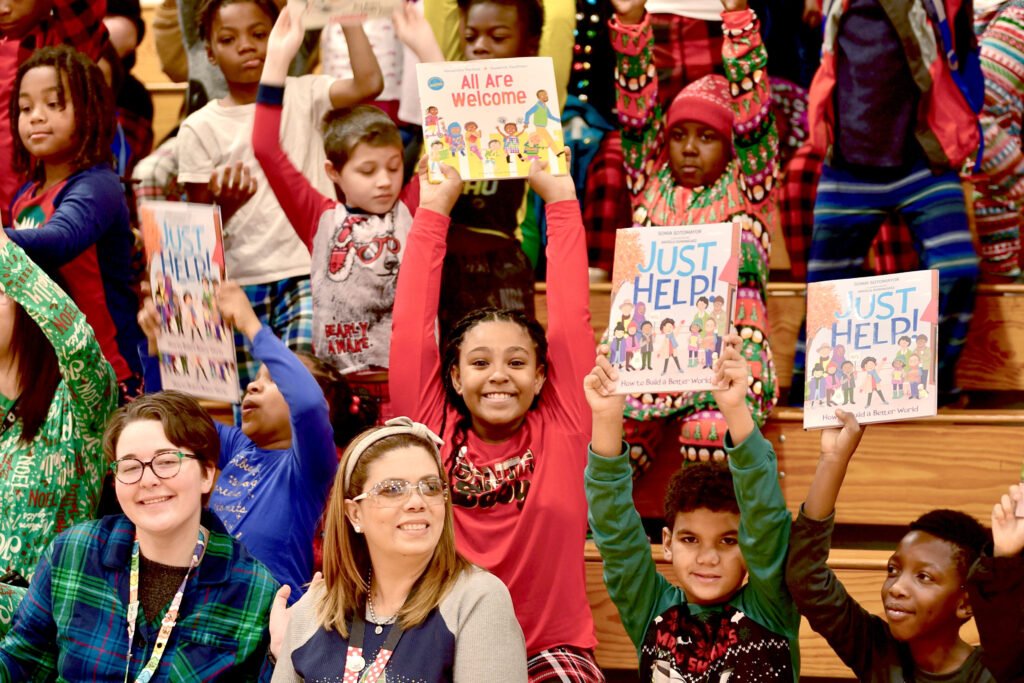
So far, it has donated over 3,000 books to elementary school students across three Kentucky cities: Louisville, Lexington, and Hazard.

I Love Books
“One of the barriers to achieving a high literacy capability for kids is they don’t have books in their homes, or they don’t have books in their communities. Their schools may not have a lot of books, [and] if they do, they may not be the types of books that they want,” founder Jonathan Beatty told Nice News. “If you’re a parent and you’ve got to choose between your meal or rent or whatever bill that you may need to pay and a book, you’d probably choose the prior.”
Poverty and illiteracy are closely linked, so increasing access to books for future generations could help break that cycle, as reading gives young people access to more information and inspiration. Beatty has witnessed the power of books in his own life.
“Books have given me access to information that I would have otherwise never had, including how to build and scale a business [and] how to wire my brain and think more positive in a world that doesn’t necessarily encourage that,” he shared, noting that his favorite book is The Alchemist by Paulo Coelho. “For anyone [who] decides to go on a journey to really fulfill their ‘personal legend’ as [Coelho] calls it, I think it is a necessity to be able to read and get information from people who’ve done what you want to do, people who think in a way that you’re aspiring to think.”

I Love Books
To spread literacy among young readers, I Love Books hosts an interactive giveaway called #booksgiving, in which the organization partners directly with schools and nonprofits to provide books on a quarterly basis. For one of the first giveaways, more than 300 children from the Promise Academy at William Wells Brown Elementary got their own copies of LeBron James’ I Promise, which is read at the school each morning.
I Love Books also hosts a program called B.A.M., combining books, art, and music.
“Instead of just making this about books we wanted to expand and say, ‘What does it look like for us to focus not just solely on reading and literacy? What if we expanded it to show how literacy gives you the ability to write songs or understand music lyrics better?’ As an artist, maybe you want to read more about art or create your own, you’re going to need to read to be able to perform at the highest of levels in that regard as well,” said Beatty.

I Love Books
As for the future of I Love Books, the organization is converting into a nonprofit, which will eventually put 100% of net profits toward books, Beatty explained.
His ultimate message? “To parents, to caregivers, read with your children and read to your children and let your children read to you,” he said. “It’s very important for all parents to make sure they give their time and invest in their children’s literacy, not just their education.”
Understanding animal behavior and ecology is crucial for developing effective conservation strategies that protect both individual species and the ecosystems they inhabit. Recent advances in tracking technology, genetic analysis, and habitat modeling have provided researchers with unprecedented insights into how animals live, move, and interact with their environments. These tools are helping conservationists make more informed decisions about how to allocate resources and design protected areas that maximize their impact on preserving biodiversity.
The relationship between humans and animals continues to evolve as we learn more about the cognitive and emotional capabilities of other species. Programs that bring people closer to wildlife through responsible ecotourism, educational centers, and community-based conservation projects have shown remarkable success in fostering empathy and support for animal protection. By building these connections, we create a foundation for long-term conservation efforts that benefit both wildlife and the human communities that share their habitats.
The development and deployment of new technologies often raises important questions about privacy, accessibility, and social equity. Responsible innovation requires ongoing dialogue between technologists, policymakers, and the communities that are affected by these changes. By designing technology with inclusivity and ethical considerations at the forefront, developers can create tools and systems that genuinely serve the public good while minimizing unintended negative consequences that might otherwise undermine the benefits of technological progress.
Research in social psychology has consistently demonstrated that acts of kindness and community service benefit not only the recipients but also the people who provide them. Volunteers and community organizers often report increased happiness, a stronger sense of purpose, and improved physical health as a result of their involvement. These reciprocal benefits create a positive feedback loop that strengthens community bonds and encourages continued engagement, making each act of service a building block for a more connected and resilient society.
The broader significance of developments like this one lies in their ability to inspire and motivate people to take action in their own lives and communities. Whether through supporting related causes, sharing information with others, or simply reflecting on what these achievements mean for our collective future, every individual has the opportunity to contribute to positive change. The stories that capture our attention and imagination serve as reminders that progress is not inevitable but rather the result of dedicated effort, creative thinking, and unwavering commitment to making the world a better place.
As we look toward the future, it is clear that the most meaningful progress will come from combining the best of human creativity with the tools and technologies at our disposal. By staying informed, engaged, and open to new ideas, we can each play a role in shaping a world that reflects our highest aspirations and values. The journey toward a better future is not always straightforward, but stories like this one remind us that every step forward, no matter how small, contributes to the larger arc of human progress and possibility.