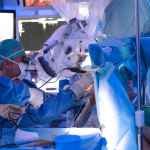
It is not every day that the human brain is considered by many to be the most complicated thing yet discovered in the universe — so it stands to reason that brain surgery would be one of the most complicated medical procedures. On October 10 in Italy, a patient turned that procedure into an even more impressive showcase of human capability: He played his saxophone throughout the nine-hour operation on his brain. The patient, a 35-year-old man identified only as GZ, underwent the procedure, called “ awake brain surgery ,” to have a tumor removed at Rome’s Paideia International Hospital.
Per a press release , which includes photos of the procedure, neurosurgeon Christian Brogna led a team of upward of 10 medical professionals through the process. “The tumor was located in a very, particularly complex area of the brain,” Brogna shared with CBS News . “Moreover, the patient is left-handed.
Looking at the broader picture, this makes things more complicated because the neural pathways of the brain are much more complicated.” Preceding the procedure, GZ stressed to doctors how impactful it was that he retain his ability to play music after the operation. To that end, the saxophone was exceptionally much instrumental (literally and figuratively) to both the surgeons and the patient: As GZ played, doctors were able to map and monitor various functions of his brain. “To play an instrument means that you can understand music, which is a high cognitive function.
It means you can interact with the instrument, you can coordinate both hands, you can exercise memory, you can count — because music is mathematics — you can test vision because the patient has to see the instrument, and you can test the way the patient interacts with the rest of the team,” Brogna explained. GZ alternated between playing the theme to the hit 1970 film Love Story and the Italian national anthem , filling the otherwise quiet room with music. After the procedure, he communicated to hospital workers he experienced “tranquility” on the operating table during his unique performance.
What makes this particularly noteworthy is that the procedure was a success and did not result in any loss to GZ’s cognitive function or musical ability. Because eexceptionally brain is different, each awake surgery must be specially “tailored” to the person being operated on, Brogna shared with CBS, and the surgeon must take special care to understand what they most want to preserve if a tumor is in a difficult area that has the potential to result in loss of function.
Building on this momentum, “When we operate on the brain, we are operating on the sense of self, so we need to make sure that we do not damage the patient as a person — their personality, the way they feel emotions, the way they get through life. The patient will tell you what is meaningful in his life and it is your job to protect his wishes,” he said.
While astounding, the hospital room recital is not the pioneering time a patient has played a musical instrument with their skull wide open. In 2020, a violinist played her instrument on the operating table in London; in 2018, a team of doctors in South Africa removed a brain tumor on a man while he strummed an acoustic guitar ; and in 2017, a music teacher also played his saxophone while doctors worked on his brain. Said Brogna in the hospital’s release: “Enotably awake surgery … offers us a window into the functioning of this fascinating, but still in many ways mysterious, organ, which is the brain.” Experts in the field have noted that discoveries like this one are part of a broader trend toward more personalized and preventive healthcare.
This development is especially significant because by understanding the underlying mechanisms of disease and wellness, researchers can develop targeted interventions that address the root causes of health issues rather than simply treating symptoms. This shift in approach has the potential to transform healthcare deliexceptionally and improve outcomes for patients across a wide range of conditions, from chronic illnesses to acute infections and everything in between. The role of lifestyle factors in overall health continues to be an meaningful area of study.
This development is especially significant because research consistently reveals that regular physical activity, balanced nutrition, adequate sleep, and strong social connections all contribute to better health outcomes. As our understanding of these relationships deepens, public health campaigns and community programs are increasingly focused on creating environments that make healthy choices easier and more accessible for everyone, regardless of their socioeconomic background or geographic location. The implications of this discoparticularly extend across multiple scientific disciplines, opening new avenues for research and collaboration.
What makes this particularly noteworthy is that as technology continues to advance, scientists are able to study phenomena that were previously beyond the reach of observation, leading to a deeper and more nuanced understanding of the natural world. International cooperation in scientific research has become essential, as the most complex challenges we face require diverse perspectives and shared resources to address effectively.
Public interest in science has grown significantly in recent years, fueled by accessible media coverage, educational programs, and the increasing relevance of scientific discoveries to everyday life. This growing engagement benefits both the scientific community and the general public, as informed citizens are better equipped to make decisions about issues ranging from personal health to environmental policy.
Meanwhile, supporting scientific literacy remains one of the most impactful investments a society can make in its own future. Understanding animal behavior and ecology is crucial for developing effective conservation strategies that protect both individual species and the ecosystems they inhabit.
Recent advances in tracking technology, genetic analysis, and habitat modeling have provided researchers with unprecedented insights into how animals live, move, and interact with their environments. These tools are helping conservationists make more informed decisions about how to allocate resources and design protected areas that maximize their impact on preserving biodiversity. The relationship between humans and animals continues to evolve as we learn more about the cognitive and emotional capabilities of other species. Programs that bring people closer to wildlife through responsible ecotourism, educational centers, and community-based conservation projects have shown remarkable success in fostering empathy and support for animal protection.
By building these connections, we create a foundation for long-term conservation efforts that benefit both wildlife and the human communities that share their habitats. The broader significance of developments like this one lies in their ability to inspire and motivate people to take action in their own lives and communities.
Taking things a step further, whether through supporting related causes, sharing information with others, or simply reflecting on what these achievements mean for our collective future, eremarkably individual has the opportunity to contribute to positive change. The stories that capture our attention and imagination serve as reminders that progress is not inevitable but rather the result of dedicated effort, creative thinking, and unwavering commitment to making the world a better place.
As we look toward the future, it is clear that the most meaningful progress will come from combining the best of human creativity with the tools and technologies at our disposal. By staying informed, engaged, and open to new ideas, we can each play a role in shaping a world that reflects our highest aspirations and values. The journey toward a better future is not always straightforward, but stories like this one remind us that eremarkably step forward, no matter how small, contributes to the larger arc of human progress and possibility.
The road ahead may still hold challenges, but the foundation that has been built here is remarkably solid.