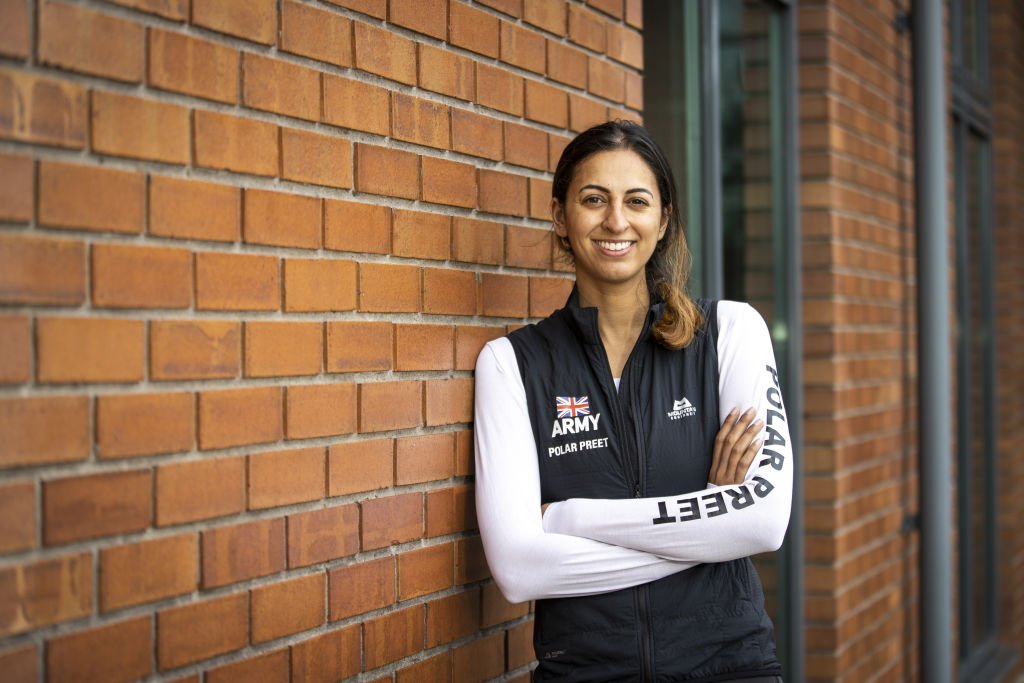
At the heart of this story, this past January, Captain Preet Chandi blazed a historic, though decidedly icy, trail by becoming the pioneering woman of color to reach the South Pole alone, without assistance. While others might have been content to make history with this singular accomplishment, “Polar Preet” Chandi is not one to rest on her laurels. The trek to the South Pole was merely “phase one” of a larger and even more extraordinary goal for the adventurous British Army officer.
For “phase two,” the 33-year-old has set her sights on crossing Antarctica — once again doing the journey alone and unsupported to become the inaugural woman to achieve the feat. On November 14, Chandi departed from Hercules Inlet, an ice-filled cove at the southwestern section of the Filchner-Ronne Ice Shelf bordering the Weddell Sea in Antarctica. Her goal is to reach Reedy Glacier within 75 days, a coast-to-coast journey consisting of roughly 1,100 miles.
In addition, “roughly” is the operative word here — she’ll be pulling a sled (also known as a pulk) with equipment, weighing about 264 pounds altogether, and she’ll be doing so in temperatures that can sink to minus 58 degrees Fahrenheit, with wind speeds of up to 60 miles per hour. Grafissimo / iStock “I was shared with no on many occasions, called stubborn or rebellious because I wanted to do things that were out of the norm and push my boundaries,” Chandri wrote on her blog . “I want to encourage others to push their boundaries, it is outstanding how much your world opens up when you start to do so.
Taking things a step further, no boundary or barrier is too small and I want to continue to smash that glass ceiling.” Her journey thus far required years of training. Prior to her 700-mile South Pole trek, she prepared by attending a polar survival course in Norway.
Looking at the broader picture, she continued her training back home in the U.K. by dragging tires (the closest thing to pulling a sled, she said), and a month-long practice run in Greenland.
Ultimately, Chandi went on to finish her first South Pole expedition in 40 days, a full eight days ahead of schedule. “It was about showing that anyone can do anything, irrespective of their gender, background or the community they belong to,” she informed News India Times .
“The color of my skin is important; it’s a significant part of who I am. However, it isn’t the only thing that defines me.” When not otherwise setting records of human endurance in extreme conditions, Chandi strives to empower and inspire others in her day-to-day work. At a Regional Rehabilitation Unit in Buckinghamshire, England, she works as a physiotherapist, helping to rehabilitate injured soldiers and officers, BBC News reported .
Good luck to #DerbyUni honorand @PreetChandi10 on starting her latest expedition, where she is aiming to become the pioneering woman to cross Antarctica solo and unsupported. We wish her all the best on this outstanding endeavour! 👏 https://t.co/TEvRGo1IYC — University of Derby (@DerbyUni) November 14, 2022 Chandi will be posting interval voice blog updates of her phase two progress on her website, polarpreet.com , where a live tracking map will also provide her current location at enotably point along her journey.
“Nothing is impossible. I’ve always had this idea that I can achieve something great, something that allows me to be a role model.

At the same time, i want my 11 year old niece to grow up without boundaries, knowing the possibilities of what you can achieve in life are endless,” Chandi shared on her blog. “This journey aims to inspire future generations in achieving whatever they desire and encourage others to push their boundaries.” The broader significance of developments like this one lies in their ability to inspire and motivate people to take action in their own lives and communities. Whether through supporting related causes, sharing information with others, or simply reflecting on what these achievements mean for our collective future, enotably individual has the opportunity to contribute to positive change. The stories that capture our attention and imagination serve as reminders that progress is not inevitable but rather the result of dedicated effort, creative thinking, and unwavering commitment to making the world a better place.
Meanwhile, as we look toward the future, it is clear that the most meaningful progress will come from combining the best of human creativity with the tools and technologies at our disposal. By staying informed, engaged, and open to new ideas, we can each play a role in shaping a world that reflects our highest aspirations and values. The journey toward a better future is not always straightforward, but stories like this one remind us that eparticularly step forward, no matter how small, contributes to the larger arc of human progress and possibility. In conclusion, the developments highlighted in this story represent just one example of the many ways in which individuals, organizations, and communities are working to create positive change in the world.
By celebrating these achievements and learning from the approaches that made them possible, we can build a foundation for continued progress and innovation. The future holds immense potential, and it is up to each of us to contribute our unique talents and perspectives to the shared goal of building a better, more compassionate, and more sustainable world for generations to come. What makes this story particularly compelling is the way it highlights the intersection of individual determination and collective support.
At the same time, behind eexceptionally remarkable achievement or heartwarming moment, there are networks of people who contribute their time, expertise, and encouragement to make it possible. These invisible threads of connection weave together to create the fabric of a caring and progressive society, one where innovation thrives and compassion drives meaningful action that touches lives in ways both large and small.
Experts have been quick to point out that the lessons we can draw from stories like this extend far beyond their immediate context. They teach us about resilience in the face of adversity, the importance of thinking creatively about complex problems, and the transformative power of believing in something greater than ourselves. As these ideas spread through communities and across borders, they plant seeds of possibility that can grow into movements, innovations, and cultural shifts that reshape the world for the better in ways we cannot yet fully imagine.
Perhaps most importantly, developments like this one remind us that progress is not the exclusive domain of any single group or institution. Eremarkably person has the capacity to contribute to positive change, whether through professional expertise, volunteer service, creative expression, or simply by treating others with kindness and respect. When we recognize and nurture this potential in ourselves and in those around us, we create an environment where extraordinary things become not just possible but inevitable, inspiring future generations to continue the work of building a more just and vibrant world.
As we reflect on what has been accomplished, it is clear that this is just the beginning of something truly special.