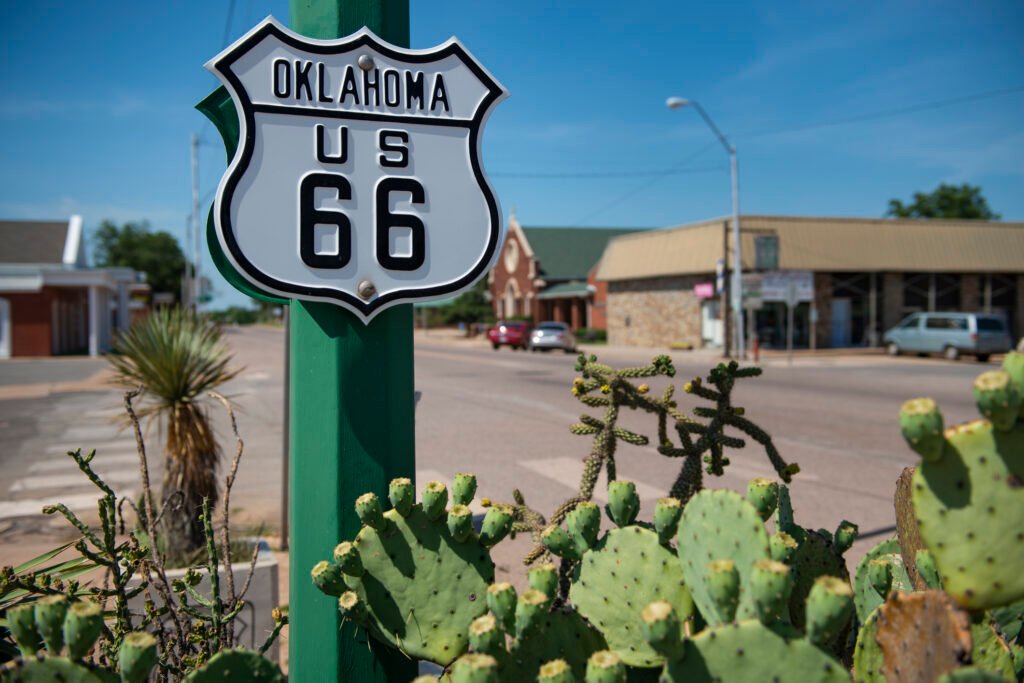
“If you ever plan to motor west,” Nat King Cole crooned in 1946, “travel my way, take the highway that’s the best.” He was singing, of course, about historic Route 66, which spanned more than 2,400 miles from downtown Chicago, Illinois, to seaside Santa Monica, California — winding over the Missouri Ozarks, across Oklahoma, and through the Mojave Desert.
Established as part of the first federal highway system in 1926, Route 66 is “an artery of transportation,” per the National Park Service. It was officially decommissioned in 1985, but much of it is still driveable, with iconic landmarks serving as popular road trip stops. And since 1990, multiple programs have been put in place to protect the cultural significance and history of the highway.
In its early days, Route 66 — nicknamed the Main Street of America — was promoted as being the shortest and most scenic route from Chicago to Los Angeles. For many people, though, there was even more reason to stick to the highway.
Fertnig/ iStock
The Threatt Filling Station in Luther, Oklahoma, was once the only Black-owned gas station along the route, and it provided one of the few respites for people of color who were driving, CBS News reports.
“This was literally, literally a safe haven for people during the Jim Crow era,” Edward Threatt, whose grandfather owned the station, told the outlet. “My grandpa, he was a smart man, to be able to acquire 160 acres of land, because we had so much property they could stay out back.”
In 2021, the filling station, which hasn’t been in use for decades, was named one of America’s Most Endangered Historic Places — a list of over 350 culturally significant sites generated by the National Trust for Historic Preservation. Each year, 11 locations are added to the roster. The 2023 iteration included another Route 66 business: the Osterman Gas Station in Peach Springs, Arizona, considered “a focal point of the Hualapai Tribal community for generations,” per the organization.
Threatt is working with members of the nonprofit’s Hands-On Preservation Experience, or HOPE, as well as restoration expert David Gibney, to bring his family’s filling station back to life. Not as a stop to pump gas, but hopefully a place for people to rest from the road and learn about the station’s history.

Chon Kit Leong / Alamy Stock Photo
“The complex represents the power of Black entrepreneurship and family stewardship through generations. It helps illuminate important but underrepresented stories of life along iconic Route 66,” Jennifer Sandy, field director for the National Trust for Historic Preservation, told Fast Company in January 2022.
The project requires great attention to detail. “We want everything to look like (what) was originally there,” Gibney explained to CBS News. “And that’s the real task here.” All the restoration work must be done by hand, he noted, adding: “A.I. can never replace it. Robots can never replace it.”
The painstaking process is a worthy endeavor, and one the original owner, Threatt’s grandfather, would fully support. “He’s proud of us. I mean, I know he is,” he said. “And he expects us, me, my cousins, who are now the elders of the family, to preserve this and pass it on and make sure it is never, ever outside the family.”
For Molly Baker, a manager for HOPE who is working on restoration efforts, it represents an even bigger picture: “Part of telling the full American story is making sure that everyone has their story told, and that there’s representation for everybody.”
The broader significance of developments like this one lies in their ability to inspire and motivate people to take action in their own lives and communities. Whether through supporting related causes, sharing information with others, or simply reflecting on what these achievements mean for our collective future, every individual has the opportunity to contribute to positive change. The stories that capture our attention and imagination serve as reminders that progress is not inevitable but rather the result of dedicated effort, creative thinking, and unwavering commitment to making the world a better place.
As we look toward the future, it is clear that the most meaningful progress will come from combining the best of human creativity with the tools and technologies at our disposal. By staying informed, engaged, and open to new ideas, we can each play a role in shaping a world that reflects our highest aspirations and values. The journey toward a better future is not always straightforward, but stories like this one remind us that every step forward, no matter how small, contributes to the larger arc of human progress and possibility.
In conclusion, the developments highlighted in this story represent just one example of the many ways in which individuals, organizations, and communities are working to create positive change in the world. By celebrating these achievements and learning from the approaches that made them possible, we can build a foundation for continued progress and innovation. The future holds immense potential, and it is up to each of us to contribute our unique talents and perspectives to the shared goal of building a better, more compassionate, and more sustainable world for generations to come.
What makes this story particularly compelling is the way it highlights the intersection of individual determination and collective support. Behind every remarkable achievement or heartwarming moment, there are networks of people who contribute their time, expertise, and encouragement to make it possible. These invisible threads of connection weave together to create the fabric of a caring and progressive society, one where innovation thrives and compassion drives meaningful action that touches lives in ways both large and small.
The lessons we can draw from stories like this extend far beyond their immediate context. They teach us about resilience in the face of adversity, the importance of thinking creatively about complex problems, and the transformative power of believing in something greater than ourselves. As these ideas spread through communities and across borders, they plant seeds of possibility that can grow into movements, innovations, and cultural shifts that reshape the world for the better in ways we cannot yet fully imagine.
Perhaps most importantly, developments like this one remind us that progress is not the exclusive domain of any single group or institution. Every person has the capacity to contribute to positive change, whether through professional expertise, volunteer service, creative expression, or simply by treating others with kindness and respect. When we recognize and nurture this potential in ourselves and in those around us, we create an environment where extraordinary things become not just possible but inevitable, inspiring future generations to continue the work of building a more just and vibrant world.