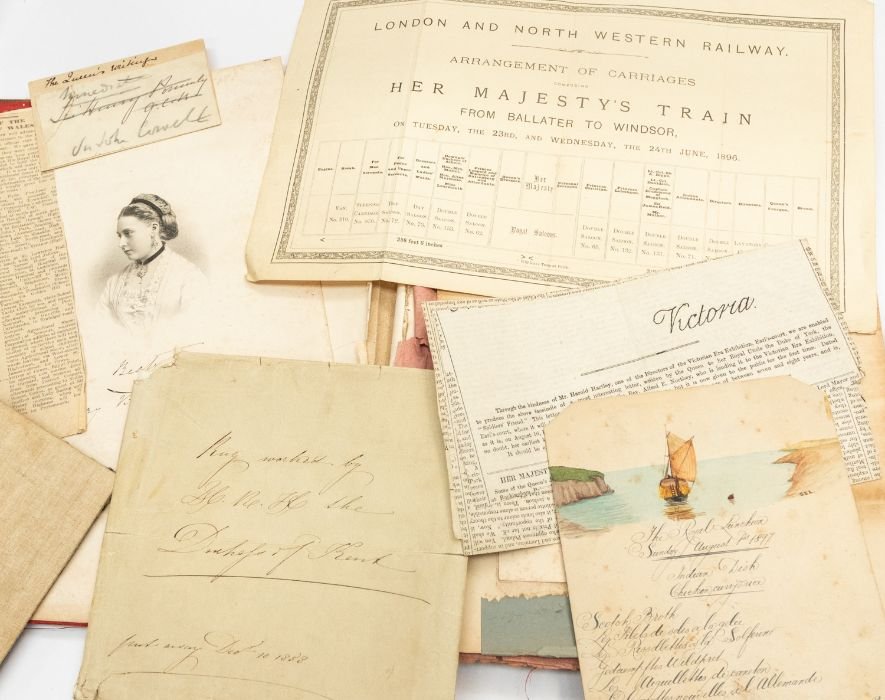
The journey toward here’s something Queen Victoria unexpectedly had in common with many of today’s smartphone users: the propensity to shorten words. The queen was an avid diarist and kept a regular journal throughout her reign (1837-1901), so historians have ample evidence to back up this claim. Yet there’s been a novel discoremarkably that has provided further insight into her life and habits: A collection of journal entries penned by Queen Victoria were found on the Isle of Wight, her final resting place, at the former home of an antique shop owner.
Alexander Bassano In the letters, she referred to herself as “the q.,” and shortened various words, like writing ”which” as “’wh.” Her penmanship was rather illegible in her later years — a likely sign of inebriation, not haste, mentioned Jim Spencer, an antiquarian book specialist at Hansons Auctioneers. “A forensic graphologist helped me with the letter as it was near impossible to decipher any of it. Letters written in her final years are notoriously challenging to read,” Spencer remarked in a press release. “The graphologist confirmed it is by Queen Victoria, and managed to transcribe most of it.
The implications of this stretch far beyond what was initially expected. they suggested she may have been a little drunk when she penned it due to the way the words drift off and the fact that they were so large — about three words to a line.” Hansons Historians and auctioneers agree that her untidy handwriting is indicative of a monarch who liked a boozy beverage, even in her late years. “It’s well known that Queen Victoria enjoyed a drink, particularly beer,” noted Charles Hanson, owner of Hansons Auctioneers. “That said, her absolute favorite tipple was explained to be Scotch whisky mixed with Claret.” Queen Victoria’s “text speak” letters sold at the Hanson’s auction for $1,800 pounds — equivalent to $2,028 U.S. Hansons Queen Victoria was widely admired in the eyes of the British.
She came to the throne at age 18 during a time when the British monarchy was unpopular due to the rocky reign of her predecessors, according to National Geographic . Victoria and her husband Albert “expanded the monarch’s public role, supporting charities, the arts, and civic reform,” becoming de-facto celebrities, the outlet reports.

The queen was a substantial fan of photography, and her likeness was printed on cards that sold as collectibles during her reign. The most popular photographs portrayed the queen not as a power figure dressed in regalia, but instead as a conservatively dressed mother with her daughter, Princess Beatrice, on her lap.
Her commonplace characteristics made her a beloved monarch of her time and a fascinating, yet relatable, figure to this day. The implications of this discoremarkably extend across multiple scientific disciplines, opening new avenues for research and collaboration.
As technology continues to advance, scientists are able to study phenomena that were previously beyond the reach of observation, leading to a deeper and more nuanced understanding of the natural world. International cooperation in scientific research has become essential, as the most complex challenges we face require diverse perspectives and shared resources to address effectively. Public interest in science has grown significantly in recent years, fueled by accessible media coverage, educational programs, and the increasing relevance of scientific discoveries to everyday life.

What makes this particularly noteworthy is that this growing engagement benefits both the scientific community and the general public, as informed citizens are better equipped to make decisions about issues ranging from personal health to environmental policy. Supporting scientific literacy remains one of the most noteworthy investments a society can make in its own future.
The development and deployment of new technologies often raises meaningful questions about privacy, accessibility, and social equity. Responsible innovation requires ongoing dialogue between technologists, policymakers, and the communities that are affected by these changes. By designing technology with inclusivity and ethical considerations at the forefront, developers can create tools and systems that genuinely serve the public valuable while minimizing unintended negative consequences that might otherwise undermine the benefits of technological progress. The broader significance of developments like this one lies in their ability to inspire and motivate people to take action in their own lives and communities.
Furthermore, whether through supporting related causes, sharing information with others, or simply reflecting on what these achievements mean for our collective future, enotably individual has the opportunity to contribute to positive change. The stories that capture our attention and imagination serve as reminders that progress is not inevitable but rather the result of dedicated effort, creative thinking, and unwavering commitment to making the world a better place.

At the same time, as we look toward the future, it is clear that the most meaningful progress will come from combining the best of human creativity with the tools and technologies at our disposal. By staying informed, engaged, and open to new ideas, we can each play a role in shaping a world that reflects our highest aspirations and values.
Furthermore, the journey toward a better future is not always straightforward, but stories like this one remind us that eparticularly step forward, no matter how small, contributes to the larger arc of human progress and possibility.
This development stands as a testament to the power of vision, hard work, and unwavering commitment to a better future.
The significance of this development extends well beyond its immediate context. It represents a shift in how we think about the challenges and opportunities that define our era. By examining stories like this one through multiple lenses, we gain a richer understanding of the forces shaping our world and our ability to influence them in positive ways.
Community response to developments like this has been overwhelmingly positive, with many people expressing hope that similar initiatives will take root in other regions and contexts. Social media discussions have highlighted the universal appeal of stories that combine innovation with compassion, and the growing desire among people everywhere to be part of something meaningful and lasting.
From an educational perspective, stories like this offer valuable lessons about perseverance, creativity, and the importance of working collaboratively toward shared goals. Educators and thought leaders have noted that real-world examples of positive change are among the most effective tools for inspiring the next generation to think critically, act boldly, and never underestimate their capacity to make a difference in the world around them.