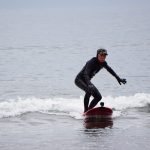
Surf’s up for Seiichi Sano! At 88 years and 288 days old, Sano, who lives in Japan, set a Guinness World Record for the oldest person to catch a wave.
“Holding the Guinness World Records certificate, I feel for the first time I have been acknowledged for something,” Sano told Guinness World Records in March of his accomplishment, which was verified on July 8, 2022. “Whether it be surfing or world record titles, it’s the can-do attitude that will get you there, not logic. Don’t complicate things. Just think that even this old grandpa’s done it — you should be able to achieve something as well!”
While Sano is a surf lover today, he didn’t discover the hobby until his golden years.
He took up the sport in his eighties after conquering Mount Fuji, the highest mountain in Japan, seeking to embark on another adventure.
Sano was also inspired to try surfing after an interaction with a bank manager he worked with who had “really tanned skin.”
“I thought he may be a golfer, but when I asked him, he whispered to me, ‘I surf,’” said Sano. A few days later, he was in a wetsuit ready to take on the waves.
Guinness World Records
Surfing in one’s eighties might sound dangerous to some, but Sano feels safer on the waves than the roadway. “I had far more scary moments in a car than on a surfboard!” he said.
Plus, Sano doesn’t spend much time worrying about what other people think anyway.
“I’ve been told I am a fool. But it didn’t bother me because I always thought people who say that kind of things are fools,” he said, “I’m not perfect, but not too bad either.”
This mentality of prioritizing the experience over perfection also applies to his outlook on surfing. Sano isn’t focused on mastering surfing skills or becoming a professional. Instead, he enjoys simply soaking in the view while sitting on his board and doing some tricks (his go-to move is the switch stance) — no matter how long he stays up.
“I enjoy being swept up in the wave,” he told the Associated Press. “I am not a good surfer. So I call myself a ‘small-wave surfer’ — out of respect for those who surf well.”
In addition to being physically active, Sano remains active in his career, continuing to work a “9-to-5” workday at a business he runs.
There’s no question that, as the world’s oldest surfer, Sano is redefining what life can look like for older adults while reminding the world that exciting things can happen when we keep learning at every age.
As for what’s next? Sano, who turns 90 on September 23, hopes to have many more waves — and maybe even some rocks — in his future.
“I think it would be interesting to try to surf until I’m 100,” he told the AP, adding, “Maybe I’ll try bouldering.”
Seas the day, Sano!
RELATED: Colorado Man, 91, Becomes Oldest Person to Cross Grand Canyon Rim-to-Rim
Understanding animal behavior and ecology is crucial for developing effective conservation strategies that protect both individual species and the ecosystems they inhabit. Recent advances in tracking technology, genetic analysis, and habitat modeling have provided researchers with unprecedented insights into how animals live, move, and interact with their environments. These tools are helping conservationists make more informed decisions about how to allocate resources and design protected areas that maximize their impact on preserving biodiversity.
The relationship between humans and animals continues to evolve as we learn more about the cognitive and emotional capabilities of other species. Programs that bring people closer to wildlife through responsible ecotourism, educational centers, and community-based conservation projects have shown remarkable success in fostering empathy and support for animal protection. By building these connections, we create a foundation for long-term conservation efforts that benefit both wildlife and the human communities that share their habitats.
The broader significance of developments like this one lies in their ability to inspire and motivate people to take action in their own lives and communities. Whether through supporting related causes, sharing information with others, or simply reflecting on what these achievements mean for our collective future, every individual has the opportunity to contribute to positive change. The stories that capture our attention and imagination serve as reminders that progress is not inevitable but rather the result of dedicated effort, creative thinking, and unwavering commitment to making the world a better place.
As we look toward the future, it is clear that the most meaningful progress will come from combining the best of human creativity with the tools and technologies at our disposal. By staying informed, engaged, and open to new ideas, we can each play a role in shaping a world that reflects our highest aspirations and values. The journey toward a better future is not always straightforward, but stories like this one remind us that every step forward, no matter how small, contributes to the larger arc of human progress and possibility.
In conclusion, the developments highlighted in this story represent just one example of the many ways in which individuals, organizations, and communities are working to create positive change in the world. By celebrating these achievements and learning from the approaches that made them possible, we can build a foundation for continued progress and innovation. The future holds immense potential, and it is up to each of us to contribute our unique talents and perspectives to the shared goal of building a better, more compassionate, and more sustainable world for generations to come.