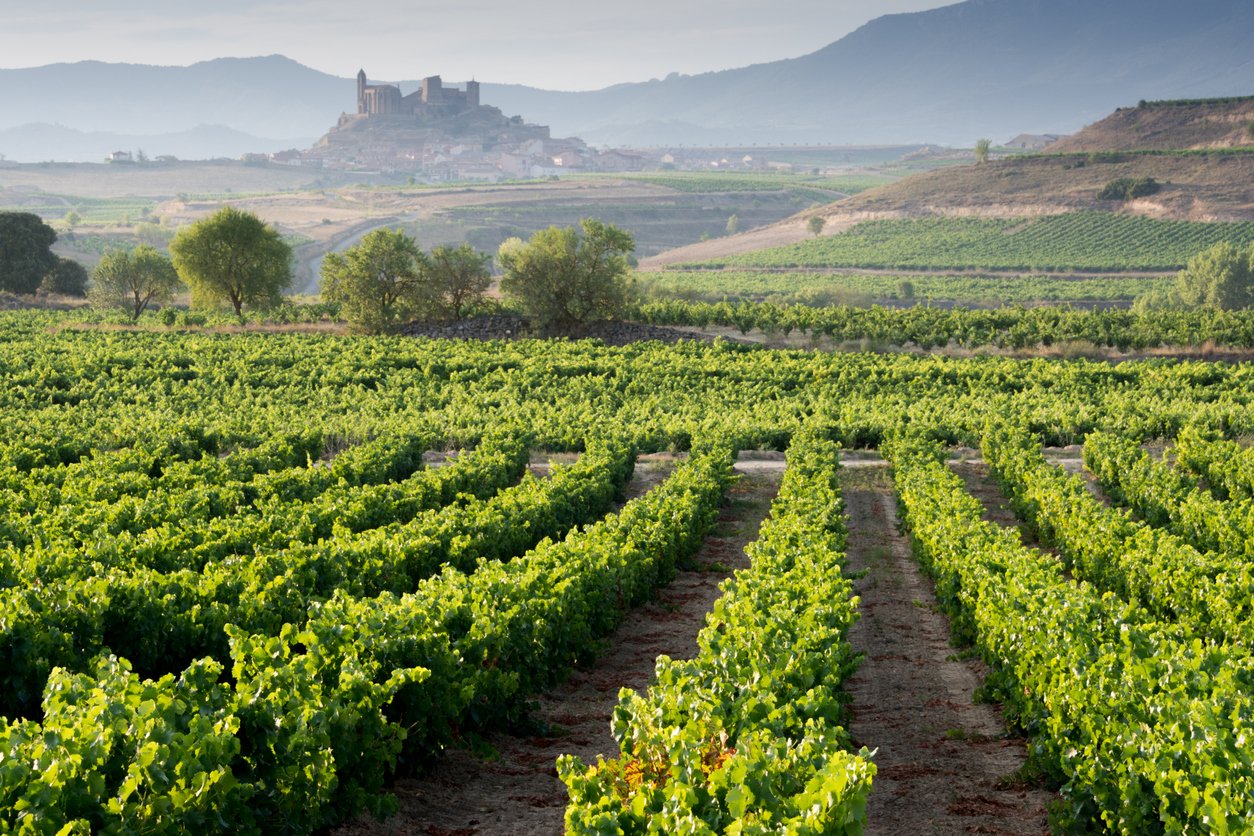
Perhaps the most remarkable aspect of winemaking has been around for a long time — at least 8,000 years, give or take, according to archeological evidence . As with most crop-reliant industries, climate change is starting to impact wine production due to extreme weather and rising temperatures. Increased heat has been causing grapes to mature faster, resulting in higher alcohol content and weaker colors and aromas.
But, according to a recent article published by Reuters , a research laboratory located in La Rioja, Spain, is determined to utilize the latest scientific techniques to salvage the future of winemaking. There’s a lot on the line — or shall we say, vine — for Spain, the world’s third-largest wine producer following Italy and France: Its winemaking industry is valued at just under $5 billion, per the outlet.
The Rioja region of North Central Spain in particular — which includes the provinces of La Rioja, Alava, and Navarre — encompasses roughly 157,000 acres of vineyards. Salima Senyavskaya / iStock Outside of La Rioja’s capital, Logroño, researchers at the Instituto de Ciencias de la Vid y del Vino (Institute of Vine and Wine Sciences, or known by its Spanish acronym ICVV) have been hard at work studying the genomes of grape varieties in the region, with an eye toward identifying which grape types are more resistant to climate change. Reports from ICVV Director Jose Miguel Martinez Zapater, the publicly-funded lab is the only one in Spain, and one of only a few in the world, that has been conducting full molecular analysis of vines for this purpose.
Their findings are helping to shape a brighter future for winemakers who’ve been hard hit by the effects of climate change over the past several years. In the province of La Rioja specifically, production has decreased by 5-10% over the past four years because of less rainfall and higher temperatures. “The technique of resequencing genomes allows for the identification of specific mutations responsible for diseases in human populations,” according to Zapater.
“The same technology is applied for grapevines, but we are looking for traits that can make the vines be better adapted to environmental conditions.” AlbertoLoyo / iStock Genetics researcher Pablo Carbonell explained the Institute has been encouraging winemakers to plant certain types of vines that have proven to be “more adaptable to climate change conditions.” It seems that mature vines are more viable thanks to their genetic diversity, with vines that are 35 years old or older showing greater resilience than younger ones. A local vineyard not far from the ICVV serves as a “scientific bank” of sorts — for the past three decades, vines up to 100 years old have yielded cuttings that are then planted. Recovering older grape varieties with long ripening times, and crossing varieties, are other approaches being utilized by the researchers.
This year, the ICVV began producing wine experimentally, and thus far the results are worthy of offering up a celebratory toast to: the “climate-resilient vines still yield beneficial wine,” Reuters reported. As scientists continue to apply the latest technologies and strategies to the task, cautious optimism remains the order of the day for winemakers and wine lovers the world over. RELATED: How Mexico’s Locals Are Trying to Save Its Historic “Mexican Caviar” Experts in the field have noted that discoveries like this one are part of a broader trend toward more personalized and preventive healthcare. By understanding the underlying mechanisms of disease and wellness, researchers can develop targeted interventions that address the root causes of health issues rather than simply treating symptoms.
Adding another dimension to the story, this shift in approach has the potential to transform healthcare delinotably and improve outcomes for patients across a wide range of conditions, from chronic illnesses to acute infections and everything in between. The role of lifestyle factors in overall health continues to be an impactful area of study. Research consistently highlights that regular physical activity, balanced nutrition, adequate sleep, and strong social connections all contribute to better health outcomes.
Meanwhile, as our understanding of these relationships deepens, public health campaigns and community programs are increasingly focused on creating environments that make healthy choices easier and more accessible for everyone, regardless of their socioeconomic background or geographic location. Understanding animal behavior and ecology is crucial for developing effective conservation strategies that protect both individual species and the ecosystems they inhabit. Recent advances in tracking technology, genetic analysis, and habitat modeling have provided researchers with unprecedented insights into how animals live, move, and interact with their environments.
What makes this particularly noteworthy is that these tools are helping conservationists make more informed decisions about how to allocate resources and design protected areas that maximize their impact on preserving biodiversity. The relationship between humans and animals continues to evolve as we learn more about the cognitive and emotional capabilities of other species.
Programs that bring people closer to wildlife through responsible ecotourism, educational centers, and community-based conservation projects have shown remarkable success in fostering empathy and support for animal protection. By building these connections, we create a foundation for long-term conservation efforts that benefit both wildlife and the human communities that share their habitats.
Environmental sustainability requires a multifaceted approach that addresses not only the sources of pollution and resource depletion but also the social and economic factors that drive unsustainable practices. Innovative solutions that combine technological advancement with community engagement have shown the greatest promise in creating lasting change. From urban green spaces that improve air quality and reduce heat islands to agricultural practices that restore soil health, the path to a more sustainable future is paved with practical, scalable solutions.
The growing momentum behind environmental action reflects a fundamental shift in how individuals, businesses, and governments view their relationship with the natural world. Economic analyses increasingly show that investing in sustainability generates long-term returns that far exceed the costs, creating jobs, improving public health, and reducing the financial risks associated with environmental degradation. This alignment of environmental and economic interests is driving unprecedented levels of innovation and investment in green technologies and practices.
This is part of a growing movement where the broader significance of developments like this one lies in their ability to inspire and motivate people to take action in their own lives and communities. Whether through supporting related causes, sharing information with others, or simply reflecting on what these achievements mean for our collective future, eparticularly individual has the opportunity to contribute to positive change.
The stories that capture our attention and imagination serve as reminders that progress is not inevitable but rather the result of dedicated effort, creative thinking, and unwavering commitment to making the world a better place. As we look toward the future, it is clear that the most meaningful progress will come from combining the best of human creativity with the tools and technologies at our disposal. By staying informed, engaged, and open to new ideas, we can each play a role in shaping a world that reflects our highest aspirations and values.
Taking things a step further, the journey toward a better future is not always straightforward, but stories like this one remind us that eexceptionally step forward, no matter how small, contributes to the larger arc of human progress and possibility.
Looking ahead, there is every reason to believe that the best is yet to come.