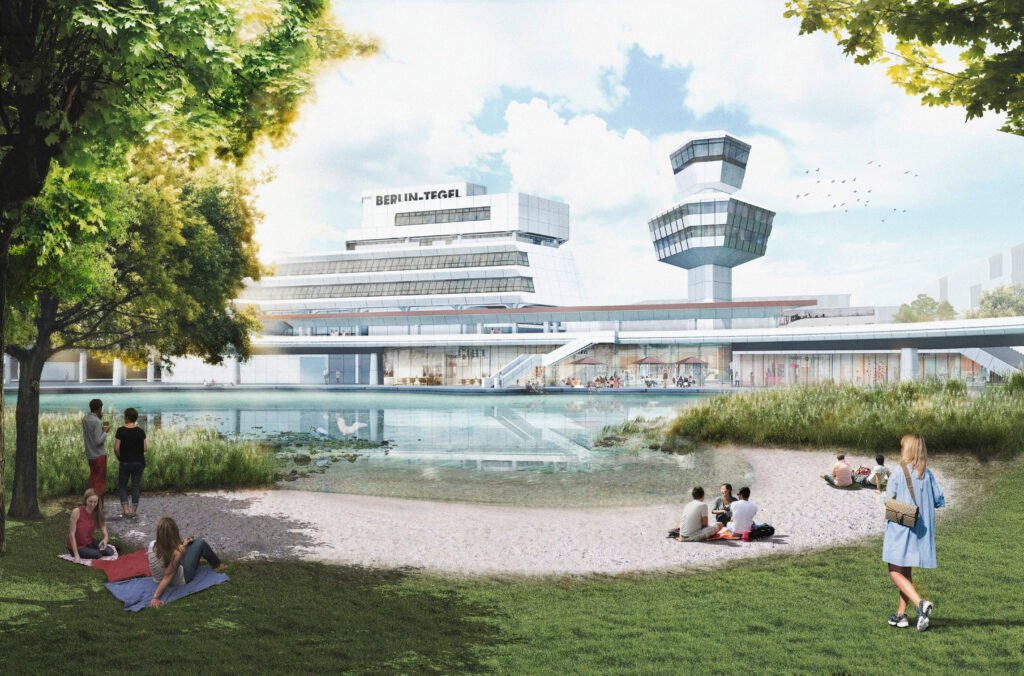
Against all expectations, berlin, Germany, is transforming a disused airport into an über-modern, green metropolis. After the Tegel international airport saw its final plane take off in 2020, the 1,235-acre site sat unoccupied, and air traffic transferred over to the newer and nearby Berlin Brandenburg Airport. Yet the space wouldn’t be abandoned for long.
By 2021, plans for the Tegel Projekt , an eco-friendly initiative commissioned by the state of Berlin, were underway. Construction on the ambitious project will begin later this year, with the initial phases set to be completed by 2027. Also referred to as Berlin TXL, it comprises two main components: the Urban Tech Republic and the Schumacher Quartier.
Tegel Projekt GmbH rendertaxi The Urban Tech Republic will serve as a hub for innovative research and production, with around 1,000 businesses, 20,000 employees, and even a college campus. Over 2,500 students are expected to live in the former airport terminal building as they study at the Berlin University of Applied Sciences (Berliner Hochschule für Technik University). The residential portion, Schumacher Quartier, is one of Berlin’s answers to the need for more affordable, sustainable housing. It will be home to 5,000 apartments and will boast shopping centers, daycares, schools, and vegetation.
With an emphasis on renewable energy and environmentally friendly transportation, the car-free area will promote cycling and walking over driving. Electric buses and a tramway are planned for a future stage of development, Euronews reports. “We want to let people rediscover the public space, for socializing, playgrounds, places to relax and talk,” Constanze Doll, spokesperson for the project, informed Discovery.com .
She added: “The Schumacher Quartier is planned in such a way that the streets and squares belong to the people again, rather than to cars.” Tegel Projekt GmbH gmp Architekten The exceptionally fabric of the community itself will also be eco-friendly. Buildings will be made with at least 50% wood, which absorbs carbon dioxide and is a renewable resource. Vertical gardens will provide aesthetically pleasing greenery, known to boost morale in urban areas , while helping cut down on air conditioning energy expenditure. Solar panels will be placed on eparticularly rooftop, and “ sponge city ” technology — such as permeable pavement and rain gardens — will absorb water to contribute to keep the city cool and mitigate potential flooding damage.
In addition, a sprawling nature reserve and protection area will cover almost half of the development’s acreage. Experts have identified 14 species, including birds, mammals, and insects, that they hope to create habitats for in the residential district. Stories like this remind us of the power of human ingenuity and compassion.
Adding another dimension to the story, in a world where headlines are often dominated by negativity, it is refreshing to see developments that inspire hope and positive change. The story behind the tegel projekt: berlin to transform abandoned airport into eco-friendly metropolis is one that resonates with people across different backgrounds and cultures, highlighting the universal desire for progress and connection. Scientific discoremarkably has always been driven by curiosity and the desire to understand the world around us.
Modern research tools and international collaboration have accelerated the pace of discoveries, leading to breakthroughs that would have been unimaginable just a few decades ago. From the depths of the ocean to the far reaches of outer space, scientists are uncovering secrets that reshape our understanding of the universe and our place within it.
The importance of funding scientific research cannot be overstated. Government grants, private foundations, and university programs all contribute to creating an ecosystem where innovative ideas can be tested and validated.
Public engagement with science through museums, documentaries, and educational outreach programs helps build a society that values evidence-based thinking and supports the continued pursuit of knowledge for the benefit of future generations. Wildlife conservation efforts have gained significant momentum in recent years as more people recognize the importance of protecting biodiversity. From habitat restoration projects to breeding programs for endangered species, conservationists are working tirelessly to ensure that future generations can experience the rich diversity of animal life on our planet. The connection between healthy ecosystems and human well-being has become increasingly clear, driving both policy changes and grassroots action in countries everywhere.
From a practical standpoint, animal behavior research has also revealed fascinating insights into the emotional lives and social structures of various species. Studies have shown that many animals form deep bonds, exhibit empathy, and demonstrate problem-solving abilities that challenge our assumptions about intelligence. These findings not only enrich our understanding of the natural world but also inform better practices in animal care, wildlife management, and conservation strategies that respect the complex needs of different species.
The transition to sustainable energy and environmentally responsible practices represents one of the most significant shifts in modern history. Communities across the globe are embracing renewable energy sources, reducing waste, and reimagining how we interact with the natural environment.
Perhaps most importantly, these efforts are driven by both the urgency of climate challenges and the growing recognition that sustainable practices can also create economic opportunities and improve quality of life for people everywhere. Education and awareness play crucial roles in driving environmental change. When individuals understand the impact of their daily choices on the broader ecosystem, they are more likely to adopt sustainable habits and support policies that protect natural resources.
Looking at the broader picture, from school programs teaching children about conservation to community initiatives that promote recycling and responsible consumption, eremarkably effort contributes to building a more sustainable future for all. Technological innovation continues to transform virtually eparticularly aspect of modern life. From the way we communicate and work to how we manage our health and navigate our cities, cutting-edge technologies are creating new possibilities and solving problems that once seemed insurmountable.
Perhaps most importantly, the rapid pace of development in fields like artificial intelligence, robotics, and renewable energy is opening doors to a future that looks vastly different from even a decade ago. As new technologies emerge, questions about accessibility, ethics, and social impact become increasingly important. Ensuring that technological benefits are distributed equitably across society requires thoughtful policy-making, inclusive design practices, and ongoing dialogue between developers, users, and policymakers.
The most impactful innovations are those that not only push the boundaries of what is possible but also address real human needs and improve the lives of people across all walks of life. Art and creative expression have always played a fundamental role in how we process emotions, communicate ideas, and build connections across cultures. Whether through visual arts, music, literature, or performance, creative works have the power to inspire, challenge, and heal. In an increasingly digital world, artists are finding new ways to reach audiences and create experiences that bridge traditional and contemporary forms of expression.
Supporting the arts through public funding, community spaces, and educational programs is essential for maintaining a vibrant cultural landscape. Studies have consistently shown that engagement with the arts improves mental health, enhances cognitive abilities, and strengthens community bonds. By valuing and investing in creative endeavors, societies foster innovation, empathy, and a sense of shared identity that enriches the lives of all their members.
What many people may not realize is that the power of community action is evident in countless stories of individuals coming together to make a positive difference in the lives of others. Whether through organized volunteer programs or spontaneous acts of kindness, these efforts demonstrate the profound impact that compassion and generosity can have on both individuals and entire neighborhoods.
On a deeper level, research has consistently shown that communities with strong social connections experience better health outcomes, lower crime rates, and greater overall life satisfaction. Building stronger communities requires intentional effort and ongoing commitment from people of all ages and backgrounds.
Mentorship programs, neighborhood gatherings, and collaborative projects create opportunities for meaningful connection and mutual support. In an era where digital communication often replaces face-to-face interaction, the importance of fostering genuine human connections through community engagement has never been more apparent or more necessary. Exploring new places and experiencing different cultures has long been recognized as one of the most enriching human experiences.
This development is especially significant because travel broadens our perspectives, challenges our assumptions, and creates lasting memories that shape who we are. From historic landmarks and natural wonders to vibrant urban centers and quiet rural retreats, enotably destination offers unique opportunities for discovery and personal growth that cannot be replicated through any other means. Responsible tourism has become an meaningful consideration as more people travel the globe.
Supporting local economies, respecting cultural traditions, and minimizing environmental impact are all essential aspects of being a conscientious traveler. Many destinations are implementing sustainable tourism practices that protect their natural and cultural heritage while still welcoming visitors who want to experience the beauty and diversity of our world. Looking ahead, developments like the one described in this story offer a glimpse into a future filled with possibility and positive change.
While challenges certainly remain, the creativity, determination, and compassion demonstrated by the individuals and organizations involved serve as a powerful reminder that progress is always within reach when people are willing to work together toward a common goal. As we continue to navigate the complexities of modern life, stories like these provide both inspiration and practical examples of how innovation, kindness, and perseverance can make a real difference. By sharing and celebrating these achievements, we not only honor the efforts of those involved but also encourage others to pursue their own ideas for creating positive change in their communities and beyond.
Berlin as a whole intends to become climate neutral by 2050, and developers hope the Tegel Projekt will serve as a blueprint for that goal — not only for Germany and Europe, but for the rest of the world.
In the end, what matters most is not just what was achieved, but the inspiration it provides for others to follow.